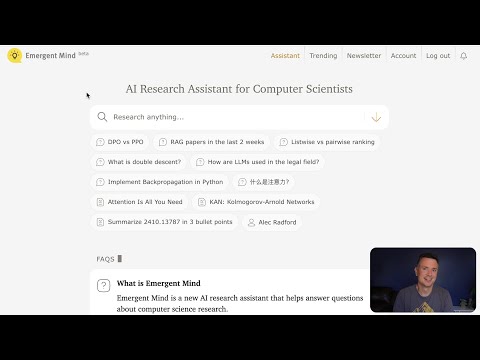
You know that moment when you’re knee-deep in a research paper, and you wish you had a super-smart buddy to explain all the tricky bits? Well, that’s kinda where AI assistants come in!
Picture this: It’s 3 AM, and you’re battling with your laptop like it owes you money. You’re trying to decode some complex science stuff that feels like it’s written in alien language. Suddenly, a little digital assistant pops up on your screen, ready to help you out. Pretty neat, right?
AI isn’t just for fancy tech companies or sci-fi movies anymore. They’re stepping into the lab coats of researchers and scientists everywhere! And guess what? They’re not just crunching numbers; they’re also helping explain findings to the rest of us mortals.
But here’s the kicker: Are these AI sidekicks making research more accessible or simply adding another layer of confusion? Let’s break it down together!
Transforming Scientific Research: Harnessing AI for Innovative Discoveries and Enhanced Insights
Artificial Intelligence is shaking up the world of scientific research like never before. You know, it’s not just about robots and self-driving cars anymore. AI is being used to uncover patterns and insights in data that humans might take ages to figure out, or even totally miss! But how exactly is this all happening? Let’s break it down a bit.
Data Analysis
First off, think about the sheer volume of data scientists deal with every day. It’s enormous! AI algorithms can process this data way faster than any human ever could. For instance, in genomics, these algorithms help researchers identify genetic markers linked to diseases. So instead of sifting through mountains of information manually, researchers can focus on interpreting results and taking action.
Predictive Modeling
Then you’ve got predictive modeling. Imagine trying to forecast the weather without computers; it would be a real headache! AI can analyze past weather patterns to predict future conditions much more accurately. In scientific research, similar models are used—like predicting how diseases might spread based on various factors such as location or population density. These predictions can save lives by helping health professionals respond quickly.
Automation
Another big area is automation, where AI takes over repetitive tasks that usually eat up precious time. This could be anything from data entry to running experiments under controlled conditions. A lab could deploy robots powered by AI to conduct high-throughput screening of potential drug candidates much faster than if humans were doing it all.
Collaboration and Communication
Also noteworthy is how AI enhances collaboration among scientists. Tools that utilize natural language processing (NLP) can help translate complex research papers into simpler language, making them more accessible for everyone—whether other scientists or just curious folks like you and me! This breakdown not only improves communication but encourages interdisciplinary collaboration too.
Ethical Considerations
However, let’s not forget there are ethical considerations at play here too. You might wonder about biases in AI algorithms which could skew results or reinforce existing inequalities in research funding or focus areas. Scientists have a responsibility to ensure their use of AI doesn’t create more problems while solving others.
The Future Ahead
Looking ahead, we can expect even more integration of AI in research settings. With innovations happening almost daily, who knows what groundbreaking discoveries lie ahead? It’s an exciting time to be involved in science—especially as we harness the power of artificial intelligence for innovative breakthroughs and enhanced insights!
So there you have it! The world of scientific research is rapidly evolving thanks to AI technologies that empower researchers at various levels—from analysis to communication and beyond. It definitely makes you wonder what next big thing is just around the corner!
Exploring AI Research Assistants: Revolutionizing Scientific Discovery and Innovation
Sure, let’s talk about AI research assistants and how they’re shaking things up in the world of scientific discovery. So, here’s the thing: science is all about asking questions, right? But sometimes, finding the answers can be a real slog. That’s where AI comes into play.
What do AI Research Assistants do?
These digital buddies are designed to help researchers sift through mountains of data, making it easier to find what they need quickly. Imagine trying to read every paper ever written on a specific topic—overwhelming, right? Well, an AI assistant can scan and analyze countless articles in seconds! It’s like having a super-fast intern who never gets tired.
How do they work?
AI assistants usually use something called machine learning. That sounds fancy, but it’s basically just computers learning from data. They get trained on lots of information so they can recognize patterns and make predictions or suggestions. For example, if you’re looking into climate change impact studies, these AIs can help highlight the most relevant findings or even suggest new areas to explore.
- Data Analysis: They crunch numbers and spot trends that might’ve slipped under human radar.
- Literature Review: Instead of manually digging through endless journals, researchers get summaries and insights from AIs rapidly.
- Collaboration: Some AI tools enable better teamwork by managing projects and keeping track of discussions.
Anecdote Time!
I remember talking with a friend who is a biologist working on cancer research. She was juggling a thousand studies when she decided to try an AI assistant. After just a few days using it, she told me how it found relevant studies she’d overlooked for years! It literally changed her whole approach to her project—how cool is that?
The Benefits:
One huge advantage is efficiency. Fewer hours spent on tedious tasks means researchers can focus more on creative thinking and actual experiments or discussions with their teams. And because AI can often identify gaps in knowledge or point out under-researched areas, it could very well lead to groundbreaking discoveries.
However—and this is important—you know there are challenges as well. Not all AIs are created equal! Sometimes they may misinterpret data or lack context that only human intuition could provide. So collaboration between scientists and AIs needs to be balanced.
To wrap things up: AI research assistants are like trusty sidekicks in the realm of science—magnifying glasses for data, if you will! They’re helping reduce grunt work while possibly opening doors to fresh ideas and discoveries that might otherwise stay hidden in plain sight. It’s exciting times ahead for sure!
The Impact of AI on Science Communication: Enhancing Understanding and Engagement
So, let’s talk about how artificial intelligence (AI) is shaking things up in the world of science communication. It’s kind of like having a super-smart friend who helps you understand complex things. AI’s impact here is really fascinating.
First off, AI can help make scientific information more **accessible**. You know how sometimes you stumble upon a research paper, and it looks like a foreign language? Well, AI tools can summarize those complicated texts into bite-sized pieces. It’s like translating science-speak into everyday language! This means more people can engage with research without needing a PhD.
Another cool thing? AI can personalize learning experiences. Imagine you’re interested in climate change but not so much in particle physics. An AI system can tailor the information it gives you based on what you’re curious about. It’s like having your own science tour guide that knows exactly what catches your interest!
Also, let’s not forget about **engagement**! With AI-driven chatbots or virtual assistants, people can ask questions and get answers almost instantly. It feels like chatting with a knowledgeable buddy who’s always around to help with your scientific queries. For instance, if you want to know why carbon emissions matter today, an AI could instantly provide info instead of waiting for hours for someone else to respond.
Okay, but there’s more! The analysis of large data sets used in research can take forever without tech support. Here’s where machine learning comes into play. AI systems analyze tons of data at lightning speed to extract patterns or insights that scientists might miss just crunching numbers manually—all while giving researchers the time and space to focus on critical thinking and creativity.
Now onto collaboration — AI tools often facilitate global teamwork among scientists from different countries or backgrounds. This is super important given that scientific challenges often span across borders—climate change being a prime example! Imagine scientists from various continents coming together seamlessly through shared platforms powered by AI.
However, there’s also this nagging thought about the **balance** between technology and human touch. While it does enhance communication and understanding in many ways, over-reliance on AI could risk oversimplifying intricate topics or leading to misinterpretations if people don’t double-check the facts from credible sources.
In summary:
- Accessibility: Simplifies complex information.
- Personalization: Tailors content to individual interests.
- Engagement: Provides instant responses via chatbots.
- Data Analysis: Speeds up research processes.
- Global Collaboration: Connects scientists worldwide.
The truth is that while AI tools are fantastic allies in making science clearer and more engaging for everyone, it’s essential we use them wisely to keep that human element alive in conversation too! That way, science becomes not just an academic pursuit but something vibrant that everyone wants to be part of!
You know, AI assistants are popping up everywhere these days, and they’re changing the way we do research and science communication. It’s kind of wild to think about. I mean, just a few years ago, I was scratching my head over complex problems in my lab or trying to write a paper with too much coffee and not enough sleep. Now? Well, thanks to AI tools, things can feel a bit easier.
Imagine you’re in a lab late at night, surrounded by stacks of papers and a whiteboard filled with doodles and equations that make no sense after midnight coffee kicks in. Then suddenly, you get an idea: why not use an AI assistant? It sounds like a sci-fi movie plot come to life! This little digital buddy can help sift through tons of data or even suggest new research directions based on existing studies. It’s like having a supercharged research partner who doesn’t need snacks or bathroom breaks!
But here’s the thing—while these AIs are super helpful, there’s still this nagging feeling about how much we should rely on them. They can analyze data faster than I can drink my morning tea (which is pretty fast), but they don’t have that spark of creativity or intuition that makes good research great. You know? Sometimes the best ideas come when you’re not even looking for them—like during those long walks where your mind can wander freely.
And then there’s science communication. Remember when trying to explain your latest findings felt like climbing Everest? Well, with AI’s help, translating complex concepts into something more understandable is kinda like having a cheat sheet for tests back in school! These assistants can help tailor messages for different audiences—scientists, policymakers, the general public—making it easier for people to grasp what’s really going on.
However, while it’s easy to be dazzled by all this tech magic, we’ve got to tread thoughtfully. AI doesn’t have feelings or ethics built into its programming; it just follows patterns and data inputs. It’s up to us humans to ensure the information stays accurate and accessible because misleading info could easily slip through if we’re not careful.
So yeah! AI assistants are shaking things up big time in both labs and lecture halls. They’re bringing efficiency that we’ve never had before and making sharing knowledge smoother than ever! But as we embrace these shiny tools, let’s keep our human touch intact because at the end of the day—that’s what makes science truly shine. Don’t you think?