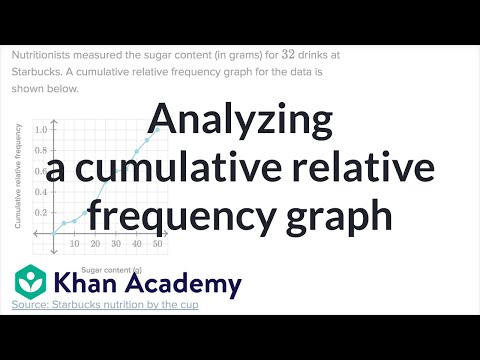
So, picture this: You’re sitting in a lab, surrounded by beakers and bubbling liquids. Suddenly, your buddy spills some of that colorful concoction all over the floor. Chaos ensues! Bottles clatter, papers fly—what a disaster! Now, amid all that chaos, you might wonder how to keep track of all those variables. Enter cumulative relative frequency; it’s like your secret weapon for figuring stuff out in science.
You might think it sounds super boring or complicated, but hang on a second! It’s actually pretty cool once you get the hang of it. Imagine being able to take a mountain of data and turn it into something that makes sense—like the last slice of pizza that everyone is trying to grab at a party.
This little concept is not just nerdy math lingo; it has real-world applications in research that can make or break your findings. From figuring out trends in ecology to understanding how diseases spread—you name it! So let’s unravel this concept together and see how it can totally transform the way we look at data in science. Are you with me?
Understanding Cumulative Frequency in Research Methodology: A Key Concept in Scientific Analysis
Cumulative frequency can sound like a complicated term, but it’s really just a way to get a clearer picture of data, right? When you’re diving into research, whether it’s about the number of people who prefer chocolate ice cream over vanilla or the results from a scientific experiment, understanding how to look at those numbers is crucial.
So, what exactly is cumulative frequency? Well, it’s basically the running total of frequencies in a dataset. Imagine you surveyed your friends about their favorite ice cream flavors. You asked 10 people: 4 liked chocolate, 3 were all about vanilla, and 3 were into strawberry. When you calculate the cumulative frequency for chocolate by adding up all who prefer that flavor (4), you see that 4 out of 10 are on team chocolate.
To put this in clearer terms:
- The first value stands alone—let’s say 4 for chocolate.
- Then for vanilla, it becomes 4 + 3 = 7.
- Finally, for strawberry: it’s like adding again—7 + 3 = 10.
Now you’ve got cumulative frequencies! This helps you see not just who likes what but also how preferences stack up as you look at more data points.
But wait! There’s more! Cumulative relative frequency comes into play here as well. Basically, it takes your cumulative frequencies and compares them to the total number of responses. So instead of just looking at solid numbers, we get percentages that can help put everything into context.
Let’s think back to our ice cream survey. To find cumulative relative frequency:
- For chocolate: (4/10) * 100 = 40%.
- For vanilla: (7/10) *100 = 70%.
- And for strawberry: (10/10) *100 = 100%!
This means when someone asks how many of your friends are down with chocolate or vanilla or both? You’re not just throwing out numbers; you’re giving them a clear picture through percentages that resonate more.
Cumulative relative frequencies are super handy in scientific analysis too! Think about clinical trials where researchers need to track patient reactions over time. By using cumulative data, they can identify trends in side effects or outcomes really clearly.
In research methodology, understanding these concepts means you’re better equipped to analyze and interpret data effectively. It gives you that edge because when you’re presenting findings or conclusions—even if it seems simple—you’re actually showing off some serious analytical skills!
So next time you’re sifting through research or working on your own study project and come across those terms—cumulative frequency and cumulative relative frequency—remember they’re tools that help paint a bigger picture of your data landscape! With practice and these concepts in your toolkit, you’ll be breezing through analysis like a pro.
Understanding Cumulative Relative Frequency: Insights and Applications in Scientific Research
Understanding cumulative relative frequency might sound like a mouthful, but it’s really just a way of looking at data that can help researchers make sense of their findings. So, let’s break it down into bite-sized chunks.
Cumulative relative frequency is all about tracking how often something happens up to a certain point. Imagine you’re keeping score during a game. Each time someone scores, you add that to your running total. That’s kind of how cumulative relative frequency works with data: it adds up the frequencies of values in a dataset step by step.
Now, to get into the nitty-gritty, let’s talk about what relative frequency means first. Basically, it’s the number of times an event happens divided by the total number of events. If you have a survey where 20 people say they like pizza out of 100 surveyed, the relative frequency for pizza lovers would be 20/100 or 0.20 (which equals 20%).
When we talk about cumulative relative frequency, we take that concept further. You add the relative frequencies together as you move through the dataset. So, if your survey continues and more people start responding, each new group gets added on top of previous results until you have one total adjusted for everyone.
But why does this matter? Well, for starters:
- Visualization: Cumulative relative frequency helps create clear visual representations like ogive graphs that show how data accumulates over time.
- Understanding Distribution: It provides insight into distribution patterns in datasets—like spotting trends or shifts over intervals.
- Decision Making: Researchers can use it to make informed decisions based on how data accumulates—very helpful in fields like psychology or education where understanding thresholds is key.
Let’s take an example from education research: Say researchers conduct a study measuring student performance on standardized tests across several schools. They want to know how many students scored below certain benchmarks and where most students lie in terms of achievement levels.
By calculating cumulative relative frequencies, they can create a graph showing what percent of students scored below each score level—say below 50%, then below 60%, and so on up to 100%. This gives them a visual tool to see not just averages but also how many are achieving at different levels.
Another cool application is in health research where scientists track outcomes after medical treatments. Cumulative relative frequency charts can illustrate patient recovery rates over time; this helps them see which treatments are more effective at specific milestones.
In short, understanding cumulative relative frequency opens up new discussions about data analysis and interpretation in scientific research! It paints a broader picture than simple means or medians ever could—letting researchers see trends unfold over time instead of just snapshots in isolation.
So when diving into any research project, keep this concept handy; it’s like adding up your scores as you go and realizing just how much progress you’ve made along the way!
Understanding the Role of Frequency Distribution in Scientific Research
Understanding frequency distribution in scientific research can feel a bit overwhelming at first, but it’s actually pretty neat once you break it down. Frequency distribution is a way to organize data so you can see how many times certain values occur. Think of it like sorting your socks by color. You know, you have a pile of black socks, a pile of white ones, and maybe some funky patterned ones too!
So, when scientists gather data, they often look at how those numbers are distributed across different categories or ranges. That’s where frequency distribution comes into play. It helps researchers visualize patterns or trends that might not be obvious at first glance. You with me?
Cumulative relative frequency is like taking that concept one step further. Instead of just counting occurrences in each category, cumulative relative frequency shows how many entries fall below a particular value in relation to the total number of entries. Imagine stacking blocks; each block represents a data point, and when you stack them up to see how high they go—that’s kind of what cumulative relative frequency does!
- Visualizing Data: With graphs like histograms or cumulative frequency curves, researchers make complex data more digestible.
- Understanding Trends: By analyzing these distributions, scientists can spot trends over time or within populations.
- Making Predictions: Cumulative relative frequencies help in predictive analyses—for example, predicting outcomes based on previous data.
Here’s an example: imagine you’re studying the heights of plants in a garden over time. You measure their heights every week and then plot that data using a cumulative frequency graph. This graph allows you to quickly see the proportion of plants that are below certain heights—really handy for understanding growth patterns!
But why is all this important? Well, we often need precise insights in fields like medicine or environmental science where decisions are made based on statistical evidence. For instance: if the majority of patients treated with a new drug experienced side effects at certain dosages, that could influence future treatment guidelines.
In short, understanding these concepts can empower scientists to interpret their results meaningfully and communicate findings effectively. That’s pretty cool if you think about it! So next time you’re diving into some research stats or grappling with data analysis—remember that frequency distribution and its cousin cumulative relative frequency are there to help bring clarity out of chaos! Isn’t science just wild?
Okay, so cumulative relative frequency might sound like a mouthful, but really, it’s just about understanding how data piles up over time. Picture this: you’re in a packed concert, swaying to the music with thousands of other fans. Every time someone claps or sings along, it adds to the energy in the place. That’s kind of what cumulative relative frequency does for data; it helps us see how all those individual pieces come together to form a bigger picture.
In scientific research, this concept can be super handy. Let’s say you’re studying a new medication and want to find out how many patients respond positively over time. By tracking not just the individual responses but also how those responses accumulate – like keeping score during that concert – you get a clearer sense of what’s working and what isn’t.
I remember when I was working on a project in college that involved analyzing survey results on environmental concerns. We gathered data from different neighborhoods about their recycling habits. By applying cumulative relative frequency, we could show not just how many people recycled but also how that changed across different areas over time—like seeing the waves of applause growing as the band played their best song! It helped paint a vivid picture for our presentation.
What’s cool is that this method doesn’t just make things look nice; it actually helps draw conclusions based on observed trends. You can see where improvement is happening or where more education might be needed. In other words, it’s about connecting the dots in ways that can inform future decisions or policies.
But sometimes it can feel overwhelming, especially with all those numbers swimming around. You gotta be careful not to misinterpret them! Like at that concert when everyone thinks they know the lyrics but sings out of tune—it could throw off the vibe completely! So researchers need to approach these figures thoughtfully and understand what they really mean in context.
At the end of the day, cumulative relative frequency is like keeping track of every cheer and shout at an event—it builds momentum and gives you insight into what truly resonates with people or situations under study. It’s all about making sense of chaos and turning those collective experiences into meaningful insights that drive science forward!