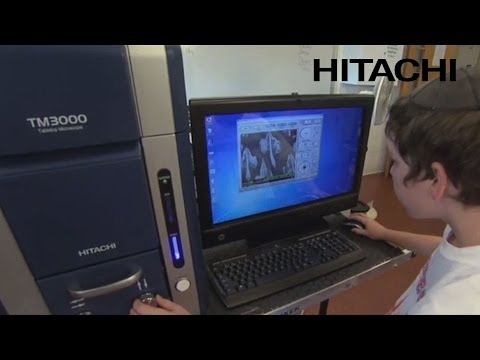
So, picture this: you’re at a science fair, and there’s this giant machine that looks like it belongs in a sci-fi movie. It’s a scanning electron microscope (SEM). Seriously, it’s that cool! But wait, there’s more—inside that beast is something magical called Energy Dispersive Spectroscopy (EDS).
Now, you might be wondering, what on earth does that even mean? Well, it’s basically like giving the microscope superpowers to analyze tiny bits of materials. Imagine being able to see elements at the atomic level! Wild, right?
This combo of SEM and EDS is where the real fun happens—the way scientists can enhance their research is just incredible. It opens up so many doors for understanding our world on a microscopic scale. So stick around; I promise it’ll be worth your while!
Advancing STEM Research: The Role of Electron Drift Spectroscopy in Scanning Electron Microscopy Labs
Alright, let’s talk about Electron Drift Spectroscopy (EDS) and its role in Scanning Electron Microscopy (SEM). If you’re diving into STEM research, this stuff is pretty crucial.
First off, SEM is like a superhero for scientists. It gives a super-close view of samples by shooting beams of electrons at them. As these electrons hit the sample, they bounce around and interact with it in some pretty cool ways. The thing is, while SEM shows us amazing details of the sample’s surface, EDS takes it a step further.
EDS is a technique that helps identify the elemental composition of a sample. Basically, when those electrons hit the target material in an SEM setup, they can knock out some inner-shell electrons from atoms in your sample. This leads to a situation where outer-shell electrons drop down to fill those gaps. When they do that? Well, energy gets released as X-rays! These X-rays are unique to each element—like fingerprints—allowing you to figure out what elements are present.
So why is all this important for advancing STEM research? Well, think about it: knowing exactly what materials you’re working with can change everything! For instance:
- Material Analysis: EDS can help scientists understand the composition of materials they’re studying. Let’s say you’re researching new alloys or nanomaterials; knowing their exact makeup could guide you in developing better products.
- Quality Control: In industries like electronics or pharmaceuticals, ensuring material quality is key. EDS helps catch impurities that might lead to failures or inconsistencies.
- Budding Research Areas: With nanotechnology on the rise, understanding materials on such a tiny scale means EDS becomes even more valuable.
Now here’s a little story for ya: I remember chatting with a researcher who was using EDS on some fascinating bio-materials aimed at treating injuries. They discovered unexpected elements in their samples that completely shifted their approach! That’s kind of the magic of combining EDS with SEM—you never quite know what surprises are waiting in those tiny particles.
But let’s not forget about how this technology keeps improving! Researchers are constantly working on making EDS faster and more accurate—think about real-time results or better resolution images. These advancements mean researchers can make rapid decisions during experiments.
In short, Electron Drift Spectroscopy plays an essential role in pushing STEM research forward by providing detailed elemental analysis alongside visual data from SEM. The synergies between these technologies pave the way for breakthroughs across various fields—from material science to medicine and beyond! So yeah, if you’re involved in STEM research, embracing tools like EDS could really take your work to another level!
Advancements in SEM-EDS Analysis: Unveiling Material Composition in Scientific Research
So, let’s talk about SEM-EDS analysis. It stands for Scanning Electron Microscopy with Energy Dispersive X-ray Spectroscopy. It sounds a bit fancy, right? But basically, it’s a powerful technique that scientists use to understand what materials are made of.
First off, what is SEM? Imagine a super-smart camera that can look at tiny bits of stuff, like one-thousandth the width of a human hair. This camera doesn’t take regular pictures; it shoots electrons instead of light. These electrons bounce off the surface of materials and create super-detailed images. You can see textures and shapes that you couldn’t with normal microscopes.
Now, here’s where things get even cooler: EDS comes into play! When those electrons hit the sample, they knock out some of its atoms, which then release energy in the form of X-rays. The EDS detector catches these X-rays and helps determine what elements are present in the material. It’s like having a magical tool that reveals hidden secrets!
Think about it: if you’re studying ancient artifacts or materials from space rocks, you can learn about their composition without damaging them. Just recently, scientists used SEM-EDS to analyze microchips in old electronics to figure out how they were made and why they failed.
Another exciting part is the advancements occurring in this field. Technology has come a long way! New gadgets allow for faster scanning and better resolution. This means scientists can get results more quickly and with greater accuracy than ever before.
Moreover, there’s software now that helps make sense of all those data points collected during analysis. With artificial intelligence making waves everywhere else, it’s also starting to make an entry into material science through SEM-EDS analysis!
And let’s not forget about applications. From studying soil samples for agriculture to analyzing biomaterials in medicine—this method is incredibly versatile! For instance, researchers could look at bone structures to develop better implants or study corrosion in metals used for bridges.
In summary:
- SEM provides detailed images using electron beams.
- EDS identifies elemental composition via X-ray detection.
- Advancements lead to faster analysis with higher accuracy.
- Diverse applications, from archaeology to medicine.
So yeah, the synergy between SEM and EDS is reshaping how we understand materials at their tiniest levels! It opens doors for breakthroughs across various fields—seriously exciting stuff happening here!
Understanding SEM EDS: The Full Form and Its Significance in Scientific Research
So, if you’ve ever heard folks chatting about SEM and EDS, you might be curious what it all means. Let’s break it down, so you really get it.
First off, SEM stands for Scanning Electron Microscopy. This is a fancy way of saying that scientists use a super powerful microscope to look at tiny stuff. Unlike regular microscopes that use light, SEM uses electrons. When these electrons hit the sample, they create detailed images that show structures much smaller than what you can see with your eyes or even with a regular microscope!
Now, let’s talk about EDS, which stands for Energy Dispersive Spectroscopy. It’s like the sidekick to SEM! After SEM gives us those cool images of our sample, EDS steps in to reveal what the sample is made of. Basically, it helps scientists understand the elemental composition by detecting the X-rays emitted from the sample when it’s bombarded by electrons.
You might be wondering why all this matters in scientific research. Well, there are several reasons:
- Elemental Analysis: EDS helps identify which elements are present in a material and their distribution.
- Material Characterization: Combined with SEM, it allows researchers to study both structure and composition together.
- Disease Diagnosis: In medical research, understanding the composition of tissues can lead to better diagnosis techniques.
- Nano-Scale Research: It’s especially useful for studying materials at nanoscale levels in fields like materials science and nanotechnology.
Let me tell you a little story that showcases its significance. A friend of mine works in a lab looking at different types of batteries. They used SEM and EDS to analyze materials inside these batteries to find out why some last longer than others. By examining both the structure and composition on such a small scale, they discovered that tiny impurities were affecting battery performance. This insight was crucial for improving battery technology!
In summary, using SEM with EDS is like pairing up two brilliant detectives investigating materials at incredibly small scales. Together they reveal not just how things look but also what they’re made of! This combination has opened doors to countless discoveries across various scientific fields.
So yeah, pretty cool stuff! The next time someone mentions SEM or EDS in passing conversation, you’ll know exactly what they’re talking about!
You know, when I first stumbled upon scanning electron microscopy (SEM), I was just blown away. I mean, seriously! The way it lets you see the tiniest details of a sample at such high magnifications is mind-boggling. The whole idea of using electrons instead of light to create images? Genius! And then, that’s not all—there’s this technique called energy-dispersive spectroscopy (EDS) that really levels up the game.
So, let’s break it down. You’ve got SEM giving you those crazy detailed images, and then EDS steps in to tell you what those images actually contain—like a detective revealing clues about what’s going on at the atomic level. Imagine being able to look at a rock and not only see its surface but also know exactly which minerals are hanging out there. It kind of feels like having superpowers!
I remember watching a researcher use this combo during a lab visit. She was examining some cool materials for renewable energy applications. With just a few clicks, she was pulling up data on the elemental composition while casually chatting about how each element played a role in enhancing efficiency. It struck me then how much more profound our understanding becomes when we mix these technologies together.
What really hit home for me is how crucial this integration is for STEM research as a whole. With EDS tagging along, researchers can make connections they might’ve missed otherwise. Like, think about studying nanomaterials or bioengineering—having that elemental insight can literally change everything from material selection to application potential.
But it’s not always smooth sailing. There’s complexity involved; sometimes the signals can get mixed up or lead to false interpretations if you’re not careful. It’s like reading between the lines—but with atoms! And while this tech is becoming more accessible than ever, some labs might still struggle with it because they don’t have the funds or resources needed.
Still, it’s hard not to be excited about where all of this is headed! As these tools become more refined and integrated into research frameworks, who knows what discoveries are waiting around the corner? If you think about it, EDS adds depth—not just literally but figuratively—to our understanding of materials and their properties.
In short, combining SEM with EDS isn’t just enhancing research; it’s like opening up entire new worlds within existing fields—making science feel even more adventurous and impactful. And honestly? That sense of wonder in science is one of the best feelings there is!