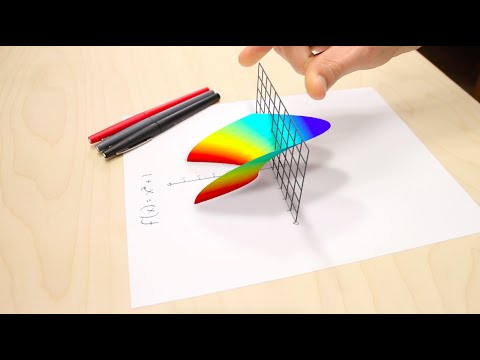
You know what’s wild? Imaginary numbers. Yeah, those quirky little things that seem to pop right out of a math book and say, “Surprise!”
I remember sitting in class, totally lost. The teacher was going on about square roots of negative numbers. I thought, “Wait, what? How can a number be imaginary?” It felt like I was in some weird dream.
But here’s the kicker: imaginary numbers are super important in physics! Seriously. They’re not just random math stuff for brainiacs to puzzle over. They help explain things like waves and electricity—big concepts that we encounter all around us.
So, let’s unravel this mystery together. Ready to dive into how those imaginary friends play a crucial role in our understanding of the physical world?
Exploring the Applications of Imaginary Numbers in Modern Physics: Unveiling Their Significance in Scientific Research and Theory
Imaginary numbers, you say? Sounds a bit spooky, right? But they’re actually a super important part of physics. Let’s untangle this a bit.
To kick things off, imagine imaginary numbers as the extra flavor in your favorite dish. They’re not just for show; they really spice things up! In math, they’re represented as “i,” which is the square root of -1. Since you can’t find a real number that does that, this idea opens some pretty wild doors.
The thing is, in physics, imaginary numbers are crucial when dealing with concepts like waves. Take electrical engineering for instance. When we talk about alternating current (AC), we often use imaginary numbers to make calculations easier and more manageable. It’s kind of like using shorthand so you don’t have to write everything out every single time. You end up with complex numbers, which combine real and imaginary parts.
- Wave Functions: In quantum mechanics, wave functions describe how particles behave. They can be expressed using complex numbers. The real part might represent position while the imaginary part could represent momentum. This combo gives us a complete picture of what’s going on at the quantum level.
- The Schrödinger Equation: This iconic equation uses complex numbers to predict how quantum systems evolve over time. It’s fundamental for understanding everything from atoms to molecules.
- Electromagnetic Theory: Imaginary numbers also pop up in theories concerning electric and magnetic fields, making it easier to solve equations without losing any detail about what’s happening with waves and fields.
You might be thinking it sounds super abstract, but there’s a practical side too! For example, when you tune into your favorite radio station, guess what? The signals being sent are often modeled using complex functions involving imaginary numbers! It helps in filtering out noise so you hear your favorite tunes loud and clear.
If we take a moment to look at something emotional—like remembering when you first learned about how light bends when it goes through water—imagine not having the tools (like imaginary numbers) to fully explain the science behind it! That can feel frustrating! But with them in our toolkit, physicists can develop theories that help us understand such phenomena much better.
In summary, don’t let the term “imaginary” fool ya! These numbers are incredibly real in terms of their impact on modern physics research and theories. They make complex scenarios more understandable and help scientists push boundaries toward new discoveries!
Exploring the Role of Complex Numbers in Physics: Applications and Implications in Scientific Research
So, let’s talk about complex numbers and how they fit into the world of physics. You might be thinking, “Complex numbers? Isn’t that some math thing?” Well, yes! But they’re way more than that. They actually play a pretty cool role in helping us understand how the universe works.
First off, a complex number is made of two parts: a real part and an imaginary part. The imaginary part is based on the imaginary unit **i**, which is defined as the square root of -1. Crazy, right? So when you see something like 3 + 4i, you have 3 as your real number and 4i as your imaginary one.
Now, you’re probably wondering why on earth we’d want to deal with imaginary numbers in physics. That’s where things get interesting!
Wave Functions: In quantum mechanics, wave functions are used to describe particles and their behaviors. These wave functions are often complex-valued functions. When scientists calculate probabilities from these wave functions, they end up using the absolute squares of them—basically taking advantage of that complex structure to get meaningful results.
Oh! Here’s a story for you: Picture a kid standing at the edge of a pool trying to measure where to jump in without getting wet first. They could splash around trying to find the best angle or use tools (like sinusoidal waves) that incorporate complex numbers to figure out exactly where to land without causing a wave! That’s kind of like how physicists use these numbers—they help pinpoint outcomes accurately.
Electrical Engineering: Now let’s shift gears for a moment. Complex numbers are used extensively in electrical engineering too! When you’re looking at alternating current (AC), it gets all wavy and complicated—literally! Using complex representation can make those calculations so much easier by expressing voltage or current as these neat little complex phasors (that just means rotating vectors in a coordinate system). You can manipulate them instead of juggling through real values—you follow me?
Relativity: It gets even wilder with Einstein’s theory of relativity. It uses spacetime, which is basically combining time with three-dimensional space into something more manageable mathematically—and guess what? You guessed it; some aspects can involve complex coordinates for certain calculations!
And here’s another gem: Quantum Electrodynamics (QED), which describes how light and matter interact at quantum levels also relies heavily on those nifty little complex numbers. The mathematics gets super intricate, but through summing over all possible paths—using Feynman diagrams—complex numbers come into play again.
But it’s not just about crunching these funky numbers down for equations and theories; it goes deeper than that with implications for technology too! For instance, think about GPS systems or MRI machines—yep, those rely on principles rooted in physics that makes extensive use of complex numbers.
So when people roll their eyes at math or think it’s fluff, remind ‘em that behind those equations lies a language we use to translate the universe’s secrets! Seriously though—the next time someone says “imaginary,” just give them a wink because it’s more real than they think.
In short:
- Complex Numbers: Made up of real and imaginary parts; used extensively in physics.
- Wave Functions: Important in quantum mechanics for predicting particle behavior.
- Electrical Engineering: Easy manipulation of AC using phasors makes life simpler.
- Relativity & QED: Fundamental for understanding modern physics concepts.
So yeah, while it may seem abstract at times, complex numbers are basically tools that help us unlock phenomena we can hardly see but affects everything around us every day!
Understanding the Imaginary Unit in Physics: Concepts and Applications in Science
The imaginary unit, often represented as **i**, plays a surprisingly crucial role in physics and mathematics. It’s not what you might expect; I mean, how can a number that isn’t “real” be so useful? Well, let’s break it down.
So, first off, what exactly is this imaginary unit? In simple terms, **i** is defined as the square root of -1. Now, I get it—square roots of negative numbers sound like something out of a math class nightmare! But hold on. When you start playing with complex numbers (which are numbers that have both real and imaginary parts), things get pretty interesting.
You see, when you combine real numbers with imaginary ones, you end up with **complex numbers**. These aren’t just mathematical curiosities; they come in handy for solving problems in different fields of science.
Now you might be wondering: where does physics come into play? Here are some key places where the imaginary unit really shines:
- Wave Functions: In quantum mechanics, wave functions (which describe the state of particles) often use complex numbers. The probability of finding a particle can be calculated using these functions. It’s kind of like leveling up your game by understanding where your character might spawn next!
- Electrical Engineering: Imaginary numbers are essential for analyzing AC circuits. You know how alternating current changes direction? Engineers use complex impedance to understand how circuits behave over time.
- Control Theory: This area deals with how we manage dynamic systems—think robots or even airplanes! Here, complex numbers help describe system stability and response to changes.
Here’s an emotional anecdote that illustrates this idea: Imagine being at a concert where the sound literally shakes the ground beneath you. That powerful music is thanks to engineers who understand these principles! They’re using math (including our buddy **i**) to design sound systems that create an unforgettable experience.
It’s not just about calculations or formulas; it’s about the world around us and how we interpret it through a mathematical lens! There’s something awe-inspiring knowing that these abstract concepts lead to real-world applications like technology and space exploration.
The thing is, while imaginary numbers may seem frivolous at first glance, they enable us to tackle complex problems more effectively. They provide solutions where traditional methods fail. It’s like having an extra tool in your toolbox—you never know when it’ll come in handy!
So next time someone brings up imaginary numbers in physics or math class, remember they’re not just for show. They’re fundamental players helping us understand and manipulate the universe just a little bit better!
Imaginary numbers, huh? At first glance, they seem a bit like mystical creatures pulled from a fantasy novel. I mean, how can a number be “imaginary”? It’s kind of mind-boggling, don’t you think? But when you dig deeper, these numbers turn out to be super handy in physics and mathematics.
Let me rewind for a second. I remember sitting in my high school math class, staring blankly at the chalkboard as the teacher scribbled complex equations that felt like a foreign language. You know that moment when someone draws an equation and it just looks like scribbles? Yeah, that was me. But then came the day we touched on imaginary numbers—specifically “i,” which is the square root of -1. It clicked! That’s when I learned these quirky numbers aren’t just for show; they help us describe real phenomena.
So here’s the deal: imagine you’re trying to understand wave patterns or electrical circuits. In physics, things are often oscillating or rotating, right? That’s where imaginary numbers strut in like they own the place. They simplify calculations involving sines and cosines by turning them into exponential functions. Seriously! They make it easier to work with those pesky waves that seem to pop up everywhere.
You might wonder why that matters. Well, take electricity. When we analyze alternating current (AC), which is what powers our homes, we need to understand how the current changes over time. Imaginary numbers let us express those changing values in ways that make calculations smoother and more intuitive.
I still love picturing my old self grappling with this stuff—sitting there half confused but gradually getting it. It felt kind of magical as if I could finally peek behind the curtain at how things worked in the universe. It’s incredible how something that seemed so abstract turned out to have so many practical applications!
Basically, imaginary numbers are not just some nerdy fad; they’re vital to our understanding of physical concepts that shape our daily lives and technologies—like smartphones and even GPS! So next time someone brings up imaginary numbers at a party (because that’s totally a thing), you’ll know they’re really part of the fabric weaving together math and physics in an elegant dance of creativity and logic.