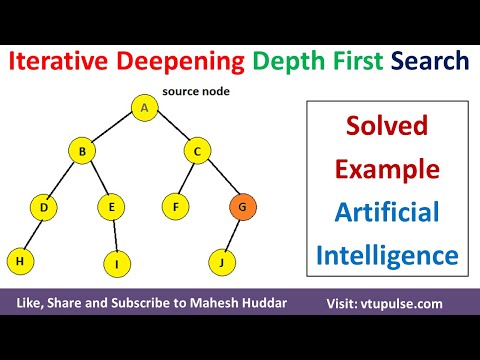
Imagine you’re playing hide and seek, but instead of looking for your friends, you’re searching through a huge maze. You know that if you just dive in head-first, you’ll get lost. So, what do you do? You start from the outside and slowly explore deeper. That’s kinda how iterative deepening search works!
Picture this: your computer is on a quest to find the best answer to a problem. It’s not just dashing in; it’s methodically checking every corner—just like you would in that maze! The beauty of this approach is that it balances depth with efficiency. But it’s not all rainbows and butterflies; there are some quirky challenges along the way.
This whole process is actually a big deal in AI research. It helps computers figure things out faster while avoiding unnecessary detours. Pretty cool, huh? So let’s chat about how this nifty little method works and why it matters in the world of artificial intelligence!
Understanding Iterative Deepening Search Algorithm in Artificial Intelligence: A Comprehensive Overview in Computer Science
So, let’s chat about the **Iterative Deepening Search (IDS)** algorithm in artificial intelligence. Sounds complicated, right? But don’t worry, it’s not as scary as it sounds.
First off, think of IDS as a way to explore a tree or graph. Imagine you’re playing hide and seek in a big maze. You want to find your friend at the end without getting lost. That’s basically what IDS does—it searches for a solution by going deeper into the tree layer by layer.
Now here’s how it works. It starts with a depth limit of zero and checks if it can find the goal there. If not, it increases that limit by one and tries again. It keeps doing this until it finds what you’re looking for. You know that feeling when you’re checking under every cushion on the couch? That’s kind of like what IDS is doing, but with actual nodes in a search space.
Key Features:
Now, about time complexity—this one’s interesting. The downside is that while each individual search is linear (which is great), you might end up repeating work. So the total time comes out to O(b^d), where b is branching factor and d is depth of the solution.
Imagine you’re retracing your steps in that maze over and over again! A bit frustrating but necessary sometimes—especially when you’re trying to figure out where you’d missed something last time.
Let me tell you about an example situation: suppose you’re trying to figure out how to get from your house to the coolest pizza joint in town using Google Maps. Sometimes that’s like searching through different routes; if you hit traffic (that’s like running into dead ends in our analogy), you’d have to circle back—kind of like how IDS keeps coming back up through its previous layers!
So yeah, Iterative Deepening Search can be pretty useful in areas where memory limits are tight or when you’re dealing with large search spaces without knowing much about them up front. It helps keep things organized while still being efficient enough for most cases.
In AI research, you’ll often see this method used because it’s smart—you don’t blindly wander; instead, you systematically explore until you find what you’re looking for! There’s something comforting about knowing that with careful searching—even if it’s layered—you’ll eventually get there!
Understanding DFS and BFS Algorithms in Artificial Intelligence: A Scientific Overview
Alright, let’s chat about DFS and BFS algorithms in artificial intelligence. These two terms might sound a bit techy, but they play a huge role in how computers think and make decisions. So, buckle up because we’re diving right into it!
Depth-First Search (DFS) is like that friend who gets super excited about a hike. They keep going deeper into the woods, exploring every little path without looking back. If they hit a dead end, they just backtrack to the last fork and try another route. Basically, DFS explores as far down one path as it can go before backing up to search for other options.
On the other hand, Breadth-First Search (BFS) is more like someone who enjoys checking out all the views from base camp before deciding which trail to take first. They explore all the neighbors first before heading deeper into any one path. So, BFS looks at all possibilities on one level before diving deeper.
Now let’s talk about this cool concept called Iterative Deepening Search. Imagine you’re trying to figure out what’s at the bottom of a well but can only shine your flashlight down in small increments. At first, you shine it down just a little bit; then you move it further down and repeat until you find what you’re looking for. That’s kind of how iterative deepening works! It combines DFS’s deep exploration with BFS’s broad approach to effectively search through layers of options.
Here’s why these algorithms matter:
- Efficiency: Each algorithm has its best use case depending on the problem size and structure.
- Memory Usage:DFS needs less memory than BFS because it doesn’t have to keep track of all nodes at the current level.
- Simplicity:The structure of both algorithms is straightforward, which makes them easy for programmers to implement.
When you’re dealing with problems where solutions are far away or not apparent right off the bat—like navigating mazes or searching through game trees—these algorithms are essential tools.
But there’s more! Imagine being stuck in traffic trying to get somewhere fast—you’d want to choose your route wisely, right? Here’s where knowing when to use DFS over BFS (or vice versa) becomes crucial. Like if you’re looking for something specific among many paths—DFS may get you there faster since it dives deep quickly.
Feeling overwhelmed yet? Don’t worry! It’s totally normal; these concepts take time to sink in. Just remember: DFS is all about going deep without looking back, while BFS checks everything out layer by layer. And when combined in iterative deepening, you get an efficient way of searching that balances depth and breadth.
This whole thing is super fascinating because understanding how these searches work helps shape AI decision-making processes—like how a computer plays chess or navigates through software applications.
So next time you’re knee-deep into some tech talk or casual coding conversation, you’ll have some solid insight about these nifty algorithms tucked under your belt! You follow?
Understanding the Key Differences Between A* and Iterative Deepening A* in Scientific Computing
So, you’re curious about A* and Iterative Deepening A* (IDA*)? That’s awesome! Let me break it down for you.
A* is a popular search algorithm used in pathfinding and graph traversal. It combines the benefits of two methods: **Dijkstra’s algorithm** and **greedy best-first search**. It uses a priority queue to find the most promising path to reach a goal based on cost, often denoted as f(n) = g(n) + h(n). Here, g(n) is the cost to reach node n from the start, and h(n) is the heuristic estimate of cost from n to the goal.
Now, Iterative Deepening A*, or IDA*, steps things up by combining features of both A* and iterative deepening search. Instead of keeping all explored nodes in memory like A*, it explores nodes layer by layer, adjusting the depth limit iteratively. This method means you can use less memory, making it handy for large search spaces.
Let’s dig into their key differences:
- Memory Usage: A* stores all nodes in memory while searching, which can get heavy quick. IDA*, on the other hand, only keeps track of the current path and last state. This is super useful when you’re working with limited resources.
- Search Strategy: A* explores all possibilities simultaneously using its priority queue. In contrast, IDA* does a series of depth-first searches iteratively until it finds a solution.
- Optimality: Both algorithms are optimal if given an admissible heuristic. However, since IDA* explores deeper paths first before going wider (like checking every option), it might take longer in some cases.
- Time Complexity: In terms of time complexity, both are similar under typical conditions but that can change dramatically depending on the heuristics used.
Imagine playing *Tetris*. When you want to place a piece optimally (like finding clear lines), that’s akin to what A* does—looking at multiple options up front before committing to one path. IDA* would be like gradually dropping each piece down until you figure out where they fit best without needing to hold onto all past configurations at once.
Each method has its strengths depending on what you’re doing. If memory isn’t an issue and you need an optimal solution quick, go with A*. But when your resources are limited or dealing with huge datasets? IDA* shines since it keeps things lean.
So there you have it—the scoop on A* vs Iterative Deepening A*. They each have their quirks and uses!
Okay, so let’s chat about Iterative Deepening Search (IDS) in Artificial Intelligence. You might have heard of it, or maybe you haven’t, but it’s actually pretty neat when you think about it.
Picture yourself trying to find your way through a huge maze. You can’t see the end, and every turn looks just as confusing as the last. That’s kind of what searching for solutions in a big space can feel like in AI. The thing is, we need a reliable way to explore all these paths without getting completely lost or running out of time.
So, IDS swoops in like that friend who always knows where to go—kinda like a GPS that gets smarter each time you use it. It combines depth-first search’s low memory use and breadth-first search’s completeness. Basically, it explores options by going deeper into one path before backing up and trying another—like digging down into one layer of the cake before moving to the next.
I remember one time I was working on a puzzle that seemed super complex. I kept thinking I’d never figure it out until I decided to break it down piece by piece, checking each option step by step. At first, it was frustrating—I mean seriously, who enjoys stumbling around? But then gradually things started making sense! That puzzle-solving experience totally reminds me of how IDS operates.
What makes IDS really cool is how it’s not just some abstract concept locked away in research papers; it’s used in real applications. For example, when robots are navigating around unknown environments or when planning moves in games like chess or Go. It finds its place everywhere.
But here’s the kicker: While it’s effective, it isn’t perfect for every situation—it can still be slow with certain searches and might get repetitive at times. Yet we keep using it because sometimes you need that blend of exploration and reassurance.
So yeah—you follow me? Iterative Deepening Search is not just an academic term; it’s an approach reflecting how we tackle problems in real-life scenarios too! It’s about persistently probing deeper until we finally find our way out of the maze—or at least a decent cupcake shop on the other side!