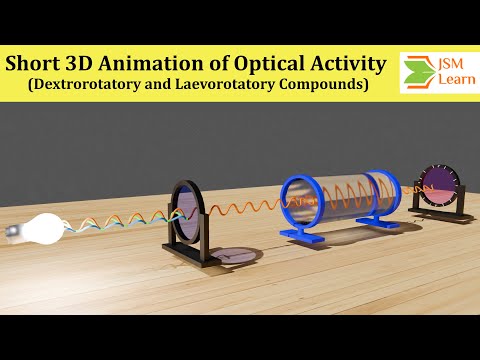
You know what’s wild? There are some molecules that can twist light. Like, literally! Imagine a party where some guests dance to the left while others groove to the right. That’s sort of how optical activity works in chemistry!
Picture this: you’re at a bar, and your buddy orders a drink that looks clear but changes color when light hits it just right. That’s optics doing its thing!
In organic chemistry, some compounds have this quirky ability called chirality. They’re like left-handed and right-handed versions of each other—totally identical, yet completely different in behavior. How cool is that?
So buckle up! We’re about to take a little trip through the world of optical activity. It’s not just about pretty colors; it’s got big implications for flavor, medicine, and even how we see the world!
Exploring the Fascinating World of Organic Chemistry: Unlocking the Secrets of Molecular Interactions
Let’s talk about organic chemistry for a bit. I mean, it might sound like one of those super complicated subjects, but honestly, it’s pretty fascinating! You see, organic chemistry is all about carbon-based compounds. Carbon can form a ton of different structures because it can bond with itself and other elements in various ways. And that’s what makes it so cool!
Now, if we zoom in a little closer, one of the neat concepts you’ll find in this field is optical activity. It’s like this little magic trick at the molecular level! Basically, some molecules can twist light in different directions. Imagine shining a flashlight at a prism and watching the colors scatter. That’s sort of what happens here but with polarized light.
So, what are these molecules? Well, they’re usually chiral, meaning they have a mirror-image form that can’t just be rotated to look the same as the original form. Think of your hands—left and right look similar but are not identical. This property leads to some cool behavior when light hits these chiral compounds.
- Polarized Light: When you shine polarized light through a chiral substance, something interesting occurs: the plane of that light rotates!
- Enantiomers: These chiral compounds have two forms known as enantiomers. One can rotate light to the left (levorotatory), while its twin rotates it to the right (dextrorotatory).
- Molecular Interactions: The way these molecules interact with other substances changes based on their orientation. This is why chirality is crucial in drug design.
An emotional moment comes to mind here—like when I first helped out at a local science fair in high school. We did an experiment showing how two enantiomers tasted differently! One was sweet while the other was bitter. The kids were blown away when they realized how similar those two compounds looked yet tasted so different!
The reason behind all this comes down to how these molecules fit together with others around them. Think of it like puzzle pieces; only certain pieces fit into specific places based on their shape! When those shapes change due to chirality, their interactions with enzymes or receptors in our bodies also change dramatically.
If we take drugs as an example again—some medications work perfectly well when they’re one enantiomer but end up causing side effects if taken as the other form! There are countless stories of drug development where scientists had to figure out which version was safe and effective for human use.
In short, optical activity in organic chemistry isn’t just an abstract concept locked away in textbooks; instead, it connects deeply with real-world applications and everyday life experiences. And who knew that swirling colored light could lead us down such intriguing paths? It really showcases just how vibrant and dynamic our molecular world truly is!
Understanding Optical Activity in Cis Isomers: Insights from Chemistry
Optical activity is a super cool concept in chemistry that deals with how certain compounds interact with light. So, let’s dig into what makes cis isomers special in this fascinating world.
Basically, optical activity occurs when a substance can rotate the plane of polarized light. Imagine holding a laser pointer and shining it through some tinted glass. If you twist the glass, you’ll see the light change direction a bit. Well, some molecules do just that with light! They have chiral centers, which are basically points where the structure can’t be superimposed on its mirror image.
Now, about cis isomers: these are types of geometric isomers that have specific arrangements in their molecular structures. Ever seen a double bond between two carbon atoms? In cis isomers, similar groups are on the same side of that double bond. It’s like standing side by side with your best buddy instead of facing away from each other.
When it comes to **optical activity**, cis isomers can sometimes show this trait if they have those chiral centers I mentioned earlier. For instance, take 2-butene; it exists as two geometric forms: *cis* and *trans*. The *cis* form has identical groups on the same side and could potentially exhibit optical activity if symmetry isn’t in play—meaning if there’s enough difference among attached atoms to create that chiral twist!
Another thing to remember about optical activity is it’s all about the balance between left-handed and right-handed forms of molecules known as enantiomers. One enantiomer might twist light one way, while its mirror image twists it the opposite way. That’s why chirality (the property of being chiral) is key here; it introduces that critical asymmetry.
When we talk about **cis isomers**, they might not always be optically active due to their symmetric nature—think of how two left shoes might look identical except for their orientation! But if you introduce different substituents around your double bond so they don’t mirror perfectly anymore, bam! You get an optically active compound.
Here are some quick highlights to keep in mind:
- Optical Activity: Molecules can rotate polarized light due to their structure.
- Cis Isomers: These have similar groups on one side of a double bond.
- Chirality: Is important for optical activity; not all *cis* forms will be chiral.
- Enantiomers: Mirror images of chiral molecules that have opposite effects on light.
You know, understanding this stuff isn’t just textbook knowledge—it has real-world implications! Think about drug design: one enantiomer could cure you while its counterpart might cause issues or even be harmful! It’s like having two sides to every story.
So next time you’re looking at molecules or maybe even discussing them over coffee (yes, I said coffee), remember how those tiny structures can twist and turn not only our understanding but also the very light around us! Pretty neat, huh?
Understanding Optical Activity and Optical Antipodes in Scientific Contexts
Alright, so let’s chat about optical activity and those quirky little things called optical antipodes. You know, they’re pretty fascinating when you peek into the world of organic chemistry. Basically, optical activity is all about how certain substances can twist light—like a funhouse mirror but with rays of light instead.
Now, what’s going on here? You see, some molecules have a special arrangement of atoms that makes them asymmetrical. This means they’re not identical on all sides—think of a hand: it has a thumb and four fingers, right? That asymmetry causes these molecules to interact with light in unique ways.
When polarized light hits these chiral (that’s the fancy word for asymmetric) molecules, it gets rotated either clockwise or counterclockwise. If it turns right, we call that dextrorotatory. If it turns left? That’s levorotatory. Yep, you’ve got two sides to this coin!
- Dextrorotatory
- Levorotatory
: Rotates light to the right. This is represented by a positive value (+).
: Rotates light to the left and is represented by a negative value (−).
This whole twisting thing isn’t just academic; it has real-life implications! Take sugars for example. D-glucose and L-glucose might look similar but they behave differently in your body because one twists light in one direction and the other twists it in the opposite direction! Crazy how something so tiny can make such a big difference.
Now let’s move on to optical antipodes. Think of them as molecular twins that are like mirrors of each other—but really not identical twins at all! These are pairs of chiral molecules where one is dextrorotatory and the other is levorotatory. Like if you took a glove off your left hand—now you’ve got a right-hand glove. Both gloves are similar but designed for opposite hands.
- Stereoisomers
- Enantiomers
: Molecules that differ in spatial arrangement but have the same formula.
: A type of stereoisomer that are mirror images; they’re basically optical antipodes!
The neat part? Even though enantiomers have the same chemical composition, their properties can be super different! Imagine one being a sweet treat while its antipode might taste bitter or have no flavor at all. This is why understanding optical activity isn’t just science fiction; it’s kind of vital in pharmaceuticals too!
A little story for ya: back in World War II, scientists discovered that one form of an anesthetic was effective while its mirror image caused serious side effects! Talk about needing to pay attention to details when messing around with those molecule shapes!
The takeaway here is this: understanding optical activity helps chemists create better drugs and materials by knowing how these twisted little molecules behave under different conditions. Those rotations matter—seriously! So next time you hear someone mention chirality or optical activity, you’ll know there’s way more than just twisting involved.
You know, when you really start to dig into organic chemistry, you stumble upon some pretty cool stuff. One of those things is optical activity. It’s like this hidden gem in the world of molecules that actually has a lot to do with how they interact with light. I still remember the first time I learned about it. It was during a lab session, and we were using polarimeters to measure how certain solutions of sugars rotated plane-polarized light. Watching that needle swing was kind of mesmerizing!
So, what’s the deal with optical activity? Well, it all comes down to the structure of certain molecules. Some compounds have chiral centers—basically, they have carbon atoms attached to four different groups. This quirky arrangement makes the molecule non-superimposable on its mirror image—kind of like your left and right hands! These chiral molecules can rotate light in different directions: clockwise or counterclockwise.
Now here’s where it gets interesting: not all compounds are chiral. Think about glucose and its mirror image; one is sweet, while the other is actually toxic. That’s a big deal! It shows just how much these tiny differences at the molecular level can impact everything from taste to biological interactions.
And speaking of biology, I think about how important this stuff is in pharmaceuticals too. Many drugs are made up of chiral molecules, and sometimes only one version works as intended while its mirror image doesn’t do squat—or worse, can cause side effects! It just blows my mind how something so small can have such significant real-world consequences.
So yeah, optical activity isn’t just some abstract concept floating around in textbooks; it connects so many dots between chemistry and reality. It makes you appreciate the beauty and complexity of life on a molecular level. Admittedly though, it took me a while to really understand it all—it felt like fitting pieces together in a puzzle that didn’t come with a picture on the box!
In summary, looking into optical activity has been quite an adventure in my science journey—not just because it’s interesting but also because it highlights how intricately connected everything is around us. And let me tell ya, that connection makes me look at everyday things like sugar or even medication with entirely new eyes!