So, here’s a funny story. You know when you’re trying to explain something complicated at a party, and your friends just glaze over? Well, I once tried explaining quaternions to my buddy, and he ended up pouring his drink on the floor instead. Yeah, it didn’t go well.
But seriously, quaternions are pretty cool! They’re all about those fancy number systems that help us understand 3D space. Imagine gaming or virtual reality; without quaternions, those smooth rotations would be all over the place.
They’re like the unsung heroes of modern science—kind of nerdy but super useful in everyday tech. So let’s break it down in a way that won’t leave you feeling like you need a drink to cope! You with me? Cool!
Quaternion Algebra: Its Fundamental Role in Modern Science and Applications – Download PDF
Alright, let’s break this down! Quaternion algebra is one of those cool mathematical concepts that sounds intimidating but is totally fascinating once you get into it. So, what are quaternions, exactly? Well, they’re a type of number system that expands on complex numbers. You know how complex numbers have a real part and an imaginary part? Quaternions take that even further by adding two more dimensions!
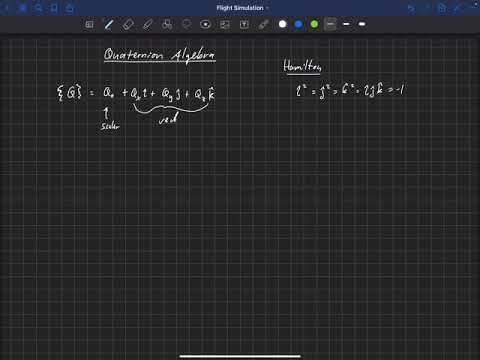
Here’s the thing: a quaternion can be expressed as q = a + bi + cj + dk, where a, b, c, and d are real numbers, and i, j, and k are the fundamental quaternion units. Each of these units represents a different dimension in space.
If you’re wondering why that matters, think about how we represent rotations in 3D space. Using traditional methods like Euler angles can lead to some tricky situations called gimbal lock. But with quaternions? They allow for smooth rotations without running into those hiccups. That’s seriously valuable in fields like computer graphics and robotics.
- Computer Graphics: In gaming or animation, quaternions help create realistic movements for characters or objects by smoothly interpolating between orientations.
- Aerospace Engineering: They’re used to calculate the orientation of spacecraft without complex mathematical computations.
- Robotics: Quaternions help robots navigate more effectively by providing accurate movement tracking in three-dimensional spaces.
You might be thinking, “Okay, but how did this all start?” Well, let’s take a quick detour into history! Quaternions were invented in 1843 by mathematician William Rowan Hamilton. Legend has it that he was so excited about this discovery that he carved the formula into the stone of Brougham Bridge in Dublin! Talk about passion for math!
This ingenuity didn’t just stay locked away in textbooks; it spilled over into modern science and technology. Programs like MATLAB or tools used for augmented reality harness quaternion algebra for their calculations and modeling techniques every day!
The beauty of quaternions lies not only in their ability to simplify calculations but also in their power to represent things we interact with regularly—like virtual reality headsets or flight simulators—making them integral to our high-tech lives.
You see? Quaternion algebra isn’t just some abstract idea floating around; it has fundamental practical applications across various disciplines. And just like Hamilton back then, today’s scientists and engineers continue to be inspired by this incredible tool as they explore new frontiers!
If you’re curious about diving deeper into this world (and there’s so much more!), looking up scholarly articles or educational resources can really open your eyes to its full potential! Just imagine where quaternion math could take us next!
Understanding Quaternions: The Role of x, y, z, and w in Advanced Scientific Applications
Quaternions can feel like a bit of a head-scratcher at first, but once you wrap your mind around them, they become pretty cool. So, what are these mysterious quaternions? Basically, they’re a way to represent rotations in three-dimensional space. You’ve got four components: x, y, z, and w. Let’s break each of these down.
x, y, and z are really just like coordinates that you might be used to in three-dimensional space, where they represent the axis directions. But the fun part is that the fourth component, w, is what really sets quaternions apart from regular vectors or matrices. It helps capture rotation without running into all those weird problems you sometimes get with things like gimbal lock—yeah, that’s that annoying situation where you lose a degree of freedom while rotating an object!
You see, in 3D graphics or robotics, when an object rotates, calculating its new orientation can be pretty tricky. Quaternions make it easier! They let you combine multiple rotations in a very neat way without messing everything up. Instead of using angle and axis pairs—which can get super cumbersome—quaternions take care of it all in one shot.
- The quaternion format is typically written as: q = w + xi + yj + zk.
- The scalar part is ‘w’, while ‘x’, ‘y’, and ‘z’ correspond to the imaginary parts represented by i, j, and k.
- When you perform operations with quaternions—like multiplying them—you end up with another quaternion that represents a combined rotation.
I remember once trying to animate a spinning globe on my computer. Using traditional rotation methods made things look jerky—like my globe was drunk or something! Then I switched to quaternions. Suddenly my globe spun smoothly as if it was gliding through space—no hiccups at all!
Now let’s talk about some scientific applications outside of just cool visuals. In aerospace engineering, for instance, quaternions help control spacecraft orientation during maneuvers without losing precision or causing lag—a must-have when life could literally depend on it!
Another nifty application pops up in virtual reality (VR). When you’re wearing those fancy VR headsets and moving your head around, quaternions keep track of all those orientations fluidly and responsively. If there were no quaternions? Well… let’s just say headaches would be inevitable after every session!
So yeah, the roles of x, y, z, and w in quaternions may seem small at first glance but trust me; they pack a powerful punch when it comes to handling rotations! They simplify complex operations and open new doors for both scientists and engineers alike.
Exploring Quaternion Rotation: A Fundamental Concept in Advanced Scientific Applications
Alright, let’s chat about quaternions. You might be scratching your head and thinking, “What even is that?” Well, let me break it down for you. Quaternions are a type of mathematical object that helps us understand rotations in three-dimensional space. Yeah, it sounds kinda complicated at first, but stick with me!
Quaternions were invented by a guy named **William Rowan Hamilton** in the 19th century. He was trying to find a way to extend complex numbers into higher dimensions. Imagine you’re playing a video game where your character needs to spin or rotate – that’s where quaternions come into play.
You know how rotations can get confusing with regular angles? Like, if you turn to the left and then up, things can start getting messy with standard math—especially when you try to combine those rotations. That’s where quaternions shine! They work like magic when you want to combine multiple rotations smoothly without running into problems like “gimbal lock,” which is basically when you lose a degree of rotational freedom.
So basically, here’s what makes quaternions special:
- Four Components: A quaternion consists of four parts—a real number and three imaginary units (i, j, k). They look something like this: q = w + xi + yj + zk.
- Compact Representation: They provide a more compact way to represent rotational data compared to matrices or Euler angles.
- Smooth Interpolation: Quaternions allow for smooth transitions between different orientations through something called “slerp,” which stands for spherical linear interpolation.
Let’s relate this back to something real-life. Think about how video games use quaternions for character movements or camera angles. If you’ve ever seen a 3D animation that rotates seamlessly… thank the quaternions behind the scenes!
And here’s another cool thing: **quaternion algebra** not only simplifies calculations but also enhances performance in graphics programming and robotics. When robots move around in unpredictable environments or when crafting immersive virtual reality experiences—we heavily depend on these nifty little computations.
In science too—like in physics or computer simulations—quaternion rotation pops up everywhere! It’s great for modeling celestial movements or any system where things need to turn and twist accurately.
So let’s wrap it up here: quaternions are more than just nerdy math objects; they play crucial roles across tech fields and scientific applications alike. Next time you’re playing your favorite game or seeing cool animation effects, remember there might just be some quaterion wizardry making it all possible!
So, let’s chat about this thing called quaternion algebra. It sounds super fancy and complex, but stick with me—it’s actually pretty cool! Quaternions are like this magical extension of regular numbers that help us describe things in three-dimensional space and even four dimensions. And trust me, they’re way more useful than you might think.
You ever tried to rotate an object in a video game? Or how about using 3D modeling software? That’s where quaternions come into play! They let you smoothly rotate objects without running into those annoying gimbal lock issues that can happen with traditional angles. I mean, who wants their objects flipping out of control, right?
Now, I once tried to tackle a 3D animation project for a class. I was all pumped up to make the coolest rotating cube ever. But then came the rotations, and wow! My cube went from looking super slick to a twisted mess in seconds. If only I had known about quaternions back then—things could’ve gone so differently!
Basically, a quaternion is made up of one real number part and three imaginary parts. You can think of it as your classic “a + bi” but cranked up a notch. The neat thing is that they can represent rotations without the headaches that come from using Euler angles or matrices.
You know what else is fascinating? Quaternions are not just for gaming or animation; they’ve wormed their way into physics and engineering too. They help model everything from spacecraft navigation to fluid dynamics because they simplify the math involved in describing complicated systems. Pretty neat stuff!
But here’s something you might not expect: despite how useful they are today, quaternions went through some tough times before people fully recognized their potential. In fact, the guy who discovered them, Sir William Rowan Hamilton, was initially met with skepticism when he introduced his ideas in the mid-1800s. Imagine pouring your heart into something groundbreaking and having people shrug it off! But over time, they proved their worth big time.
So yeah, if you’re curious about why modern science often seems like black magic with all its complex equations and models, just remember quaternions are doing some heavy lifting behind the scenes! They’re hidden treasures that quietly make our tech work better while keeping our creative dreams alive.
In the end, whether you’re crafting virtual worlds or exploring real ones through physics—quaternion algebra has got your back! It’s just one of those nifty parts of math that makes life a little more manageable while looking really slick at the same time.