Alright, picture this: you’re at a friends gathering, and someone mentions they’ve just optimized their school project using math. You raise an eyebrow like, “Wait, what?” That’s kind of how I felt the first time I heard about the Simplex Tableau. Seriously, who knew math could actually help in making life easier?
But here’s the thing—this isn’t just some nerdy party trick. It’s a real deal for optimizing problems in science and beyond! Imagine taking a messy situation, like figuring out how to use your budget wisely for a camping trip.
You want cool gear, snacks, and maybe even a fancy hammock. The Simplex Tableau is like your secret weapon that helps you figure it all out efficiently without losing your mind over numbers.
So yeah, stick around and let’s unravel this together! We might just turn you into an optimization whiz without even breaking a sweat.
Harnessing the Simplex Tableau: A Powerful Tool for Optimization in Scientific Research
The Simplex Tableau is a nifty tool that comes from the world of linear programming. Basically, it’s a method that helps you solve optimization problems, where you want to get the best possible outcome under certain constraints. Imagine you’re trying to plan the ultimate pizza party with limited ingredients—how do you maximize deliciousness? That’s kind of what the Simplex Tableau helps researchers do in their work.
So, let’s break it down a bit. When scientists want to optimize something—like minimizing costs or maximizing efficiency—they often run into situations where they have multiple variables affecting their outcomes. Enter the Simplex method! It uses a structured approach to navigate these variables and find optimal solutions, all while keeping everything organized.
- Simple Structure: The Simplex Tableau organizes information neatly in a table format. You can see your constraints, variables, and coefficients all in one place.
- Iterative Process: It works through iterations by moving along edges of a feasible region until it finds the best corner point, or optimal solution.
- Duality Concept: It gives insights into the dual problem which can be super useful for understanding resource allocations better.
Now, imagine being in a lab where you’re trying to produce some new medicine. You have various resources like time, money, and raw materials. Here’s where the Simplex Tableau comes into play: you set up your equations with these resources as constraints and define what you want to optimize (maybe maximizing production or minimizing cost). The tableau helps you visualize this scenario clearly.
Let me tell you something cool: even in agriculture research! Say farmers are looking at crop yields based on water usage and fertilizer availability. They could use this method to figure out how much water and fertilizer leads to the best harvest without overspending or harming the environment.
But it’s not just about crunching numbers; using this tool can lead to some pretty innovative solutions! Think about issues like climate change impact on food production—scientists can model these scenarios using optimization tools like the Simplex Tableau to drive smarter decisions.
So yeah, whether it’s optimizing healthcare processes or figuring out how much tomatoes are needed for that perfect sauce (hello again pizza!), this method proves its strength across different fields of scientific research. It’s about taking complex problems and breaking them down into manageable parts so we can find effective solutions together. Isn’t that neat?
Maximizing Scientific Efficiency: A Comprehensive Guide to Using the Simplex Tableau for Optimization
Alright, so let’s talk about the Simplex Tableau. This nifty tool is a method often used in linear programming. Essentially, it helps optimize a problem by finding the best possible solution under given constraints. You might think, “Why do I need to know about optimization?” Well, if you’ve ever tried to make the most of your time or resources—like planning a budget or organizing your day—you’ve already dipped your toes into it!
The Simplex Method, which uses the tableau format, is all about moving through potential solutions until it finds the best one. Imagine you’re at a buffet. You can only make one trip and want to maximize your plate with yummy food. The Simplex Tableau is like mapping out which foods give you the most satisfaction without making you feel overstuffed.
Now, here’s how it generally works:
- Create an objective function: This represents what you want to optimize. For instance, if you’re maximizing profits from sales, your function could be something like 10x + 15y.
- Identify constraints: These are limits you can’t surpass, like budget caps or available materials. Think of them as guardrails keeping your choices in check.
- Add slack variables: Sometimes you need to turn inequalities into equalities for calculations. Slack variables fill this role; they represent unused resources.
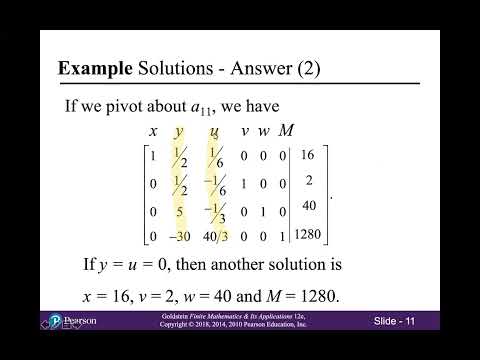
- Set up the tableau: This is where the magic happens! The tableau organizes all the information neatly so you can start evaluating solutions systematically.
- Iterate through pivots: By performing pivot operations (which involve row transformations), you move towards more optimal solutions with each step.
You might be thinking—“This sounds super complicated!” But hang on a second! It’s kind of like playing chess; once you get used to how pieces move and how strategies develop, it becomes clearer and… well, kind of fun! Like when I first got hooked on trying out different setups for my home office. I wanted everything in reach while looking great—using some optimization techniques gave me a productive space without clutter!
The beauty of using a Simplex Tableau is its efficiency in tackling big problems quickly. It allows scientists and researchers to find optimal solutions faster than just guessing or using trial and error. For example, if you’re trying to allocate resources for multiple experiments while minimizing costs and maximizing output—that’s where this tool shines!
You know what? Like any good recipe—it takes practice to get right! While it might feel overwhelming at first glance, breaking down the steps will make it manageable over time. So whether you’re working on projects related to data analysis, economics, or even environmental science—understanding how simple yet powerful tools like the Simplex Tableau work can really up your game.
Just remember: it’s not just math; it’s about making smart decisions and solving real-world problems efficiently! And who doesn’t want that?
Comprehensive Guide to Simplex Method: Essential Questions and Answers PDF for Science Students
The **Simplex Method** is a powerful tool used mainly in linear programming. You know, it’s like having a guide to navigate through a maze of options to find the best possible outcome. Whether you’re maximizing profits, minimizing costs, or allocating resources, this method shines. Let’s break it down.
First off, what’s linear programming? Basically, it’s a mathematical method for determining a way to achieve the best outcome. Imagine you’re trying to make the most pizza with limited ingredients. You want your dough and toppings to stretch as far as possible without wasting anything. That’s where linear programming comes in.
Now, let’s talk about the Simplex Tableau. It’s a neat little table that helps organize information clearly, making it easier to see your options and constraints. The tableau allows you to manipulate data efficiently.
Here are some key aspects to keep in mind:
- Objective Function: This is what you’re trying to optimize—like profit or cost.
- Constraints: These are limitations or conditions your solution has to meet, like resource availability.
- Basic and Non-Basic Variables: Basic variables are those included in the solution set; non-basic ones are not but can be brought into play at any time.
- Feasible Region: This is like the zone where all your constraints overlap; any solution must sit within this area.
You start by setting up your objective function mathematically and listing all constraints. Then you create your tableau from this info. Sounds daunting? Trust me; once you get into it, it clicks!
Here’s an example… Let’s say you run a bakery and want to maximize profits from cookies and cakes based on how much flour and sugar you have.
1. Define your profit: Cookies bring $2 each, cakes $5 each.
2. Your constraints: Maybe 10 cups of flour per day limits how many cookies (2 per cookie) or cakes (3 per cake) you can make.
3. Set up that tableau!
You adjust values within the tableau until reaching an optimal solution—basically pinpointing how many cookies versus cakes yield max profit without exceeding flour or sugar limits.
And here’s where things get even cooler! The **Simplex Method** iteratively improves solutions by swapping basic variables in and out of the feasible region until no further improvements can be made; then boom—you’ve got that sweet spot!
But why all this matters? Optimization techniques like these are foundational in many fields! From economics to engineering—even healthcare! Picture better resource allocation in hospitals during a crisis—that’s seriously impactful stuff.
So next time you’re looking at problems with multiple choices that need refining—think about using the **Simplex Method** as your trusty sidekick!
Alright, so picture this: you’re crunching numbers for a big project or maybe trying to find the best way to allocate limited resources. It’s like being a chef with a set amount of ingredients, and you want to whip up the tastiest dish possible without running out of anything. That’s where the simplex tableau comes into play.
Now, I remember back in college when I first encountered this concept. It was late at night, and my friends and I were frantically studying for an exam on linear programming. Someone drew out a tableau on the whiteboard, and it looked like some sort of mysterious code. I mean, rows and columns filled with numbers—it seemed pretty overwhelming at first! But then something clicked; once we started playing around with it, it turned out to be a powerful tool for optimizing our problems.
The simplex method helps simplify complex decision-making processes by taking mathematical principles and making them accessible. It looks at constraints—like how much money or time you have—and evaluates how best to maximize your outcomes, whether it’s profit or efficiency or whatever floats your boat.
You set up your tableau by defining decision variables (those are the ones you’re trying to solve for) along with your objective function (that’s basically what you’re aiming towards). As you progress through pivots—actually moving numbers around—you can get closer and closer to that optimal solution. It’s like solving a puzzle where every piece matters but may not fit perfectly until you tweak things just right.
And here’s where it gets really interesting: this process isn’t just useful in business or economics; scientists are using similar techniques too! Think about resource management in labs or maximizing the output of renewable energy systems. The beauty of math is that it transcends fields; it connects us all in ways we might not immediately see.
So yeah, while that initial tableau may look daunting, it’s seriously just a structured way to visualize solutions. Embracing tools like these can transform chaos into clarity—not bad for some rows and columns on paper!