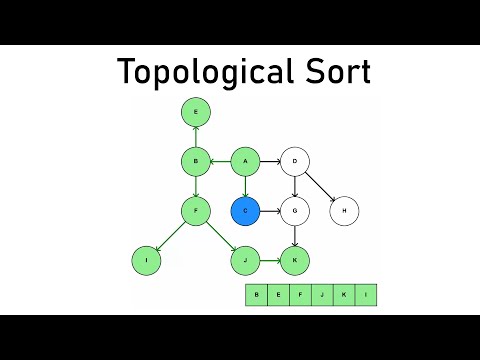
You know what’s wild? Imagine you’re trying to put together a jigsaw puzzle, but some pieces are locked away until you find others first. It’s like a game of patience, right?
Well, that’s kinda how topological sort works in computing! Seriously. It helps organize stuff so you can actually get the whole picture without the headache. Picture this: all those tasks piling up like laundry on a Sunday—some need to be done before others can even start.
It’s not just about sorting things; it’s about doing them in the right order. And let me tell you, using topological sort can save you tons of time and frustration! Buckle up, because we’re diving into how this nifty little algorithm makes life easier for programmers and beyond. Let’s see how it all connects!
Exploring the Advantages of Topological Sort in Data Structures: Implications for Scientific Computing
Topological sort might sound like a fancy term, but it’s actually pretty simple when you break it down. It’s a way to order the items in a directed graph so that if one item relies on another, the dependent item comes after it. This means that if you’re looking at things like tasks in a project or courses in a degree program, you can see which ones need to be done before others.
So why should we even care? Well, topological sort has some serious implications for scientific computing. Imagine you’re juggling various experiments, and each one depends on the results of previous ones. You wouldn’t want to start an experiment before gathering all the necessary data from its predecessors, right? That’s where topological sorting steps in.
Here are some advantages of using topological sort:
- Efficiency: It helps streamline processes. By sorting tasks logically, you cut down on wasted time and effort. You avoid the classic “wait, I can’t do this yet” scenario.
- Coding Simplicity: It makes your code cleaner and easier to understand. Whenever you’re working with complex data structures, having a clear order simplifies things.
- Error Reduction: It reduces the chance of errors when dependencies are involved. When things are sorted out correctly before executing, there’s less room for mistakes.
- Flexibility: If new tasks come up or priorities change, adjusting the sort can be straightforward without disrupting everything else.
Now let me share a little story here—well, more like an example! Think about your college days (or maybe they’re still fresh in your mind). Imagine registering for classes where some were prerequisites for others. Topological sort would allow you to quickly figure out which classes to take first so that you don’t find yourself stuck not being able to enroll because you skipped that intro course everyone warned you about.
In terms of scientific applications, think about building complex models or simulations where certain variables depend on others. With topological sort guiding which calculations need to come first—like how temperature influences pressure—you can run simulations smoothly and get accurate results without backtracking all the time.
You could also see topological sorting making its mark in scheduling problems, such as organizing workloads in high-performance computing clusters or distributing tasks across multiple processors effectively. That means faster results for researchers who need them yesterday!
To wrap it up: while topological sorting may seem like just a technical tool used by programmers and data scientists, its real value shines through in making complicated tasks manageable and efficient—especially in scientific computing scenarios where dependencies are everywhere you look!
Exploring Real-Life Applications of Sorting in Scientific Research and Data Analysis
Sorting might seem like a simple concept, but its applications in scientific research and data analysis are incredibly profound. Ever tried organizing your closet? That’s similar to what sorting does in data—it helps make sense of everything!
When we talk about sorting in computing, one key player stands out: **topological sort**. This method organizes elements based on their dependencies. Imagine you’re trying to tackle a project with several tasks. You can’t start Task B until you finish Task A. Topological sort helps us figure out that order, making it crucial for various fields.
For instance, in **computer science**, topological sorting is widely used in scheduling problems, such as determining the sequence of course prerequisites at universities. If Course B requires Course A to be completed first, topological sort will ensure students follow the right path through their degree program.
Also, think about **version control systems** like Git. When you make changes to files, these systems need to organize commits based on their dependencies—using topological sorting ensures that the final version reflects all changes accurately and logically.
In areas like **bioinformatics**, researchers use sorting when they deal with large datasets from DNA sequencing. They can identify relationships between genes or proteins by determining which ones depend on others for proper functioning. This process not only simplifies complex biological information but also aids in understanding diseases.
Here’s another example: let’s say scientists are analyzing how different species interact within an ecosystem. They could use topological sort to represent those interactions and identify key species whose presence or absence might affect the entire system.
Beyond these direct applications, sorting algorithms play a big role in data analysis too! When you’re sifting through massive datasets—be it social media trends or clinical trials—efficiently organizing that data helps researchers draw quicker and more accurate conclusions.
In summary, sorting isn’t just for keeping things tidy; it’s a powerful tool that drives critical decisions across fields like education, software development, biology, and environmental science. So next time you’re tidying up your space—or just organizing thoughts—remember that behind those simple actions is a world of complex science making everything run smoother!
Exploring the Applications of Topological Indices in Scientific Research and Molecular Analysis
Topological indices are this cool concept that comes into play when we talk about chemistry and molecular analysis. Basically, they help us understand the structure of molecules by focusing on their connectivity rather than just the arrangement of their atoms. It’s like seeing the forest for the trees, you know?
One of the main applications of topological indices is in quantitative structure-activity relationship (QSAR) studies. Researchers often use these indices to predict how certain molecular structures can affect biological activity. Imagine you have a bunch of chemical compounds and you’re trying to figure out which one might be effective as a drug. You’d use these indices to crunch some numbers, looking for patterns that could point you in the right direction.
In addition to pharmaceuticals, topological indices find a home in fields like materials science. Scientists analyze how different structures impact properties like conductivity or strength. For example, if you’re designing a new polymer, understanding its topological properties might help you create something lighter yet stronger. It’s pretty fascinating how understanding connections can lead to tangible innovations!
Oh, and don’t forget about network analysis. In social sciences or even computer science, networks can represent connections among various entities—be it people or data points. Topological indices help researchers measure things like centrality or connectedness within these networks. So basically, whether it’s molecules or social media interactions, understanding the shape and connections makes all the difference.
But here’s where it gets even more interesting! The mathematical backbone behind topological sorting is used in computing too. Think about scheduling tasks based on their dependencies; without sorting them correctly, stuff could get messy fast! This overlap between chemistry and computing shows how versatile these concepts are.
So yeah, exploring how topological indices apply across different scientific fields opens up a universe of possibilities! Whether it’s finding new medications or optimizing materials, they make such a big impact through their straightforward yet powerful ability to reveal underlying structures. Don’t overlook these little gems—they’re shaping research in ways we’re just beginning to understand!
So, let’s chat about topological sort. I mean, it might sound super technical and all, but just hang tight, and I’ll break it down. Picture this: you’re planning a huge day out with your buddies. You’ve got a list of things to do—like grab breakfast, go to the movies, and hit the ice cream shop—but there’s a catch. You can’t just do whatever you feel like whenever; some things need to happen before others. Like, you probably don’t want to go for ice cream before breakfast, right? That’s where topological sort struts in.
In computing, this process is all about organizing tasks based on their dependencies—like those activities on your list. In computer science terms, these tasks are often represented as nodes in a graph (think of them as little dots). The edges (the lines connecting the dots) tell you which task comes before another. So when you run a topological sort on that graph, you’re basically figuring out an order where each task can be completed without running into issues.
Now, let’s take a step back for a second and think about why this matters. Imagine you’re designing a game or building some complex software. There are countless pieces that need to fit together in just the right way—like puzzles! If you don’t get the order right… well, things can get messy really fast. You could end up trying to load assets before they even exist or execute code that relies on something not yet finished.
And there’s something kind of satisfying about seeing everything laid out in a logical sequence! It’s like when I finally finish organizing my room after avoiding it for weeks—I stand back and look at it like “Wow! That’s how it should have been all along.” With topological sorting, developers save both time and sanity by making sure everything is completed in the right order.
But here’s another cool thing: it ain’t just for games or apps! Whether you’re scheduling jobs on your computer or organizing tasks in project management software—it all boils down to getting that order nailed down.
To wrap up this little chat—topological sort isn’t just some fancy term tossed around in textbooks; it has real-world applications that help keep everything running smoothly behind the scenes. So next time you’re breezing through a well-organized app or playing an epic game without glitches—just know there might be some topological magic helping make that happen! Pretty neat huh?