Okay, so let’s say you’re at a party, right? And someone starts talking about confidence intervals. You might be thinking, “What in the world is that?” But seriously, it’s not as boring as it sounds!
Picture this: You’re throwing darts. You hit the bullseye a good chunk of the time. This is pretty similar to what scientists do when they’re trying to figure out how sure they are about something.
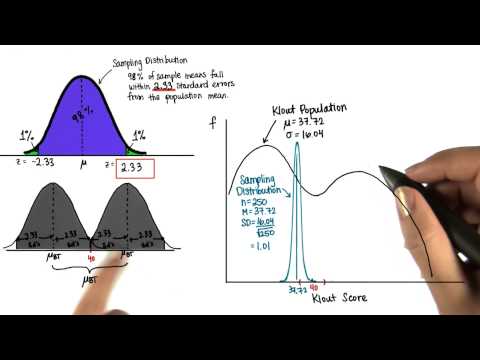
So here’s the deal—when they say they have a 98 percent confidence interval, it’s like saying, “Hey, we’re pretty sure we know what we’re talking about!” But what does that really mean?
Let’s dive into this and make sense of all those numbers and stats! I promise it’ll be way more fun than you think.
Step-by-Step Guide to Constructing a 98% Confidence Interval for the Population Mean in Scientific Research
When you’re diving into the world of statistics, constructing a confidence interval can seem tricky at first. But really, it’s about putting together a few simple pieces. Let me break it down for you in a friendly way.
First off, what’s a 98% confidence interval? Well, think of it like this: you’re saying you’re pretty darn sure (98% sure, to be exact) that the true average of whatever you’re measuring falls within a certain range. This range is constructed from data you collected from a sample.
Okay, so how do we get there? Here’s the basic process:
1. Gather Your Data
You start by collecting your sample data. Let’s say you want to know the average height of plants in your garden. You measure ten plants and record their heights.
2. Calculate the Mean
Next up is finding the mean (or average) height of those plants. You add up all their heights and divide by the number of plants. Easy peasy!
3. Calculate the Standard Deviation
Now, you’ve got to figure out how varied your heights are with something called standard deviation. It tells you how spread out your measurements are around that average.
4. Find the Sample Size
Count how many plants you measured—this is your sample size (let’s say it was 10).
5. Determine the Critical Value
Next comes finding something called a critical value. Since we’re aiming for 98% confidence, you’ll look this up in a statistical table or use software to find it based on your sample size and desired confidence level.
6. Calculate the Margin of Error
Now we need to calculate what’s called the margin of error. You multiply that critical value by your standard error (which is basically your standard deviation divided by the square root of your sample size).
7. Build Your Interval
Finally, it’s time to build that interval! You take your calculated mean and add/subtract that margin of error from it.
So, if your mean plant height was 30 cm and your margin of error came out to be 2 cm, then your 98% confidence interval would be from 28 cm to 32 cm.
That means you’re pretty confident (98% sure!) that if you measured every single plant in your garden instead of just ten, you’d find that average height falls between those two numbers.
It might sound like a lot at first glance, but once you’ve walked through it a couple times with different datasets, it’ll start feeling more familiar! And who knows? Maybe one day you’ll impress someone at dinner with how confident you can be about plant heights!
Understanding the Significance of a 99% Confidence Interval in Scientific Research
So, let’s talk about confidence intervals. You’ve probably heard of these in the context of scientific research. A 99% confidence interval is like saying, “Hey, I’m pretty sure that the real answer is within this range, and I’m so confident that I’d bet my favorite pizza on it.” Seriously, it’s a big deal!
A confidence interval gives you an idea of how certain you can be about your results. When researchers say they have a 99% confidence interval, it means that if they were to keep doing their study many times over with new samples, 99 out of 100 times, the true value would fall within that range. In other words:
- Higher Confidence: A 99% CI shows a lot more certainty than a lower percentage.
- Wider Range: It’s usually wider than something like a 95% CI because you’re trying to be extra sure.
- Balancing Act: There’s always a trade-off between width and confidence level; if you want to be more confident (like at 99%), your interval gets broader.
You might be thinking, “Okay, but what does this even look like?” Imagine you’re rolling a die. You want to know the average roll over time. If you calculate it and say “with 95% confidence my average roll is between 2 and 4,” you’re saying that most of the time you’d get that result. If you bump that up to 99%, your range might change to something like “between 1 and 5.” It’s less precise but way more reliable!
This matters because researchers need to communicate how certain they are about their findings. For instance, if they’re looking at the effect of a new drug on blood pressure and claim it’s effective with a 99% CI, it really drives home how much they believe in their results compared to a lower percentage.
The downside? Well, sometimes scientists find themselves in a pickle because wider intervals can make it harder to draw clear conclusions. That’s why understanding these numbers isn’t just for fun; it’s crucial for making decisions based on research outcomes.
You see? A confidence interval isn’t just some fancy math thing; it tells us how much we can trust the data we’re looking at. And when you’re dealing with something as important as health or safety decisions based on research, having that level of assurance really counts.
The next time someone mentions those percentages in research papers or studies, you’ll know they’re signaling how much faith we can put into those findings! Pretty neat stuff!
Understanding the 98% Confidence Interval T-Score: A Comprehensive Guide for Scientific Research
So, let’s chat about this thing called the 98% confidence interval T-score. Sounds fancy, right? But really, it’s a pretty straightforward concept when you break it down. It’s crucial in scientific research because it helps us understand how certain we can be about our estimates.
First off, what is a confidence interval? Well, think of it like this: if you’re trying to figure out the average height of your friends and you measure just a few of them, the average you calculate may not represent all your friends. A confidence interval gives you a range where you expect the true average height lies.
Now, why 98%? This number tells us how confident we are in that range. Essentially, if we were to repeat our measurements countless times and create a confidence interval each time, **98%** of those intervals would contain the true average. That’s pretty solid assurance!
Now onto that **T-score** part. The T-score comes into play when we don’t know what the population standard deviation is—it’s basically a way to estimate variation from sample data instead. The formula involves your sample mean, expected mean under the null hypothesis (that’s just an assumption we start with), and standard error:
T = (Sample Mean – Expected Mean) / Standard Error
That standard error, by the way, is calculated by dividing your sample standard deviation by the square root of your sample size. So if you’ve got 30 friends instead of just measuring five at random, your estimate becomes more reliable.
The T-score essentially tells you how far away your sample mean is from that expected mean in terms of standard errors. If it’s super high or super low, it suggests that there could be something interesting going on—just like when I found out my friend Dan was way taller than all the rest!
To get our confidence intervals with a T-distribution (which is what we usually use for smaller samples), we look up our T-score in statistical tables or use software to find critical values corresponding to that 98% confidence level. Here’s where things get mathematical:
- Your lower bound: Sample Mean – (T Score * Standard Error)
- Your upper bound: Sample Mean + (T Score * Standard Error)
This gives you two numbers—a range—and if your study’s true average falls within these bounds 98% of the time with repeated sampling methods, then voilà! You’ve got yourself an estimated range for your research findings.
The magic happens because as more data comes in or as research methods improve over time, these intervals will tighten up around that true mean. If most studies consistently show similar results within those intervals, then researchers can start feeling more confident about their conclusions.
You might find some researchers aiming for even higher percentages like 99% or going lower at around 90%, depending on how careful they want to be with their interpretations—kind of like adding extra layers of cake frosting for more sweetness! The higher the percentage you choose, though, usually means wider intervals.
To sum it up: The 98% confidence interval T-score helps scientists make informed decisions by giving them a clearer picture about where their data stands relative to what they’re testing. It turns uncertainty into something tangible—kinda cool when you think about it!
Alright, let’s talk about that 98 percent confidence interval. Sounds fancy, doesn’t it? But really, it’s just a way to express how certain we are about something when we’re working with data. Picture this: you’re at a carnival, tossing balls at those stacked cans to win a stuffed bear. You’ve got your technique down, but sometimes you miss.
Now, if you threw your balls ten times and hit that stack eight times, you could say you have an 80 percent success rate. But if you wanted to be even more specific and confident about how many times you’d hit the target in the future based on this trial? That’s where those confidence intervals come into play.
So here’s the deal: A 98 percent confidence interval gives us a range where we can expect our results to fall within a certain percentage of time—98 percent of the time! If you were repeating that ball toss over and over again, this interval would suggest that if you did it a hundred times, you’d expect your successful hits to fall within that range almost all the time.
But let’s break it down even more simply. Imagine you’re measuring your height every year since childhood. Your average height might be 5’6″, but some years you had growth spurts while other years not so much—like that awkward phase in middle school when everyone else shot up taller than you! A confidence interval shows us how much variation is normal for your height over the years.
And here’s where it gets real interesting: sometimes people get confused and think a 98 percent confidence interval means you’re saying there’s only a 2 percent chance of being wrong. That’s not quite right—it means that if we took many samples or measurements, we’d expect 98 percent of those intervals to capture the true average height (or whatever we’re measuring).
Honestly, though, I always found these concepts hard to wrap my head around at first. I remember struggling with statistics in college—sitting there staring at graphs like they were written in another language! But once it clicked for me, realizing that it’s just about trying to make sense of uncertainty—that was super rewarding.
So next time someone mentions a confidence interval—or you’re caught up in data analysis—just think about those carnival games and how each throw is a chance at hitting the target. It’s all about understanding what we know while accepting there’ll always be some unknowns lurking around!