Alright, picture this: you’re at a party, and someone starts talking about mass spectrometry. Yeah, sounds like the most boring convo ever, right? But hang on! Turns out, this fancy science thing is actually a game changer in drug discovery.
You know how finding the right medication can feel like searching for a needle in a haystack? Well, affinity selection mass spectrometry (ASMS) is like having a super-smart magnet that helps scientists fish that needle out much faster. Seriously!
Imagine researchers hunting down potential drugs with the accuracy of a hawk spotting its prey. It’s kinda wild how this tech transforms the whole process into something sleek and efficient.
So let’s break it down! We’ll chat about how ASMS works, why it’s so cool, and what it means for the future of medicine. Buckle up!
Enhancing Drug Discovery Through Affinity Selection Mass Spectrometry Techniques in Biomedical Research
Drug discovery can feel like searching for a needle in a haystack, right? Scientists are always on the lookout for new ways to find those precious compounds that can become life-saving medications. One of the cool methods helping with this is called **Affinity Selection Mass Spectrometry**, or ASMS for short. So, what’s the deal with it? Let’s break it down.
First off, ASMS is this technique used to identify and analyze molecules that bind specifically to a target, which is usually a protein. In drug discovery, you want to find small molecules or peptides that will effectively hit their targets. And this is where affinity selection comes into play.
How does it work? Well, it all starts with a target protein that’s mixed with various potential drug candidates in a solution. These candidates are tested for how well they stick to the protein. The ones that have a strong bond are separated out using mass spectrometry—a method that’s super sensitive and precise in measuring molecular masses.
Why is mass spectrometry so special? Basically, it tells you not just what’s there but also how much of it sticks around. You don’t want just any binding; you want strong interactions because those are more likely to lead to effective drugs.
Another important point about ASMS is its versatility. You can use this technique for small molecules, peptides, and even larger biomolecules! This means you can cast a wide net when searching for potential drugs without getting bogged down with complicated processes.
So let’s hit some key points:
- Specificity: It helps select compounds that bind closely and strongly.
- Sensitivity: Mass spectrometry picks up even tiny amounts of substances.
- Speed: It’s faster than traditional methods—less waiting around!
- Diversity: Different types of candidates can be screened at once.
Imagine being in the lab during an intense ASMS session—you’ve got all these potential drug candidates lined up like contestants on a game show, each hoping to win the golden ticket—the ability to bind effectively with a disease-causing protein. As each candidate gets tested through mass spectrometry, there’s this thrill when one lands as “the one”—the strong binder!
The journey doesn’t stop at finding these binders though; researchers then dig deeper into understanding how they work. This understanding leads designers to tweak these compounds further until they’ve got something potentially ready for clinical trials.
It’s like sculpting—you chip away at the rough edges until you get something worth showcasing! And thanks to techniques like ASMS, we’re speeding up the sculpture process in biomedical research.
So next time you hear about new drug discoveries hitting the headlines, remember: behind those breakthroughs are methods like affinity selection mass spectrometry helping scientists make smarter choices faster in their quest against diseases! It’s pretty amazing how science continually finds ways to help us all out!
Unveiling New Targets and Chemical Space Through Affinity Selection-Mass Spectrometry
So, let’s talk about this exciting concept called **Affinity Selection-Mass Spectrometry** (AS-MS). This method is all about finding new targets for drugs, and that can really change the game in treating various diseases. The basic idea here is to connect molecules with potential drug-like properties to their targets in a super-efficient way.
First off, what does affinity mean? Well, it’s like a special bond. Picture a lock and key. If the key fits the lock just right, you’ve got good affinity. In a scientific context, when we say a molecule has high affinity for a target, it means they fit together really well.
Now, **mass spectrometry** (MS) is where things get interesting. It’s like having an ultra-sensitive scale that can measure tiny bits of stuff in an incredibly precise way. When you mix those two concepts—affinity selection and mass spectrometry—you get this powerful tool that helps researchers figure out which molecules might work as drugs and how they interact with different biological targets.
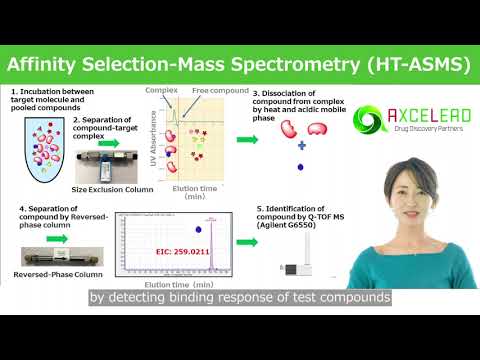
Here’s how it works: Researchers start with a pool of different molecules—imagine thousands of them swimming around in a giant molecular soup. They then introduce those molecules to their target proteins while applying some conditions that basically force the best-fitting ones to bind together. After some time, the unbound molecules are washed away.
Next up is mass spectrometry! The bound pairs are introduced into the mass spectrometer, which will separate and identify them based on their mass-to-charge ratio. It’s kind of like having your favorite playlist but only letting you hear the songs you love most! This way, researchers can pinpoint which molecules actually have potential as drug candidates.
There’s something cool here too: AS-MS allows scientists to explore what we call **chemical space** more efficiently than traditional methods would allow. Think of chemical space as an enormous universe filled with countless possibilities—different molecular structures that could potentially become new therapies or treatments. With AS-MS, researchers can uncover new candidates much faster!
But why does this even matter? Well, every time researchers find new drug candidates through AS-MS, they create opportunities for breakthroughs in medicine that could help people suffering from diseases that have been tough to tackle before. Imagine someone discovering a compound that could treat cancer or another chronic illness just because they were able to navigate through this vast chemical space better.
Still not sure? Here’s an analogy: remember when Netflix began using algorithms to recommend shows? That’s similar! The more data they collected on what people liked—and didn’t like—the better they became at suggesting new favorites. Similarly, as scientists gather more data from AS-MS experiments, they’re able to refine their searches for potential drugs more effectively each time.
To sum it up:
- Affinity selection<!– helps identify which molecules bind strongly to potential protein targets.
- Mass spectrometry accurately identifies these binding pairs by measuring molecular weights.
- This combination uncovers valuable chemical compounds faster than traditional methods.
- Discovering new drug candidates opens doors for innovative treatments and therapies.
So there you have it! AS-MS is like having a high-tech treasure map leading researchers through the expansive world of chemical possibilities—it just makes finding promising drugs so much easier and quicker!
Enhancing Drug Discovery: The Role of Affinity Selection Mass Spectrometry in Accelerating Pharmaceutical Development
So, let’s chat about drug discovery! It’s this super complex world where scientists are constantly trying to find new medicines to tackle diseases. One exciting tool that’s making waves in this space is Affinity Selection Mass Spectrometry, or ASMS for short. Sounds fancy, but I promise it’s not that complicated!
First off, what does it do? Well, ASMS helps researchers identify which molecules can bind to a target protein. Imagine you’re trying to find the perfect puzzle piece that fits into a specific spot; that’s basically what ASMS does with drugs and proteins. It lets scientists rapidly test thousands of potential drug candidates against their targets.
Here’s how it works:
- Selection: Scientists start with a pool of molecules, often called a library. They mix these molecules with the target protein.
- Binds and washes: The ones that fit or bind well get to stick around, while others are washed away. This is like shaking off the loose change from your pockets!
- Ionization: Next, they use mass spectrometry to turn those bound complexes into ions. This step is crucial because it allows them to measure the mass-to-charge ratio.
- Analysis: Finally, they analyze this data to figure out which molecules had the strongest binding interactions with the protein.
What makes ASMS super cool is its speed and efficiency! Traditional methods of finding drug candidates can take forever—years even! With ASMS, you can do experiments in just hours or days instead of months.
Let me tell you about something interesting I read: there was this whole study where researchers were looking for new treatments for cancer. Using ASMS, they were able to sift through thousands of compounds really quickly—finding potential hits in no time at all! Imagine how many sick people could have better options faster because scientists have this tool.
Additionally, one advantage of using affinity selection is that it gives scientists a clearer picture of how strong or weak those interactions are. A stronger bond might mean better effectiveness when given as a drug!
However, despite its awesomeness, there are still challenges ahead. Sometimes, not every binding event translates into good clinical outcomes; some compounds might look promising but fail when tested more thoroughly down the line.
In summary, Affinity Selection Mass Spectrometry is pushing boundaries in drug discovery by making it faster and more efficient! While it’s not without its hurdles—hey, science isn’t always smooth sailing—it sure holds great promise for future pharmaceuticals. You see? The journey from lab bench to medicine cabinets can be shorter and more productive thanks to tools like ASMS!
Okay, let’s talk about this really cool thing called Affinity Selection Mass Spectrometry (ASMS). You might be thinking, “What on earth is that?” and I get it; it sounds like a mouthful. So here’s the deal: it’s basically a super smart way of figuring out how different molecules – particularly proteins or drugs – interact with each other.
I remember when I first learned about drug discovery in school. There was this sense of wonder, you know? The idea that scientists can create something that might save lives or improve health is just mind-blowing. Imagine being part of that world! Anyway, ASMS kind of plays a superhero role in that journey.
So, picture this: researchers have a target protein they want to hit with a drug—think of it like trying to toss a ball into a specific area at the park, right? ASMS helps by using those molecular interactions to find out which compounds bind best to the target. It’s like having the ultimate guide that shows you exactly where to throw your ball so you don’t miss!
This method is super efficient too. Unlike traditional approaches where you might spend ages screening thousands of compounds manually, ASMS lets researchers rapidly sift through tons of options all at once. It’s almost like speed dating for molecules; finding the right match quickly without all the awkwardness!
But here’s the thing: while ASMS is an amazing tool, developing drugs still requires loads of trial and error after that initial screening. It reminds me of baking! You mix ingredients till you get just the right flavor, but sometimes it takes several tries before you perfect your recipe.
The emotional side of drug discovery and techniques like ASMS really tap into something profound for people in science—making discoveries that could change lives means they’re not just playing with lab equipment; they’re in the business of hope. And honestly? That gives me chills every time I think about it.
So yeah, while Affinity Selection Mass Spectrometry might seem super technical and scientific, at its core, it’s about connection—between molecules and between people working tirelessly to make our world healthier!