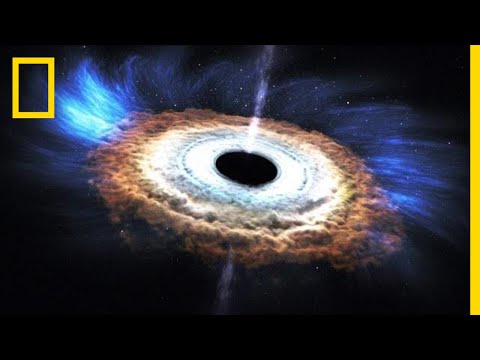
So, picture this for a sec: you’re at a party, right? And someone starts talking about black holes. You’re probably thinking, “Oh boy, here we go!” But then they hit you with this mind-blowing fact: black holes can actually warp the fabric of space and time. I mean, what?
Like, that’s some serious intergalactic stuff! You’re standing there with your drink, just trying to keep up. It’s wild how something that sounds so sci-fi can actually be real.
Black holes are these mysterious cosmic phenomena that seem to pull everything into their depths—kind of like that one friend who always goes back for more nachos. But they’re not just devourers; they also help us understand the universe in ways we’d never think possible.
Let’s chat about the different types of black holes and why they’re such a big deal in our cosmos. Buckle up; it’s gonna be a ride!
Exploring the Enigma: The Fascinating Science Behind Black Holes
So, black holes, huh? They’re like those cosmic vacuum cleaners that vacuum up everything around them, even light! It’s wild to think about, but let’s break it down a little.
First off, what exactly is a black hole? Basically, it’s a region in space where the gravitational pull is so strong that nothing can escape from it. Not even light! You might imagine them as these mysterious voids in the universe – and honestly, they kinda are.
Now, let’s talk about how they form. Most black holes begin their life cycle when massive stars run out of fuel. When that happens, they collapse under their own gravity. It’s like when you blow up a balloon and then let it go; all that air rushes out, creating chaos. But with stars, instead of letting go of gas slowly, they end up exploding in a supernova first! The core left behind can either become a neutron star or collapse into a black hole if it’s massive enough.
There are different types of black holes, and here’s where things get really fascinating:
- Stellar Black Holes: These are formed from collapsing stars and typically have masses ranging from about 3 to several tens of solar masses (you know how heavy our sun is?).
- Supermassive Black Holes: Found in the centers of galaxies (including our Milky Way), these behemoths can weigh millions or even billions of times the mass of our sun!
- Intermediate Black Holes: These are kind of the oddballs. They’re somewhere between stellar and supermassive black holes and still not fully understood.
- Primordial Black Holes: Hypothetical tiny black holes that could’ve formed right after the Big Bang.
Ever had that moment when you’re totally lost in thought while staring at the night sky? I remember being at a campfire once with friends way out in the woods. We looked up at all those stars—and I thought about something as crazy as black holes chilling out there. It made me feel both tiny and amazed by this vast universe!
Back to black holes—so how do we know they’re even out there if we can’t see them? Well, they affect things around them: when matter falls into a black hole, it speeds up and heats up, giving off X-rays before crossing what’s called the event horizon, which is basically their point of no return.
And let’s talk about time for a sec. When you get close to one of these bad boys—crazy stuff happens! Time appears to slow down because gravity warps spacetime itself. So if you were near one (not recommended!), you’d age differently than someone far away observing you.
Black holes also play an essential role in galaxy formation and evolution. They help regulate star formation by influencing how gas behaves within galaxies through their immense gravitational pull.
So yeah, while we may never completely unravel all their mysteries—or hop on a spaceship to study one directly—the science behind them is nothing short of mind-blowing! Every new discovery adds another layer to our understanding of these fascinating cosmic enigmas. Who knows what else awaits us among the stars?
Exploring the Mysteries of the Galaxy: Insights from Modern Science
Alright, let’s chat about black holes. These cosmic beasts are like the rock stars of the galaxy—mysterious, powerful, and kinda hard to understand. So, what really goes on with black holes? Well, buckle up!
First off, what exactly is a black hole? It’s a region in space where gravity is so strong that not even light can escape from it. Seriously! This gravitational pull happens because a huge amount of mass gets squished into a tiny space. Think of it as a super dense star that has collapsed under its own weight.
You might have heard about different types of black holes. Let me break it down for you:
- Stellar black holes: These form when massive stars run out of fuel and collapse after a supernova explosion.
- Supermassive black holes: Found at the centers of galaxies, including our Milky Way, these guys can have millions or even billions of times the mass of our sun!
- Intermediate black holes: Less common and still kind of mysterious, they sit between stellar and supermassive sizes.
I remember reading this story about scientists observing how stars move around something invisible in the center of our galaxy. That invisible thing? Yep, they believe it’s a supermassive black hole named Sagittarius A*. It’s like trying to find your friend in a packed concert without any lights—the gravitational pull is there; you just can’t see it!
The physics behind these things gets pretty wild too. When matter gets close to a black hole, it forms what we call an “accretion disk.” This disk is made up of gas and dust swirling around at incredible speeds as they’re drawn in. As stuff spirals closer to the event horizon (the point of no return), it heats up and emits X-rays—kind of like how rubbing your hands together makes them warm!
You might wonder whether we can ever actually “see” a black hole. Not really seeing them directly since light can’t escape them but astronomers use techniques like measuring how nearby stars behave or detecting those X-ray emissions I mentioned earlier to study them. It’s all about piecing together clues from their surroundings!
The more we learn about these cosmic enigmas, the more questions pop up. For instance: What happens inside a black hole? Some theories suggest there could be something called singularity—a point where density becomes infinite! Mind-blowing stuff!
You know what’s cool? Black holes play an essential role in shaping our universe. They influence star formation and even affect galaxy structures over time! So while they might sound scary or purely destructive, they also help create new stellar systems.
To sum things up: Black holes are fascinating manifestations of gravity taken to an extreme level. They remind us just how much we still don’t know about the cosmos. Every new discovery opens up fresh mysteries waiting to be unraveled! And who knows? Maybe one day we’ll uncover secrets that currently seem impossible.
If you wanna get wrapped up in mysteries that stretch across time and space, keep your eyes on those shimmering stars—they just might lead you closer to understanding those sneaky gaps in our knowledge called black holes.
Exploring the Enigmatic Spectrum of Black Holes: Insights into the Universe’s Most Mysterious Phenomena
Black holes. Just saying the name sounds a bit mysterious, right? They’re these cosmic monsters that just suck up everything around them. But what are they really? And why are they so fascinating? Let’s break it down.
First off, black holes aren’t some sci-fi fantasy. They’re real, and they come in a few different flavors: stellar, supermassive, and intermediate.
- Stellar black holes are formed when massive stars run out of fuel and collapse under their own gravity. Think of it as a cosmic implosion.
- Supermassive black holes, on the other hand, sit at the centers of most galaxies—including our own Milky Way—and can be millions or even billions of times more massive than our sun.
- Intermediate black holes? Well, they’re kind of the mystery guests at this cosmic party. Their existence is suggested but not yet firmly proven.
I remember reading about this one supermassive black hole called Sagittarius A*. It’s like 4 million times heavier than the sun! When scientists tracked stars whizzing around it with telescopes, they could see how strong its gravitational pull was. Pretty wild to think about! You’ve got this giant invisible mass that’s got a powerful grip on everything nearby.
But here’s the kicker: you can’t “see” a black hole like you’d see a star or planet because light can’t escape from them. Instead, they’re detected through their effects on surrounding matter. So you might observe gas swirling around in a disc-like shape before it disappears into oblivion.
This swirling gas heats up and emits X-rays before getting gobbled up—sort of like popcorn popping before disappearing into your mouth (kind of an extreme analogy!). Scientists use telescopes sensitive to X-rays to spot these energetic hotspots. That’s how we know they exist!
You might be thinking: “Alright, but what makes them so mysterious?” Well, there’s this thing called Hawking radiation. It’s named after physicist Stephen Hawking who proposed that black holes aren’t completely black! They can actually emit small amounts of heat over time due to quantum effects near their event horizon—the point beyond which nothing can escape.
This suggests that black holes could eventually evaporate! Can you imagine that? A celestial vacuum cleaner just fading away over eons? Mind-boggling!
The big question for scientists is: what happens when something crosses into that event horizon? Do all those particles just vanish forever? It raises tons of questions about space, time, and even what lies beyond those dark gates.
This is where theories start to get interesting—some suggest there could be wormholes or alternate universes hidden inside them! Sure sounds exciting but hey—it’s still very much theoretical stuff!
If you think about it, black holes challenge our understanding of physics and push us toward new realms of thought. Are we ready for that kind of cosmic exploration?
The bottom line is this: black holes are enigmatic entities, fueling both scientific inquiry and imagination alike. They’ve opened doors to conversations about the universe’s most profound mysteries—leaving everyone wondering what lies ahead in our quest for knowledge!
Black holes are just… wow, right? These cosmic phenomena have an almost mythical status in the universe. I remember my first encounter with the idea of a black hole. I was a kid, probably around ten or eleven, curled up on my couch watching a documentary about space. They showed this swirling mass of nothingness, pulling everything into it. I was both terrified and completely captivated! Imagine something so powerful that not even light can escape it. It really gets you thinking about the vastness and mystery of the universe.
Now, let’s break down some cool stuff about black holes. There are various types, with stellar black holes being some of the most common. They form when massive stars run out of fuel and collapse under their own gravity. Imagine the life cycle of a star; it’s kind of like us hitting our peak and then… bam! The end leads to something as incredible as a black hole.
Then you’ve got supermassive black holes lurking at the centers of galaxies—like our Milky Way. These dudes can be millions or even billions times heavier than our sun! Seriously, that’s some heavy lifting! Scientists think they might help shape galaxies by influencing their formation and evolution through gravity.
And let’s not skip over those little guys, called micro black holes, which are theoretical but intriguing nonetheless. They could be as small as an atom but might pack a pretty substantial punch if they exist! It’s like thinking about all those tiny things in life that hold immense power—like love or hope—right?
But here’s where it gets really wild: the concept of Hawking radiation proposed by Stephen Hawking. He theorized that black holes could emit radiation and eventually shrink over time until they disappear completely—like magic disappearing acts in space! That just blows your mind when you think about how something so seemingly unyielding could fade away.
So much is still unknown, though. Black holes seem to sit at this intersection between physics and philosophy; they challenge what we understand about space and time itself. Just sitting there in their dark glory makes you wonder about existence itself—what lies beyond them? What secrets do they hold?
Thinking back to that little kid watching documentaries on his couch, I feel grateful for how curious we can be about these mysteries in our universe. It reminds me that while we may feel small in this grand cosmos, every question we ask opens up new avenues for exploration—you know? And isn’t that part of what makes science so thrilling?
In this crazy ride through space-time, there’s always more to discover—more layers to peel back—and sometimes those layers lead us right back to ourselves and our place in all this vastness.