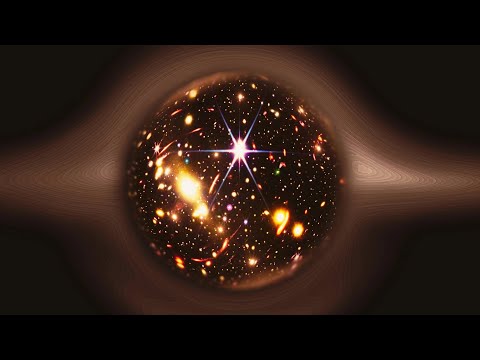
So, picture this: you’re having coffee with a buddy, and they casually drop a mind-boggling fact about black holes. They say something like, “Did you know there are massive black holes out there that could gobble up a whole galaxy?” You’d probably laugh and think, “That’s just sci-fi nonsense!” But guess what? It’s totally real.
Black holes are like the universe’s ultimate mystery box, right? We’re talking about these dense, invisible giants lurking in the cosmos, pulling everything in without mercy. Seriously, it’s wild! One moment you’re cruising along in space-time, and the next—wham! You’ve crossed the event horizon. Ever thought about what that would feel like? I mean, just imagine being sucked into oblivion!
Anyway, we might not completely get them yet. But diving into the world of massive black holes is like chasing shadows in the dark—a little creepy but oh-so-thrilling! So let’s unwrap this enigma together and see what’s really going on with these cosmic beasts.
Exploring the Enigma of Black Holes: Unraveling the Mysteries of the Universe
Black holes are, like, one of the coolest and most mysterious things in the universe, you know? Seriously, these cosmic vacuum cleaners have a way of turning our understanding of space upside down. So let’s explore this enigma together!
First off, what exactly is a black hole? Well, a black hole is an area in space where gravity is so strong that nothing can escape it, not even light. That’s why they’re called “black” holes—because you can’t see them! They’re formed when massive stars collapse under their own gravity at the end of their life cycle. It’s like a giant cosmic implosion!
Now, there are different types of black holes. There are stellar black holes, which are formed from dying stars, and then there are supermassive black holes, found at the centers of galaxies. Our Milky Way has one called Sagittarius A*, and it’s millions of times more massive than our sun! Isn’t that mind-boggling?
- The event horizon: This is the point around a black hole where nothing can escape its gravitational pull. If you cross it, well… goodbye!
- Singularity: This is what’s at the core of a black hole. It’s where all the mass gets crushed into an infinitely small point, creating infinite density. Sounds scary, right?
- The accretion disk: Matter spiraling into a black hole forms this disk around it. As materials fall in, they heat up and radiate energy, which helps astronomers detect black holes.
You might be thinking: “Okay cool, but how do we even know these things exist?” Great question! Well, scientists can’t see them directly since no light escapes. Instead, we look for their effects on nearby stars and gas clouds. For instance, if you observe a star orbiting something invisible but massive—boom! That might be evidence of a black hole pulling it in.
I remember once reading about how two galaxies collide over time—like cosmic traffic accidents! During this process, they merge their supermassive black holes. The gravitational waves created by such events are so powerful that we can actually detect them on Earth with instruments like LIGO. It gives me chills to think about!
Speaking of gravitational waves—we recently found out that when two black holes collide and merge into one larger one, they send ripples through spacetime itself! It’s like dropping a rock in water but imagine the ripples affecting everything across the universe.
A lot remains unknown about these fascinating beasts though! For instance: what happens inside? What lies beyond the event horizon? Are there really wormholes connecting to other parts of the universe or even different universes altogether? Those ideas sound straight outta sci-fi movies!
The pursuit to unravel these mysteries isn’t just for science nerds either; it’s part of understanding our place in this vast cosmos. Every discovery brings us closer to knowing how everything fits together—from tiny particles to massive superclusters.
The enigma surrounding black holes challenges our very understanding of physics and reality itself. They push the limits on what we think we know about time and space while making us ponder deeper questions about existence.
This journey into understanding takes time—and that’s completely okay! So whether you’re just curious or seriously interested in astrophysics, remember that every question matters on our quest to explore these dark corners of our universe.
Exploring Stephen Hawking’s Black Hole Paradox: Implications for Modern Physics and Cosmology
So, let’s talk about black holes. These colossal cosmic entities have been a hot topic in physics for ages. Among the big names associated with these mysterious objects is none other than Stephen Hawking. He came up with the famous black hole paradox that made a ton of physicists scratch their heads and wonder.
The paradox is all about what happens to information when something falls into a black hole. According to Hawking, things like stars and matter can get sucked in, never to be seen again. But here’s the kicker! If that happens, does the information about those objects just disappear? I mean, think about it—doesn’t it feel wrong to just lose all that info? Seriously!
Hawking argued that this was a big no-no for physics because it clashes with the law of quantum mechanics, which basically says that information cannot just vanish into thin air. That’s where we get the term “black hole information paradox.” It’s like losing your favorite shirt and not being able to ever find it again! You feel me?
Now, modern physics has tried to tackle this conundrum from various angles. Some researchers suggest that maybe information isn’t lost but transformed in some way. Imagine your shirt got eaten by a monster but instead of disappearing, it turns into something else entirely—like a cloud or something fluffy! This means there could be hidden ‘ghosts’ of information that exist outside the black hole event horizon (which is kinda like its point of no return).
There’s also talk about black holes emitting particles through something called Hawking radiation. This idea means that black holes aren’t totally stable; they could eventually evaporate over time and release some of that lost info back into space. So now you’ve got layers of complexity and different theories swirling around like planets in orbit!
Let’s explore how these ideas fit into our understanding of the universe today. When scientists study massive black holes—those titanic ones at the centers of galaxies—they’re trying to figure out how they affect everything around them, including cosmic structure and evolution. They’re like cosmic vacuum cleaners but with style!
There are theories suggesting that massive black holes might actually play a role in galaxy formation. Picture galaxies as big swirling soup pots; massive black holes could be stirring things up and helping them form efficiently. Who knew those dark giants had such an important job?
Moreover, researchers are investigating whether hybrid models combining ideas from general relativity (the theory explaining gravity) and quantum mechanics (the rules governing tiny particles) could lead us closer to resolving this paradox once and for all.
The debate continues! So many questions remain unanswered, you know? How do we reconcile these two powerful frameworks of physics? Are we on the brink of discovering something revolutionary?
In short, Stephen Hawking’s black hole paradox pushes us hard against the boundaries of what we understand in physics and cosmology today while also challenging us to think deeply about reality itself—the nature of existence might be way more complicated than we thought! It’s sort of thrilling if you ask me; who knows what other secrets lie out there among the stars?
The Impact of Black Holes on Earth: Understanding Cosmic Risks and Timelines in Astrophysics
You know, black holes are one of those cosmic wonders that totally blow our minds. While they’re out there swirling in the depths of space, it’s natural to wonder, “Hey, could they ever impact Earth?” Well, let’s break it down together.
First off, what even is a black hole? In simple terms, it’s a point in space where the gravitational pull is so strong that nothing—not even light—can escape from it. Imagine taking all the mass of a star and cramming it into a tiny ball; that’s pretty much what’s happening with these celestial giants.
Now, you might be wondering about the risks. The truth is, we’re pretty safe from black holes at our current spot in the Milky Way. Earth is located about 26,000 light-years away from Sagittarius A*, which is our galaxy’s supermassive black hole. That distance means we don’t need to worry about getting sucked in anytime soon!
But here’s where it gets interesting: if a massive black hole were to wander closer to our solar system—not likely but possible—it could pose some serious cosmic risks. The gravity from such a black hole could disrupt orbits, potentially sending planets crashing into each other or flinging them out into deep space. Imagine Earth floating around like a wayward soccer ball!
So what are some possible timelines here? Well, astrophysicists have predicted scenarios where this cosmic drama might unfold over millions of years. You follow me? It’s like the slowest game of cosmic Jenga you’ve ever seen!
Now let’s chat about another angle: stellar black holes. These form when massive stars collapse under their own gravity after using up their nuclear fuel. When these bad boys go rogue, they can sometimes create gamma-ray bursts—think high-energy explosions that can release more energy than our sun will in its entire lifetime! If one went off near Earth… well, we wouldn’t be having this chat anymore!
Still feeling uneasy? Don’t sweat too much! Astronomers keep an eye on nearby stars and any movement that hints at a potential threat from such astronomical phenomena. Plus, like I said earlier, the chances of one actually affecting us are slim.
To wrap this up: while black holes may seem scary and mysterious, scientists are constantly studying them to keep humanity informed and safe. Black holes really are just part of the universe’s wild tapestry—and for now? We’re just spectators enjoying the show.
- Black holes are incredibly dense regions in space.
- Earth is far enough away from Sagittarius A* to be safe.
- If a massive black hole came too close… it could wreak havoc on planetary orbits!
- A gamma-ray burst from a stellar black hole could have catastrophic effects if nearby.
- Astronomers monitor these cosmic giants so we stay informed on any potential risks.
And there you have it! Isn’t space intriguing?
You know, when I think about space, I can’t help but feel a mix of awe and confusion. It’s like, seriously, the universe is this gigantic puzzle, and black holes are some of the biggest enigmas out there. Massive black holes in particular—those giants hiding in the centers of galaxies—fascinate me. I mean, how did they even get so massive?
Picture a swirling mass of stars and gas all crammed into one tiny point in space. It’s mind-boggling! And yet, here we are, trying to figure out these cosmic beasts that can swallow entire stars without breaking a sweat. Just a while back, I stumbled on an old photo from a trip with friends where we laid under the stars for hours. We stared up at that endless canvas and chatted about everything and nothing at all. It was one of those moments where you realize how small we are compared to the universe. Looking up at those twinkling lights made me wonder if any of them might be around a massive black hole.
Now, researchers have come up with all sorts of theories about how these colossal entities form. Some say they emerge from smaller black holes merging over time or maybe from the collapse of huge clouds of gas right after the Big Bang! Can you imagine? All that chaos leading to something that sucks light itself into its grasp. Crazy stuff!
But here’s where it gets even wilder: these things can actually influence their surroundings in ways we’re still trying to understand. They can control star formation in their host galaxies simply by being… well, themselves! It’s kind of like how a popular kid at school can affect everyone’s vibe just by walking into a room.
And let’s not forget how scientists recently captured an image of a black hole’s shadow for the first time—mind blown! The Event Horizon Telescope team worked tirelessly on that project. They spent years analyzing data from all over the world just to show us what these beasts might look like.
Of course, there’s still so much we don’t know about massive black holes — why some are bigger than others and what happens inside them remains mostly speculative. Sometimes I think it’s pretty humbling to realize just how much mystery is left out there in the cosmos.
In the grand scheme of things, it’s easy to feel overwhelmed by these mysteries because they remind us just how little we truly understand about our own existence and reality as a whole. But then again, isn’t that part of what makes life thrilling? You dig?