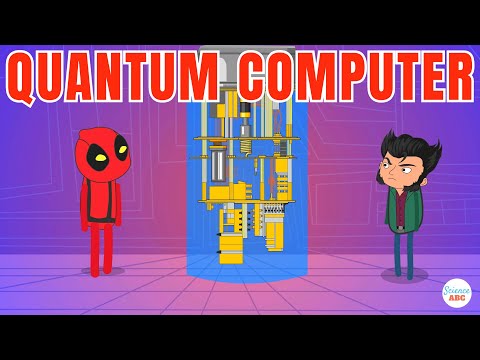
So, picture this: you’re hanging out with your buddy, and they keep bragging about their new super-fast computer. “Dude, my laptop can process a billion calculations in a split second!” You nod, trying to sound impressed while secretly wondering what makes it so special.
Well, here’s the kicker—underneath all that shiny tech are two tiny heroes: bits and qubits. Yup! These little guys are like the secret sauce behind modern computing.
You’ve probably heard of bits before—they’re the classic binary soldiers, standing tall as 1s and 0s. But qubits? Now that’s where it gets really interesting. They’re like bits on a wild rollercoaster ride, able to be both at once!
So let’s unravel this mystery together—what these bits and qubits really do and why they’re shaking things up in the tech world!
Understanding Bits and Qubits: The Fundamental Building Blocks of Quantum Computing in Modern Science
So, you might have heard of bits and qubits, especially when chatting about computers and quantum tech. It’s like comparing apples and oranges, but they’re both vital in their own ways. Let’s break it down.
A bit, short for binary digit, is the most basic unit of data in classical computing. Think of it as a tiny switch that can be either off or on. These states can be represented as 0 or 1. Everything your phone does—playing videos, running apps—ultimately boils down to millions (or billions) of these bits flipping on and off.
Now let’s get into the realm of qubits. A qubit, or quantum bit, operates a bit differently. It’s like that old friend who shows up at a party and just doesn’t play by the rules! Instead of just being 0 or 1, qubits can be both at the same time thanks to something called superposition. Imagine if your light switch could be neither fully off nor on but instead glowing with an in-between glow! This property lets qubits handle way more information than regular bits.
You see, when qubits are combined through their unique ability to exist in multiple states at once, they can perform complex calculations much faster than classical bits could ever dream of. Think about how many tasks you can manage at once versus how many your friend can juggle; it’s similar with these two.
An important concept tied to qubits is entanglement. This is when two qubits become linked so that the state of one instantly influences the state of another, no matter how far apart they are! It’s like having a long-distance friendship where you somehow know what the other person is feeling even though you’re in different cities. This helps quantum computers make decisions and computations much quicker.
The thing is—quantum computing is still kind of in its baby steps phase. Lots of researchers are working hard to understand how these principles play out in real-world applications like cryptography and drug discovery. Looking back on my first encounter with this stuff brings back memories—it felt surreal trying to wrap my head around it all; I remember asking my buddy who was studying physics over and over again until my brain hurt!
- Bits:A tiny unit of data that can either be 0 (off) or 1 (on).
- Qubits:Can exist in multiple states at once thanks to superposition.
- Entanglement:A phenomenon where linked qubits influence each other instantly regardless of distance.
The potential here is enormous! Imagine solving problems in seconds that would take today’s most powerful supercomputers thousands of years. That’s why so many folks are excited about the future possibilities with quantum tech.
If this topic fascinates you as much as it does me, keep an eye out for developments—it feels like we’re standing on the edge of something big!
Understanding Qubits: Exploring the Bit Equivalence in Quantum Computing
So, let’s talk about qubits. You know, the tiny building blocks that help make quantum computing work? They’re kind of like the stars of the show in the quantum world. But before we dive into qubits, let’s quickly revisit what a bit is, in case you need a little refresher.
A bit is the most basic unit of information in classical computing. Picture it as a light switch: it can either be off (0) or on (1). That’s it! It’s super straightforward. But here comes the twist: qubits don’t just stick to those boring binary states. They can be both 0 and 1 at the same time—this funky situation is called superposition.
Imagine flipping a coin. When it’s spinning in the air, it’s neither heads nor tails—it’s kind of both! That’s how qubits operate when they’re not being measured. This cool characteristic lets quantum computers hold way more information than regular computers.
Now, let me throw in another exciting concept: entanglement. This happens when two qubits become intertwined so that the state of one instantly influences the state of another—even if they’re far apart! Think of it like having a pair of magical shoes; if you step into one, your friend feels it no matter how far away they are. So basically, entangled qubits can work together in ways classical bits never could.
Now you might be thinking, “Okay, but what’s so special about all this?” Well, because qubits can exist in multiple states at once due to superposition and can communicate instantly via entanglement, they’re incredibly powerful for computing tasks. A quantum computer can process tons of possibilities simultaneously!
Let’s break down some key points about qubits:
- Superposition: Qubits can exist as 0s and 1s at the same time.
- Entanglement: When qubits are linked, changing one affects the other.
- Quantum Interference: Quantum algorithms use interference to cancel out wrong answers and bolster correct ones.
- Error Correction: Quantum error correction is crucial to protect information stored in qubits because they’re really sensitive!
Now about that error correction—it’s vital! Qubits are influenced by their surroundings much more than classical bits. Think about how hard it is to keep a balloon inflated on a windy day; that’s how delicate those tiny guys are. So scientists have developed techniques to fix errors that pop up when working with them.
So why does all this matter? Imagine solving complex problems like drug discovery or cryptography much faster than we do today—that’s what quantum computing promises! It’s still in its early days but full of potential for innovation.
In short, understanding qubits gives us insight into why quantum computing could revolutionize technology as we know it! They turn out to be way more than just fancy bits—they’re game-changers with superpowers waiting to be unleashed on some seriously challenging problems ahead. Exciting stuff, right?
Exploring the Future of Science: Will Quantum Computing Outpace Artificial Intelligence?
So, let’s talk about two of the coolest concepts in modern tech: quantum computing and artificial intelligence (AI). Both are like those superheroes of the science world, but each has unique powers and potential. The real question is, which one will take the lead in the future? Will quantum computers outpace AI? Let’s break it down.
First off, what even is quantum computing? Think of it as a supercharged version of traditional computing. Normal computers use bits, which are like tiny switches that can be either on or off—1s or 0s. Quantum computers use qubits. They can be both on and off at the same time, thanks to a little principle called superposition. This might sound confusing, but just imagine flipping a coin. While it’s spinning in the air, it’s not just heads or tails; it’s kind of both! That opens up a whole new world of possibilities for solving problems much faster than our current tech.
Now let’s throw AI into the mix. AI is all about making machines smart—like they can learn from data and make decisions without being explicitly programmed to do so. It’s behind everything from your favorite streaming recommendations to those chatbots you talk to when you need help online. Imagine trying to teach a kid how to ride a bike; through practice and feedback, he learns pretty quickly. AI does something similar with data: it learns patterns and improves its performance over time.
But back to our main point: can quantum computing outpace AI? Well, here’s where things get interesting:
- Speed: Quantum computers could potentially tackle massive datasets way quicker than traditional ones. So if you combine that speed with an AI algorithm, who knows how much more efficient it could be?
- Complex problem-solving: Some issues—like simulating complex molecules for drug discovery or optimizing huge logistics networks—are tough for regular computers but might be manageable for quantum ones.
- A symbiotic relationship: Instead of one outpacing the other completely, they could work together! Picture an advanced AI running on a quantum computer—it could analyze heaps of data at lightning speed while learning from past outcomes.
It’s kind of like when I tried cooking pasta for the first time; I had no clue what I was doing until my friend helped me figure things out step by step. Both technologies have their strengths—and they might just turn out to be better together.
Now remember that quantum computing is still in its early days; there are challenges we need to overcome before we fully unlock its potential. It’s like trying to get a bike up a steep hill—it takes effort, right? Meanwhile, AI has already made significant strides and impacts across various sectors today.
In essence, it’s not about one winning over the other but rather how they’ll shape our future together. Whether you’re excited about lightning-fast calculations or intelligent machines learning from their experiences (or both!), there’s no doubt that both fields are paving new paths in scientific innovation and technological advancement.
So next time someone asks if quantum computers will leave AI in the dust, you’ll know exactly how complicated—and exciting—the future really is!
You know, when you think about computers, it’s easy to get lost in all that high-tech jargon. Bits and qubits? It might sound like a secret language or something. But really, they’re just the building blocks of how our devices work, and let me tell you, it’s pretty mind-blowing.
So, let’s start with bits. A bit is the simplest piece of information in computing; it can be either a 0 or a 1. Imagine flipping a coin. Heads could be your “1” and tails your “0.” That’s how computers store and process data. Even though it’s so simple, when you stack enough bits together—like millions of them—you can create everything from the photos on your phone to the software running on your laptop. It’s kind of like building with Lego bricks—you start with tiny pieces to craft something way more complex.
Then we step into the world of qubits. Unlike bits that can only be in one state at a time—0 or 1—qubits are like the cool kids on the block who can do both at once thanks to something called superposition. It’s like if that coin could spin in mid-air! This feature allows quantum computers to process information much faster than traditional ones because they can handle multiple possibilities simultaneously.
I remember watching a documentary about quantum computing once; there was this part where they explained how qubits could potentially solve problems that would take classical computers millions of years to crack! Just picturing that makes my head spin!
But here’s where things get even more interesting… Qubits are also intertwined through something known as entanglement. Think of it as two friends who always know what each other is thinking—even if they’re far apart! This connection means that changing one qubit instantly affects its pair. It’s almost like magic!
However, it’s not all smooth sailing for qubits; they’re delicate little creatures susceptible to interference from their environment—like pesky little flies buzzing around when you’re trying to concentrate on a book! There are still loads of challenges researchers face in making quantum computing practical for everyday use.
You see? It’s all connected—a world made up of tiny bits and fancy qubits working together. The evolution from traditional computing to quantum computing opens up exciting paths for everything from medicine to cryptography! So next time you’re scrolling through your phone or surfing the web, remember: there’s a whole universe behind those screens built from these tiny elements—and who knows what they’ll cook up next? It truly makes you appreciate just how far we’ve come and how much further there is to go!