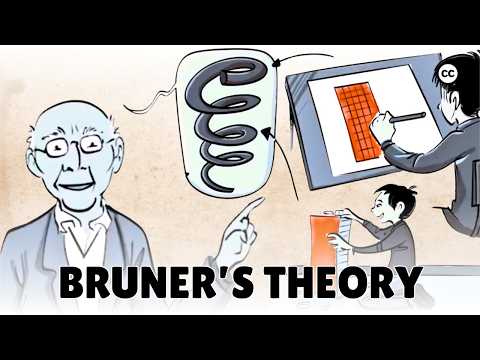
So, picture this: you’re trying to teach your little cousin how to ride a bike. One minute, they’re wobbling all over the place, and the next, they’re zooming past you like a pro. Seriously! It’s wild how quickly kids can pick things up when they’re ready.
That’s where Bruner comes in. He’s the dude behind some pretty interesting ideas about how we learn and grow. It’s like he put on his scientist hat and said, “Let’s figure out how our brains work while we’re at it!”
His theory digs into this whole cognitive development thing. It’s about how kids make sense of the world around them as they grow. You know, like how we all start off with that simple picture of a dog and then gradually learn about breeds and behaviors? Pretty cool stuff!
But there’s more to it than just cute kiddie moments. Bruner’s ideas have shaped education and psychology in huge ways. They help us understand not just what kids learn but also how they think about learning itself. So let’s unpack that a bit, shall we?
The Significance of Bruner’s Theory in Advancing Scientific Understanding
Bruner’s theory of cognitive development is pretty intriguing, to say the least. It’s all about how we learn and understand the world around us. So, let’s break it down.
Jerome Bruner, a renowned psychologist, had this idea that education isn’t just about pouring facts into someone’s head. Instead, it should be more like guiding them to discover things for themselves. He believed that learning happens in three stages: enactive, iconic, and symbolic. These stages show how our understanding matures over time.
- Enactive Stage: This is where you learn through actions. Think about a toddler learning to walk or stack blocks. They figure out balance and gravity by trying things out.
- Iconic Stage: Here, you start using images and visual aids to represent things. It’s like when kids draw pictures of their toys or use flashcards.
- Symbolic Stage: Finally, you get to language and symbols. This is where abstract thinking kicks in—learning math or reading books comes into play.
Now, why does this matter so much for science? Well, Bruner’s approach nudges us towards more hands-on learning experiences. It tells educators that active engagement helps students grasp complex ideas better than just memorizing facts. This has been huge for teaching methods in science classrooms.
Think back to high school science labs—lab experiments are basically a way to apply Bruner’s principles! Instead of just reading theories from a textbook, students mix chemicals or observe plant growth firsthand. They create their own understanding through exploration.
Bruner also stressed the importance of culture in learning. He suggested that knowledge isn’t isolated; it’s shaped by our surroundings and experiences—like food preferences or the language we speak! So teachers can’t just drop facts on students without considering their backgrounds.
You know what’s cool? His ideas have influenced modern educational practices like project-based learning and inquiry-based science education. Students work on real-world problems instead of rote memorization—all thanks to these insights.
In essence, Bruner helped shift the narrative from passive learning to active exploration. His theory emphasizes curiosity as key in scientific understanding—and hey, curiosity might just be one of our greatest tools as humans!
By understanding his theory more deeply, educators can help shape curious minds that think critically about scientific concepts instead of simply absorbing information—making the world a bit brighter!
Exploring Bruner’s Theory: Its Impact and Contributions to Education in the Field of Science
Alright, let’s chat about Bruner’s Theory. Jerome Bruner was a big name in education and psychology, especially known for his ideas on cognitive development. His theory is like a roadmap for understanding how we learn—and it’s pretty cool.
One of the major concepts he introduced is the idea of scaffolding. You know how when you’re learning to ride a bike, you might have training wheels at first? That’s kind of like scaffolding! In education, it means providing support as students learn new concepts. As they gain confidence and skills, that support gradually fades away. This approach encourages independence and helps learners take charge of their education.
Bruner also highlighted the importance of discovery learning. Instead of just memorizing facts or formulas, he believed in letting students explore and find answers themselves. Imagine being in a science class where instead of reading about plant cells from a textbook, you get to look at them under a microscope and draw your own conclusions! It’s way more engaging, isn’t it?
- Cognitive Development: Bruner suggested that learning happens in stages. So kids don’t just absorb information randomly; they build on what they already know.
- The Spiral Curriculum: This one’s neat! Bruner proposed revisiting topics multiple times at increasing levels of complexity. Think about how you might learn about gravity in elementary school with simple experiments and then dive into Einstein’s theories later on.
- Cultural Context: He emphasized that what we learn is influenced by our background and experiences. So incorporating diverse perspectives into learning can really enhance understanding—especially in science!
A little personal story here: I remember my high school biology teacher who absolutely lived by these principles. She would set up experiments that made us feel like real scientists—you know? We’d hypothesize about outcomes and then test those ideas ourselves. That experience made me super curious about science beyond the classroom—you know?
The impact of Bruner’s theory on education is huge! It’s shaped not only how teachers approach lessons but also how curricula are designed around practical experiences rather than rote memorization. This means students entering fields like science are often more prepared to think critically and solve problems creatively.
In essence, exploring Bruner’s contributions sheds light on making learning active, meaningful, and connected to real-world scenarios. And that truly reflects what effective education should aim for—helping learners become not just knowledge consumers but knowledge creators!
Exploring the Four Key Elements of Bruner’s Theory in Scientific Education
Bruner’s Cognitive Development Theory is pretty fascinating when it comes to scientific education. This theory emphasizes how we learn and perceive the world around us. It’s all about engaging students actively in the learning process. So, let’s take a closer look at the four key elements of this theory and how they fit into scientific education.
1. Enactive Representation: This is all about learning through actions. When students interact with materials and experiments, they grasp concepts better. Imagine a kid discovering gravity by dropping different objects from a height—now that’s a real-life example! They’ll remember that lesson far longer than if they’d just read about gravity in a textbook.
2. Iconic Representation: Here, students start using pictures and diagrams to understand concepts. Think of how much easier it is to understand something when you can see it visually! For instance, showing the structure of a DNA molecule in a diagram can be way more engaging than just explaining its parts verbally. It’s like giving their brains a little memory boost.
3. Symbolic Representation: This involves using symbols and language to express ideas more abstractly. In science, this could mean discussing equations or using scientific terms like “photosynthesis.” At this stage, learners are able to use symbols to communicate complex ideas effectively, like writing an equation for chemical reactions instead of just explaining them.
4. Discovery Learning: Bruner believed that learners should actively participate in their own learning process through exploration and discovery rather than just memorizing facts. This method encourages curiosity and critical thinking—both super important in science! Picture kids observing plants’ growth while experimenting with different light conditions; they learn so much more by exploring than by sitting in lectures.
So, when you combine these four elements—enactive, iconic, symbolic representation, plus discovery learning—you create an awesome environment for scientific education that really sticks with students. It’s not just about throwing information at them; it’s about making connections and encouraging exploration along the way.
This approach aligns beautifully with how we naturally learn throughout life; after all, think back to when you first learned something new! Maybe you played around with LEGO blocks before reading instructions on how to build something complex? That hands-on experience helped shape your understanding! So yeah, Bruner’s work really highlights the importance of experiential learning within science education—and let me tell you—it makes all the difference!
So, have you ever thought about how we learn and understand the world around us? It’s pretty interesting, right? This brings us to a guy named Jerome Bruner, who had some really cool ideas about cognitive development. You know, basically how we think and process information as we grow up.
Bruner believed that learning happens in stages. He introduced three key modes of representation: enactive, iconic, and symbolic. In simpler terms, it’s like a progression of figuring things out. First off, there’s the enactive stage where you learn through actions. Think of a toddler touching a hot stove. Ouch! They learn that fire is hot by experiencing it firsthand.
Then comes the iconic stage, where kids start using images and symbols to represent things they’ve learned. Like when they draw pictures or use toys to tell stories—so adorable! Finally, there’s the symbolic stage; that’s when language becomes super important. Kids can express complex ideas and understand symbols like letters and numbers.
What really gets me is how this theory highlights that learning isn’t just about memorizing facts or passing tests; it’s more about understanding concepts deeply and flexibly applying them in different situations. It makes so much sense when you think about it! I remember tutoring a friend’s kid in math once—he was struggling with multiplication tables. Instead of just making him memorize them, I started using objects around us to visualize the problems; suddenly everything clicked for him!
Bruner’s work reminds us that our cognitive development can be dynamic and varied based on experiences—not just locked into rigid patterns or structures. That’s significant because it suggests learning can be personalized across different contexts—like your unique approach to cooking based on what spices you love!
In essence, Bruner’s theory serves as a guide not only for educators but also for parents—and anyone interested in fostering better ways to engage with knowledge. When we realize there are multiple ways to learn something new or grasp a tough concept, it opens doors for creativity in teaching and understanding ourselves better!
So yeah, Bruner’s contributions are still super relevant today as we navigate through all those complex layers of human thinking and learning together!