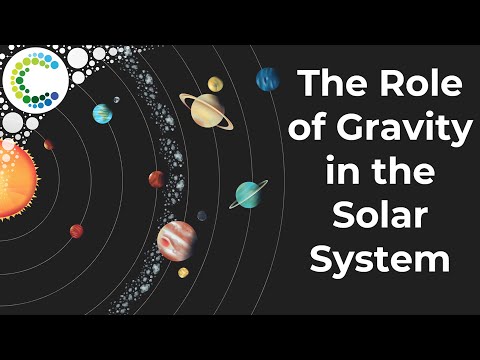
You know that feeling when you jump off a swing and your stomach drops? That’s gravity for ya! It’s this sneaky force that’s always pulling you back down, and it doesn’t stop with us.
Imagine the sun and all those planets spinning around it like dancers at a cosmic party. So much of that is thanks to gravity. It’s wild how something we can’t even see holds everything together in space.
But here’s the kicker—gravity isn’t just about keeping us grounded. It’s key to how our solar system works. It shapes the paths of the planets, controls their orbits, and even gives life to stars. Cool, right?
So, let’s unravel this whole gravity thing and see how it plays its part in solar dynamics. It’s gonna be a ride!
The Role of Gravity in Shaping Our Solar System: A Scientific Exploration
The influence of gravity in our solar system is like an invisible hand guiding everything around us. It’s basically the glue that holds our cosmic neighborhood together. Without gravity, planets would drift away into the void, and, well, that would be pretty chaotic, don’t you think?
First off, let’s talk about why gravity matters so much. You see, all objects with mass pull on each other. The more massive an object is, the stronger its pull. So our Sun is a gigantic ball of gas that’s super heavy, which means it has a super strong gravity. Because of this force, planets like Earth are held in orbit around it. Imagine trying to throw a ball while being pulled by a giant magnet; that’s how it works.
Now consider how gravity shapes orbits. Planets travel in elliptical paths around the Sun thanks to its gravitational pull. This keeps them from flying off into space! However, their speed and distance from the Sun also play important roles here. For example:
- Mercury zips around the Sun really fast because it’s close.
- Neptune hangs out far away and takes a long time to orbit.
Gravity even has an effect on smaller bodies like asteroids and comets. They’re influenced by the gravitational fields of larger planets too! This can cause some wild interactions where asteroids might get pulled towards a planet or flung into deeper space.
And let’s not forget about moons! Just like planets orbit the Sun, moons orbit their respective planets because of that lovely gravitational attraction at play here. Take Earth’s moon as an example: it stays in place not just because Earth is big but also because they kinda dance together due to gravity.
Here comes another twist! The balance between gravity and velocity helps keep everything in check. If a planet moves too slowly? It could spiral into the Sun! But if it’s too fast? It might escape altogether! It’s this balancing act that’s crucial for stability.
Sometimes things can get outta whack though—like when two massive objects come close together in space; they can affect each other’s orbits dramatically—think of it as cosmic bumper cars! That interaction can lead to some really weird orbital paths.
So next time you look up at night and admire all those twinkling stars (and maybe our Moon), remember: gravity is behind it all. It’s responsible for keeping everything in order so we can enjoy this grand show in our solar system without things going haywire! Pretty cool stuff if you ask me!
Exploring the Role of Gravity in Galactic and Solar System Motions: A Scientific Insight
You know, gravity is like that invisible glue holding everything together in the universe. I mean, without it, can you even imagine how chaotic things would be? Just think about it for a second: stars, planets, and galaxies swirling around without any order! So let’s take a closer look at how gravity plays a role in both galactic and solar system motions.
Gravity and Galactic Motions
In galaxies, gravity is the main force that governs how stars move within them. You’ve got billions of stars in a galaxy, and they’re all attracted to each other. It’s like a cosmic dance party where everyone is trying to find their place on the dance floor. The more massive a star or object is, the stronger its gravitational pull. This means that larger stars can attract smaller ones into orbit around them.
- This gravitational pull helps form spiral arms in spiral galaxies. Stars closer to the center feel stronger gravity than those on the outskirts.
- And guess what? Dark matter also plays a big role here! It doesn’t emit light but has mass. It affects how galaxies rotate.
Ever heard of the Andromeda Galaxy? It’s on a collision course with our Milky Way! This isn’t due to some aggressive behavior—it’s gravity pulling them together over millions of years.
Gravity in Our Solar System
Now let’s zoom into our own backyard—the solar system. Here, gravity is responsible for keeping planets in orbit around the Sun. The Sun’s massive gravitational force acts like an anchor for all its planets!
- The planets are constantly falling towards the Sun but also moving sideways due to their speed. Imagine swinging around while holding onto something—it’s kind of like that!
- The balance between these two forces keeps each planet on its path. If there’s too little gravity or too much speed, we’d be in trouble!
Take Earth for example: if it were just slightly closer to the Sun because of some gravitational hiccup, we’d be frying up here! If it went farther away? Well, time to bundle up because it would get chilly fast.
The Influence on Other Bodies
Besides just planets and stars, other celestial bodies feel this gravitational love too! Moons orbit planets similarly; they’re held tight by their planet’s gravity.
- Think about our Moon: Its gravitational influence causes tides on Earth! That pull affects everything from ocean waves to marine life.
- Asteroids and comets follow their own paths influenced by various bodies’ gravities as well—sometimes leading them close to Earth!
And speaking of asteroids—ever seen that space rock fly by? Thanks to their unpredictable orbits influenced by nearby planetary gravities or even larger objects!
A Little Bit About Black Holes
If you thought regular gravity was wild enough, consider black holes! When a massive star collapses under its own gravity after running out of fuel, it creates something so dense that not even light can escape it! That’s some serious gravitational power right there!
- This intense pull can warp space-time itself—can you believe that?
- The effects are so strong they can affect nearby stars which might spiral into them or get flung away entirely!
This whole dance between objects due to gravity makes our universe dynamic and beautiful. So next time you gaze at the night sky or feel that gentle tug of your weight against Earth—remember it’s all thanks to good ol’ gravity making sure every star and planet knows where they belong. Cool stuff, right?
Exploring Solar System Gravity: Understanding the Forces That Shape Our Cosmic Neighborhood
So, gravity. It’s that invisible force that keeps your feet on the ground and your coffee cup from floating away. But in the grand scheme of things, especially in our solar system, gravity plays a massive role. Seriously, you wouldn’t believe what a big deal it is!
Let’s break it down. Gravity is basically the glue of the universe. It holds everything together: planets, moons, asteroids, and even those fuzzy little comets that zoom by from time to time. Without gravity, everything would just drift aimlessly in space. Can you imagine? A chaotic mess of celestial bodies with no order whatsoever!
First up: The Sun’s Gravity. Our Sun has an enormous gravitational pull because it’s so massive—about 330,000 times heavier than Earth! This strength keeps all the planets—including Earth—in orbit around it. Think of it like a giant merry-go-round where the Sun is at the center and all the planets are holding on for dear life as they spin around.
- Without the Sun’s gravity, Earth would just fly off into space.
- The further you get from the Sun, like Neptune or Pluto (if you wanna consider them), the weaker its gravitational grip becomes.
Now let’s chat about planetary gravity. Each planet has its own gravitational force based on its size and mass. For instance, Jupiter is a real heavyweight champion with gravity more than twice as strong as ours! If you weighed 100 pounds on Earth, you’d weigh about 252 pounds if you were standing on Jupiter’s surface. Ouch!
But what about smaller bodies like moons? Well, they’ve got their own pull too! The Moon pulls at us with enough force to create tides in our oceans—a classic case of gravity affecting our daily lives without us even noticing.
- The Moon’s gravitational influence causes ocean tides.
- Saturn’s moons are kept in check by Saturn’s powerful pull.
Now think about asteroids and comets. They’re way smaller than planets but hey, they can be influenced by gravity too! When an asteroid gets close to a large planet like Jupiter or Saturn, it can be pulled into their orbit or even flung out into space by their massive gravitational forces. This can cause some wild changes in their trajectories.
And then there are black holes—those cosmic vacuum cleaners with insane gravitational pulls! Anything that crosses their event horizon just gets sucked right in… talk about a one-way ticket!
Gravity shapes not only how objects move but also how they interact with each other across vast distances. Ever heard of gravitational waves? These ripples in spacetime are generated when massive objects accelerate—like when black holes merge or neutron stars collide. It’s kind of like throwing a stone into a pond; those ripples travel outwards!
But let me tell you a quick story: Imagine standing outside on a clear night looking up at all those stars twinkling away. Each star out there has its own story intertwined with gravity—it’s incredible! Those stars formed from clouds of gas collapsing under their own weight due to gravity.
So yeah, next time you’re gazing at the night sky or feeling your feet firmly planted on Earth, remember that lovely force called gravity is not just keeping you grounded; it’s literally governing our entire solar system and beyond! Isn’t nature just amazing?
Gravity, huh? It’s that invisible force that keeps us grounded, literally. I mean, can you imagine if Earth didn’t have gravity? We’d just float away, probably making a mess of things up there! Anyway, when you think about the solar system and how it all works—planets spinning around the sun, moons circling their planets—it’s like a cosmic dance. And gravity is the DJ keeping everything in rhythm.
Have you ever watched a kid swing on a swing set? When they pump their legs, they go higher and higher until they reach that perfect moment of weightlessness at the top. That’s sort of what happens with gravity in space. It pulls celestial bodies with an unyielding grip. The sun, being this giant ball of gas and energy, has a crazy strong gravitational pull. You could say it’s like the ultimate boss in our solar system.
So here’s a little personal story: once when I was stargazing with some friends, we started chatting about how everything in the universe seemed so far apart yet connected through gravity. One friend even said it felt comforting to know that no matter where we were—down here on Earth or up in space—we’re all under the same physical laws. It really struck me how gravity is this silent force binding us to something way bigger than ourselves.
But then there’s solar dynamics to unpack! Think about solar flares or coronal mass ejections—those super powerful bursts from the sun’s surface that send energy crashing through space. Gravity plays a role there too; it helps contain that chaotic energy long enough for these phenomena to happen before flinging them out into space.
And what about black holes? They’re like gravity gone rogue! You’ve got this point where gravity is so intense that not even light can escape it. That just blows my mind! It’s amazing how something so simple as an attraction between masses can create such extraordinary phenomena.
It’s pretty wild when you start connecting those dots—the gravitational pull of the sun creating orbits for planets and influencing everything from climate on Earth to what happens millions of miles away. So next time you’re enjoying a beautiful day or marveling at the stars twinkling above, just remember… it’s all thanks to good ol’ gravity keeping our cosmic neighborhood together!