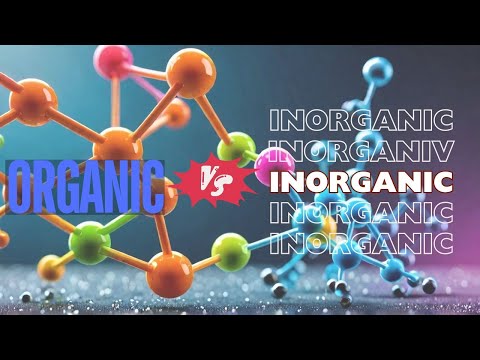
You know, when I was in high school, I thought chemistry was all about mixing stuff in beakers and watching it fizz. Seriously, I had no idea there were two big worlds: organic and inorganic.
It’s like having two favorite ice cream flavors – one is smooth and creamy (that’s organic) while the other is rich and full of minerals (that’s inorganic). Both are awesome in their own way!
But here’s the thing: they’re not enemies. In fact, bridging the gap between them can be pretty mind-blowing. Imagine combining that creamy sweetness with a touch of mineral crunch.
In this chat, let’s explore how these two worlds connect. You might find it more interesting than you ever expected!
Comparing the Complexity of Inorganic Chemistry and Organic Chemistry: Which Field Is More Challenging?
When you think about the world of chemistry, it’s easy to get a little overwhelmed. You got two big players here: inorganic chemistry and organic chemistry. They both have their quirks and complexities, and folks often wonder which one is actually more challenging. So, let’s chat about it.
Inorganic chemistry is all about substances that basically don’t contain carbon-hydrogen (C-H) bonds. We’re talking metals, minerals, and everything that falls out of the organic vs. inorganic category. It deals with a massive range of elements from the periodic table, which means you’re looking at a ton of different compounds—think salts, metals, and even some gases.
Now, organic chemistry, on the other hand, is like a cozy club for compounds that are built around carbon atoms. This field includes everything from gasoline to DNA! A key thing here is the complex way carbon can bond with itself and with other elements; it forms chains and rings that can twist and turn in crazy ways.
But wait—here’s where things get interesting!
It’s like comparing apples to oranges sometimes! Organic gives you these sprawling networks while inorganic sticks fairly close to simple forms but can delve into some heavy-duty stuff like coordination complexes—which are basically coordination numbers that define how many molecules or ions surround a central atom.
And hey, let’s not forget about reactions. Organic reactions often involve multiple steps with mechanisms that require you to predict what could happen at each phase—those little arrows showing electron movement? They’re key! Inorganic reactions might seem straightforward in comparison but can throw curveballs too; transition metals have this way of acting unpredictably due to their electron configurations.
Now consider an emotional angle—I remember when I first cracked open my organic chem book; the symbols looked like hieroglyphs! Yet once it clicked? Total euphoria. That feeling when you put the pieces together? Hard to beat!
So yeah, both fields present unique challenges and complexities. It really depends on your brain style: are you more into intricate structures (hello organic!) or do metal bonds get your gears turning (hey inorganic!)? Each has its own beauty—and challenges—and many find bridging those two worlds super inspiring!
In short:
Ultimately, embrace your curiosity in either realm; they both offer delightful surprises along the way!
Understanding the Distinction Between Organic and Inorganic Compounds in Scientific Research
So, let’s chat about this whole organic and inorganic compounds thing. It’s pretty interesting, and it’s actually a huge part of what scientists study. When you’re diving into chemistry, these two types of compounds pop up all the time.
First off, what makes organic compounds stand out? Well, they’re mostly made up of carbon atoms. Imagine carbon like a building block. These blocks connect in all sorts of ways to form chains or rings with other elements like hydrogen, oxygen, and nitrogen. For example, when you think about sugar (which is a carbohydrate), you’re looking at an organic compound because it has that carbon backbone.
On the flip side, inorganic compounds don’t typically rely on carbon. They can be made of metals and nonmetals and often include minerals from the earth. A classic example is table salt—sodium chloride (NaCl). Here, sodium is a metal and chlorine is a nonmetal. They come together but don’t play around with that carbon we talked about before.
Now here’s where it gets even more intriguing: some compounds blur those lines! Take carbon dioxide (CO2). It has carbon in it, but we categorize it as inorganic because it lacks hydrogen atoms connected to that carbon atom. It’s kind of a rebel in the chemistry world!
Another thing worth mentioning is how these two types interact in scientific research. Scientists often study how organic molecules can react with inorganic ones and vice versa. For example:
- Catalysts: Certain inorganic substances can accelerate organic reactions.
- Biominerals: Some organisms create inorganic materials (like shells) using organic processes.
That interplay is crucial for understanding things like environmental science or even biology! Think about coral reefs; they blend organic components (like coral polyps) with inorganic compounds (like calcium carbonate) to build those stunning structures.
It’s also fascinating how both fields have their own branches! Organic chemistry dives into reactions involving large biological molecules like proteins and DNA. Inorganic chemistry looks at metals, minerals, and everything else that doesn’t fit neatly into the organic category.
Sometimes people wonder why we need both categories in research too. Well, each brings unique insights to different problems! Whether we’re developing new drugs or figuring out ways to clean up pollution, both perspectives are super important.
So there you have it—organic vs inorganic compounds isn’t just some dry topic from your high school days! It’s full of life and real-world applications that matter a lot more than you might think!
Comparing the Challenges of Organic and Inorganic Chemistry: Which Field Poses Greater Difficulty?
Organic and inorganic chemistry are like two sides of the same coin. They both deal with different types of compounds, and each has its own set of challenges. But which one is tougher? That’s a bit tricky, you know? Let’s break it down.
First off, organic chemistry focuses on carbon-based compounds. This area is known for its complexity because carbon can form various bonds and structures. Think about it—carbon can make chains, rings, and a whole bunch of functional groups. This variety means that you have to remember tons of reactions and mechanisms. Some students find themselves lost in the maze of different reaction types like substitution or elimination reactions.
On the other hand, we’ve got inorganic chemistry, which mostly deals with metals, minerals, and coordination compounds. You might think it sounds simpler since these compounds often have more straightforward structures compared to organic ones. But hold on! Inorganic chemistry can get really complex too, especially when you start dealing with concepts like crystal field theory or ligand field theory. These theories help explain how metal ions behave in a compound but can make your head spin if you’re not careful.
Then there’s the problem-solving aspect. Organic chemists often need to visualize molecular structures in three dimensions—a real challenge if you’re not good at spatial reasoning! Inorganic chemists have their own hurdles too; they need to know how different elements interact based on their electronic configurations, which can be tricky.
And let’s not forget about lab work! Organic chemistry labs typically involve lots of hands-on techniques—synthesis procedures that require precision and patience. You might spend hours trying to isolate your product from a messy mixture using chromatography techniques that could test anyone’s nerves. Meanwhile, inorganic labs often focus more on analysis rather than synthesis—chemical characterization methods with some pretty intricate instruments involved.
Sometimes it helps to consider personal experiences as well. Like my buddy who struggled big time with organic reactions but found inorganic bonding theories super exciting! It just goes to show how personal interest really shapes how we see these fields.
In terms of bridging the gap between them—think about organometallic chemistry! This subfield combines aspects from both worlds by studying compounds containing bonds between carbon and metals. It’s where you might see the creativity from organic reactions meet the structure-focused world of inorganic chemistry.
So yeah, in the end, whether you find organic or inorganic chemistry more challenging is pretty subjective! Each field has unique difficulties that can trip you up if you’re not paying attention. It all boils down to what resonates with you more personally. Ultimately though: learn to appreciate both sides for what they bring into this vast world of science!
You know, there’s something pretty cool about the worlds of inorganic and organic chemistry, how they’re like two best friends who don’t quite see eye to eye. Seriously, they both play crucial roles in our understanding of the chemical universe, yet they often feel so different, almost like they belong to separate parties!
When I first stumbled into this topic during my class, I remember feeling totally baffled. I mean, organic chemistry was all about those long carbon chains and vibrant molecules that seemed alive with potential. Then you have inorganic chemistry, mingling with metals and minerals—definitely a more rigid atmosphere! It felt like trying to fit puzzle pieces together from two entirely different sets.
But here’s the thing: despite their differences, they actually depend on each other in many ways. Take catalysis as an example; it’s this incredible process where inorganic substances—like metals—help organic reactions happen faster. So it’s like the two worlds collide in this beautiful dance of transformation! Honestly, it reminds me of that time when I tried to bake cookies with a friend who was all about precision while I just wanted to throw in whatever ingredients sounded fun. We clashed at first but ended up creating something delicious together!
And then there’s biomimicry. This idea shows how we can mimic natural processes—think photosynthesis or enzyme functions—to create new materials or drugs. Here again, it’s a blend of organic compounds doing their thing while keeping solid foundations rooted in inorganic structures.
So yeah, bridging that gap isn’t just some academic challenge; it opens doors for innovation that could change everything from medicine to clean energy solutions. Every time I dive deeper into the interplay between these two fields, I get a shiver of excitement thinking about potential breakthroughs waiting just around the corner.
In a way, embracing their differences can spark creativity and unexpected discoveries. Maybe that’s what it’s all about: pushing boundaries while keeping an open heart and mind to the possibilities right before us! Chemistry is such an amazing language when you really think about it, connecting so many aspects of life—from the tiny particles we can’t see to those big ideas that shape our future!