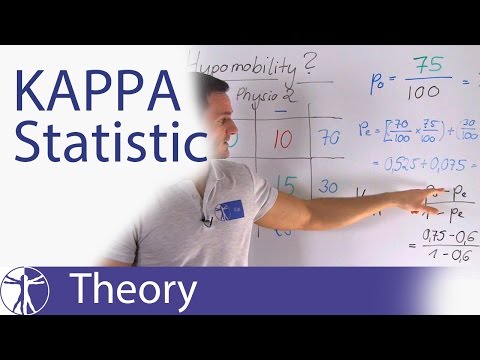
You ever played a game of telephone? You know, where you whisper something to one person, and by the time it gets to the last person, it’s totally jumbled? Well, that’s kinda what happens when researchers try to agree on something.
That’s where this cool thing called the Kappa statistic comes in. It’s like a referee for data. Basically, it helps folks figure out how much agreement there is among them when they’re making assessments or observations.
Imagine two people looking at the same set of data and coming up with different results. Awkward, right? Kappa helps shine a light on that confusion.
So, stick around! We’re gonna break down how this quirky little number works and why it matters in scientific research. Trust me, you’ll never look at data the same way again!
Understanding Kappa: Its Role and Significance in Statistical Analysis and Scientific Research
Kappa is a statistic that plays a big role in measuring agreement or consistency between different observers or raters. You see, when you’re doing research, especially in fields like psychology or medicine, it’s super important to know if everyone is seeing things the same way. This is where Kappa comes into play.
First off, what exactly does Kappa measure? In simple terms, it tells you whether there’s more agreement than what you’d expect by random chance alone. So if two doctors are diagnosing the same patients, Kappa can help us understand how often they agree beyond just luck. Pretty neat, right?
There are different types of Kappa coefficients, but the most common one is Cohen’s Kappa. This one’s used when you have two raters who classify items into categories. Imagine two teachers grading the same group of essays—Cohen’s Kappa would help us see how much they agree on their grades.
Now let’s break it down a bit with some details:
- Value Ranges: The values of Kappa range from -1 to 1. A value of 1 means perfect agreement; 0 indicates no agreement beyond chance; and negative values suggest less than chance agreement.
- Interpretation: Typically, a Kappa value below 0 means poor agreement, between 0 and 0.20 gives slight agreement, and anything above 0.80 is considered almost perfect.
So why do researchers go through all this trouble to compute Kappa? Well, let’s say you’re working on a study about anxiety in teens and have two professionals evaluating symptoms independently. If their assessments only match by luck most of the time (which would show a low Kappa), maybe you’d need to rethink your criteria for classifying those symptoms.
And here’s something interesting: if you’re ever involved in research where subjective judgments come into play—like assessing art or judging performances—Kappa helps validate that “yes,” there really is consensus among experts.
One time while I was working on a project about kids’ reading levels with my buddy who was also an educator, we each rated the same set of students based on their reading fluency. To our surprise (and slight embarrassment), we found out our ratings only agreed moderately according to Cohen’s Kappa! It kind of sparked this hilarious debate about our own biases and made us realize how crucial it was to discuss our criteria before even starting.
In summary, understanding Kappa not only helps improve measurement reliability but sparks discussions among researchers about what they’re actually observing and classifying during studies! It pushes for clearer definitions and better collaboration—and that’s always a win in scientific research! So remember that next time you’re encountering those disagreements with colleagues!
The Importance of the Kappa Statistic in Epidemiological Research: Understanding Agreement Measurement
So, the Kappa statistic, huh? It’s like this cool little tool that helps researchers figure out how much agreement there is between different observers or tests. And in the world of epidemiology, where we’re dealing with health data and trying to understand what’s happening in populations, this can be super important.
First off, what’s Kappa? Well, it’s a number that ranges from -1 to 1. A value of 1 means perfect agreement—like two best friends always thinking the exact same thought. A value of 0 means there’s no agreement at all. If it dips into negative numbers, that’s like saying things are worse than random chance. Yikes!
Why does it matter? Imagine a situation where doctors are diagnosing a disease based on symptoms. If one doctor says a patient has the flu and another says they don’t, you might wonder who’s right. The Kappa statistic helps us see if there’s a consistent way doctors are interpreting those symptoms or if it’s just random guessing.
Here are some key reasons why you should care about the Kappa statistic:
Now let’s throw in an example here to paint the picture better. Picture researchers studying a new outbreak of flu-like symptoms. They set up two teams; Team One uses one guideline for diagnosis while Team Two uses another one completely different guideline. The outcome? They find themselves diagnosing patients differently more often than not! The Kappa statistic would highlight just how bad that disagreement was and push them towards finding more standardized criteria.
A couple of things to keep in mind: First up is that a high Kappa score doesn’t always mean everything’s sunshine and rainbows—sometimes it can mask problems if everyone involved interprets symptoms similarly but incorrectly! Also, context matters; values might mean something different depending on your specific study area or population.
In epidemiological research—where we’re constantly trying to analyze patterns and impacts on health—the Kappa statistic makes sure we’re not just throwing darts at a board hoping to hit something useful! It gives depth to our findings and reassures us (and everyone else!) that we’re making informed decisions based on solid evidence rather than random luck.
So yeah, next time someone mentions the importance of measurement in health research, remember this little statistic hanging out there quietly making sure everything makes sense behind the scenes!
Understanding the Kappa Statistic: A Comprehensive Guide to Its Application in Scientific Research and Data Assessment (PDF)
The Kappa statistic is one of those nifty tools that help researchers figure out how much agreement there is between two or more raters, or even the same rater over time. You know when you and a friend don’t quite see eye to eye on a movie? Well, Kappa puts a number to that kind of disagreement, which can really matter in scientific research.
First off, let’s break down what Kappa actually measures. It’s essentially a statistic that compares the observed agreement between raters with the agreement you’d expect by chance. Sounds simple enough, right? But why would this matter in research? If you’re studying something like how well doctors diagnose a condition, you want to know if they’re truly in sync or just lucky.
The formula for Kappa looks complex at first glance, but it’s not too scary once you get into it. The equation is:
Kappa = (Observed Agreement – Expected Agreement) / (1 – Expected Agreement)
So let’s say two doctors are diagnosing patients and they agree 80% of the time. But just by random chance, they’d agree 50% of the time. That means your Kappa would be:
Kappa = (0.80 – 0.50) / (1 – 0.50)
And voilà! You’ve got a number that tells you how much better they are than random guessing.
Now, what does that number mean? Well, here’s where things get interesting! Generally speaking:
- If Kappa is less than 0, it indicates less agreement than expected by chance.
- A Kappa of 0 means agreement is exactly what you’d expect by chance.
- A score between 0 and 1 shows increasing levels of agreement—higher is better.
- A Kappa above 0.75 often suggests excellent agreement.
Now picture this: You’re conducting research on whether people prefer chocolate or vanilla ice cream. You ask your friends for their opinions and tally their responses. If most agree on chocolate being superior, you’re seeing some solid consensus there! If each friend has wildly different tastes despite being in similar situations—and your Kappa score reflects low agreement—it gives insight into varied preferences among these taste buds.
Another key point to keep in mind is the limitations of the Kappa statistic itself. It’s sensitive to the number of categories you’re using—think about how things can seem totally different if you’re rating something on a scale from one to five compared to just saying “yes” or “no.” Plus, sometimes researchers use weighted versions of Kappa when some disagreements are more “serious” than others.
Take a study where people are rating tumor stages: missing an early stage can have big consequences versus mixing up late-stage tumors might not be as critical in certain contexts—but all ratings count toward getting that final score!
So yeah… while understanding this statistic isn’t rocket science, applying it takes some thought! When used correctly and with context in mind, the Kappa statistic can be an invaluable tool for researchers looking to assess reliability and validity across various studies.
In summary, whether you’re rating movies (which I totally wouldn’t recommend), diagnosing conditions as healthcare professionals do everyday or even sorting flavors at your next ice cream party—the beauty of understanding kappa lies in its ability to quantify agreements and disagreements between ratings with clarity and detail!
You know, I was thinking about the Kappa statistic recently, and how it’s one of those things that often gets lost in the shuffle when talking about research stats. I mean, we all know that data is super important in science, right? But when it comes to measuring agreement between different observers or raters, Kappa steps in like a superhero—except it doesn’t wear a cape.
So, picture this: you’re putting together a team to assess some medical images. You’ve got two doctors looking at the same set of x-rays trying to diagnose a condition. They might have their own opinions based on experience, and sometimes they might not fully agree. This is where Kappa comes into play. It gives you a way to see how much they agree beyond just chance. So if Kappa is really high, like above 0.8 or something, that means they’re on the same page—you can feel pretty good about their assessments!
But here’s the catch—Kappa isn’t perfect. If you ever hear someone raving about it like it’s the Holy Grail of statistics, take a breath and remember: context matters. Sometimes it can be influenced by the prevalence of what’s being assessed and how many categories you’re working with. And let me tell you, realizing that was like when I found out my favorite wool sweater wasn’t machine washable—I had to rethink some things.
Once I sat down with a cup of coffee and dug deeper into Kappa’s quirks, it clicked for me why researchers should tread carefully with it. You don’t want to flat-out trust what Kappa says without understanding its limitations! It’s kinda like relying solely on spell check—you still need your own brainpower to catch those sneaky typos.
The beauty of all this is knowing that Kappa allows scientists to be more transparent about their findings. By evaluating how well different people hit that agreement mark, researchers can build trust in their results and maintain credibility in their work.
So yeah, next time you’re knee-deep in data or maybe just chatting about research methods over coffee with friends, consider bringing up Kappa! It could spark a fun conversation about the challenges we face when trying to find clarity amidst all those numbers and opinions floating around.