You know that feeling when you get a bunch of friends together for game night, and everyone’s score is all over the place? Some are rocking it, while others barely scrape by. That’s kind of what population standard deviation does for data—helps us understand just how wild or chill things really are.
So imagine you’ve got fifty people trying to guess how many jellybeans are in a jar. Some guess low, some way high! The population standard deviation is like that little buddy who tells you, “Hey, it’s not just about the average—look at how everyone guessed!”
In scientific research, this number is a big deal. It helps to make sense of the chaos and shows how closely people’s answers stick together—or don’t. It’s all about finding patterns in the madness, right? Let’s chat more about it!
Understanding Population Standard Deviation: Key Insights for Scientific Analysis and Data Interpretation
Understanding population standard deviation can feel a bit dense at first, but it’s really just a fancy way of talking about how spread out your data is. You know when you have a bunch of numbers and you want to see how they compare to each other? That’s where this comes in.
So, let’s break it down. The **population standard deviation** measures the amount of variation or dispersion in a set of values. It tells you how much the individual data points differ from the mean (which is just the average). If all those numbers are pretty close to that average, the standard deviation will be small. But if they’re all over the place? Well, you guessed it—a bigger standard deviation.
Now, why do we care? Think about it like this: say you’re studying test scores for a class. If most students score around 75, but a few score really low or really high, that difference is important! The population standard deviation would help show just how tightly those scores are clustered around the average score.
To calculate it isn’t as scary as it sounds! First, you find the mean of your data set. Then subtract that mean from each number to find out how far each one is from that average. Next, square those differences (to get rid of negative numbers), and then find their average — this gives you what’s called **variance**. Finally, take the square root of that variance and boom! You’ve got your population standard deviation.
Here’s a quick rundown:
- Mean: Average of your data.
- Differences: How far each number is from the mean.
- Variance: Average of squared differences.
- Standard Deviation: Square root of variance!
Let me share an example that’s pretty relatable. Imagine you’re tracking daily temperatures in your city over a month. If most days hover around 70 degrees but some days spike to 90 or drop to 50, understanding those fluctuations helps you prepare more effectively for various weather conditions—kind of like knowing whether to wear shorts or bring an umbrella!
When scientists look at data in research, having a solid grasp on population standard deviation often becomes crucial for interpreting results accurately. It informs conclusions about trends and patterns which can significantly influence their findings.
In short, mastering population standard deviation not only sharpens your analytical skills but also enhances your ability to communicate what those numbers really mean in real-world situations—bringing clarity where confusion often reigns!
Understanding the Role of Standard Deviation in Scientific Research: Applications and Importance
So, let’s chat about standard deviation, shall we? It’s like that trusty friend who helps you understand how spread out your data is—kinda like checking how different the scores are on a test taken by a whole bunch of students. When you look at a bunch of numbers, they can either be really close together or all over the place. Standard deviation helps you measure that spread.
First off, what exactly is standard deviation? You’ve got this thing called the mean, which is just the average of your data. Now, the standard deviation tells you how much, on average, each number differs from that mean. If your standard deviation is low, it means most of your data points are pretty close to the mean. A high standard deviation shows more variation in your data.
You might be wondering why this even matters in scientific research. Well, think about it: if you’re studying something like plant growth under different lighting conditions, knowing how consistent (or inconsistent) your results are could totally change interpretations. Like, if one light source gives really varied results compared to others, that’s important information!
- Applications in Research:
- In psychology studies, researchers often look at test scores or response times to see how varied their subjects are reacting under certain conditions.
- In medicine, when testing a new drug, scientists monitor side effects and effectiveness across various patients—standard deviation helps show whether most patients respond similarly or not.
- When analyzing environmental data—like temperature changes—the standard deviation can help indicate stability or volatility over time.
Let’s say you have two sets of data: one with heights of 10 friends and another with heights of 10 professional basketball players. Your friends might have heights ranging from 5’2” to 6’0”, while the basketball players could range from 6’4″ to 7’1″. Here’s where standard deviation kicks in! The friends may have a smaller standard deviation because their heights are closer together than those of the basketball crew.
Now comes the fun part: visualizing this! In graphs or plots—like histograms—you can see bell curves where most data huddles around the mean and tails off towards extremes. A narrow curve implies small standard deviation; a wider curve shows more variation. Without taking note of these patterns through standard deviation, researchers could misinterpret their findings.
The feeling when you finally wrap your head around this concept? It’s pretty rewarding! It’s like solving a puzzle and realizing that those little differences matter big time in making conclusions from research. So next time you’re crunching some numbers for an experiment or study… keep an eye on that standard deviation—it’s much more than just a number!
Mastering Population Standard Deviation: A Comprehensive Guide for Data Analysis in Scientific Research
So, let’s chat about population standard deviation. It’s a fancy term, huh? But don’t worry, it’s not as scary as it sounds. Basically, it’s a way to measure how spread out the numbers in a whole population are. If you think of it like a big family gathering, the standard deviation gives you an idea of how much everyone varies from the average height or age.
What is Standard Deviation?
Just to get on the same page, standard deviation quantifies how much individual data points differ from the mean (or average). It tells you if your data is all bunched up closely around the mean or if it’s scattered all over the place.
Why Should You Care?
Well, this matters in scientific research because being able to measure variability helps researchers understand their data better. If you have two groups—say, one taking a new medication and another on a placebo—the standard deviation tells you whether the results are consistent across both groups or if they’re all over the place.
The Formula
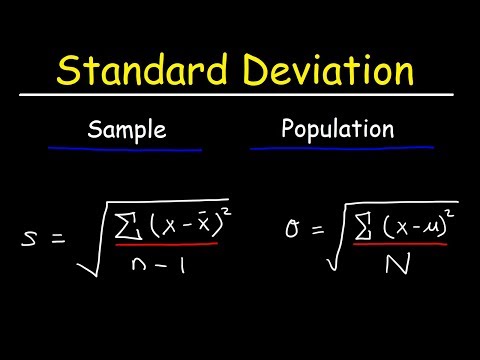
Okay, so here’s where things can get a little mathy. The formula for population standard deviation looks like this:
Sigma (σ) = √(Σ(xi – μ)² / N)
Now let’s unpack that!
- Σ means “sum of”—you’ll be adding things up.
- xi is each individual data point.
- μ is the mean—the average of your dataset.
- N is the total number of data points in your population.
It sounds complicated, but let’s break it down with an example. Say you have five friends who scored 70, 75, 80, 85, and 90 on a test. First step? Find that mean! Add them up (70 + 75 + 80 + 85 +90 = 400), then divide by 5 friends:
400 / 5 = **80** – that’s your mean.
Next step? You’ll subtract each score from that mean and square it:
(70 – 80)² = **100**
(75 – 80)² = **25**
(80 – 80)² = **0**
(85 – 80)² = **25**
(90 – 80)² = **100**
So now you’ve got those squared differences:
- 100
- 25
- 0
- 25
- 100
Add those babies up! That gives us (100 + 25 + 0 + 25 +100 = **250**).
Now divide that sum by N (which was our friend count of five):
250 /5 = **50**.
Finally take the square root of that result to find the population standard deviation:
√50 ≈ **7.07**
This means scores tend to be about ±7.07 points away from our mean score.
The Bigger Picture:
In research settings, knowing how spread out your data is helps with making decisions about treatments or understanding behaviors in populations. A smaller standard deviation indicates more consistency in results while a larger one suggests variation which could lead to different interpretations or further investigations.
So there you have it! A basic rundown on mastering population standard deviation—like having your own mathematical compass while navigating through data analysis in scientific research! It’s pretty neat once you get a hang of it; really makes sense when you’re diving into big pools of numbers and trying to pinpoint what they actually mean for your study!
Alright, let’s chat about something that might sound a little math-y at first—population standard deviation. But don’t worry, I promise this will be more interesting than it sounds!
So, picture your favorite TV show or a super fun game night with friends. Everyone’s laughing, having a blast, and you decide to track how many laughs each person has in an hour. You might end up with some people cracking up multiple times, while others are just chuckling here and there. Now, wouldn’t it be cool if you could figure out how much laughter varies from person to person? That’s where the standard deviation comes into play—it’s all about measuring that variability.
When researchers collect data from a population—let’s say they’re studying the height of all the eighth-graders in a city—they’re not just looking for average height. They want to understand how different everyone is from that average height. Do most kids hover around it? Or are there some tall giants and tiny tots skewing the numbers? Enter population standard deviation! It gives scientists a way to quantify this spread.
I remember working on a school project where we measured how long it took everyone to finish a puzzle. Some folks zoomed through it while others took their sweet time fiddling with pieces. We calculated our own little standard deviation for fun and discovered who the puzzle pros were versus the puzzlers who needed more practice! It was like uncovering hidden talents.
But here’s the thing: understanding this concept isn’t just about crunching numbers for scientists; it’s about making sense of real-world situations too. For instance, in public health research, knowing how much disease rates vary can help allocate resources better. Or in finance, standard deviation can show us which investments are riskier. You add up all this information, throw in some percentages and voilà! You start seeing patterns that help make better decisions down the line.
Now don’t get me wrong—statistical stuff can feel daunting sometimes (I mean, who likes wrestling with formulas?). But at its core, it’s really about telling stories with numbers. When you understand population standard deviation, you’re not just examining facts; you’re unlocking deeper insights into human behavior and natural phenomena.
So next time you’re munching on popcorn while watching your favorite show or chatting with friends during game night, remember: every laugh or puzzle piece is part of an intriguing dance of data waiting to be understood! And as long as we keep asking questions and seeking answers through numbers like the standard deviation, we’ll continue finding meaning in our complex world.