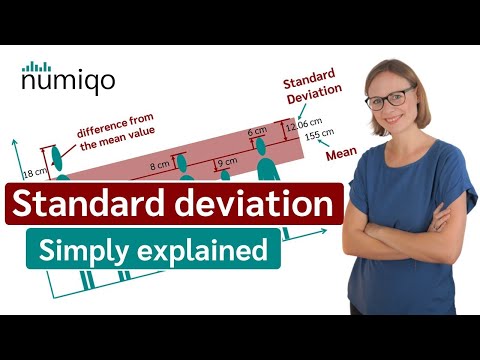
You know that feeling when you’re at a party, and someone shouts out the average height of people in the room? Suddenly, it’s like everyone’s measuring themselves against that number. Kind of hilarious, right? But here’s the twist: averages can be super misleading!
Imagine you’ve got a group of pals who all hit the gym regularly—except for one buddy who just joined and is, well, way shorter than everyone else. If you just look at averages, it creates a weird picture. Enter the mean standard deviation!
This little gem helps us see how much everyone’s heights vary from that average. It’s like zooming out to get the full view of your crew. Seriously, once you grasp this concept, everything starts to make more sense in science and research.
So let’s chat about why this is such a big deal! You’ll see how it plays into so many things we encounter every day.
The Significance of Mean and Standard Deviation in Scientific Research: Enhancing Data Analysis and Interpretation
So, let’s chat about mean and standard deviation—two buddies that really help us understand data in scientific research. You know, when scientists collect data, it’s like gathering pieces of a puzzle. But what do you do with all those pieces? That’s where the mean and standard deviation come in. They help to make sense of things.
First off, the mean. It’s just a fancy word for the average. If you took a math test and scored 70, 80, and 90, you would add those numbers together (that’s 240) and then divide by how many scores there are (which is 3). So your mean score would be 80. Simple enough, right? This number gives you a snapshot of where most of your data hangs out.
Now, let’s move on to standard deviation. This one’s a bit more complex but super important. Basically, it tells you how spread out the numbers are around that mean we just talked about. If everyone in your class scored around 80 (like between 75 and 85), you’d have a low standard deviation because not much variation is going on. But if some people scored really low while others aced it—let’s say scores ranged from 50 to 100—the standard deviation would be high. This is helpful because it shows how consistent or variable your results are.
- The mean gives you an idea of central tendency.
- The standard deviation shows variability in your data.
- Together they provide context: Are results clustered closely or widely apart?
Let me tell you something personal: when I started learning statistics in school, I remember feeling lost at times. Like trying to catch smoke with my bare hands! But once I figured out what these terms meant and how they worked together… oh man! It was like flipping on the lights in a dim room! I could see patterns where I couldn’t before.
Now think about science experiments—you know those cool ones where researchers might test new medicines or study nature? Using mean and standard deviation helps scientists determine if their findings are significant or if they just got lucky. If researchers find that people taking a new drug have an average improvement with a tiny standard deviation, it means most people benefited pretty equally from it! On the flip side, if there was huge variation in responses—that’s something scientists need to look at closely; could be something funky going on there!
So why does all this matter? Well, without understanding these concepts…
- Your conclusions might be off.
- You might overlook important trends.
- You risk making bad decisions based on incomplete info!
In short, both mean and standard deviations are fundamental tools for any scientist analyzing data—I can’t stress this enough! They’re not just numbers; they tell stories about what’s happening under the surface.
So next time you’re looking at some research data or even your own test scores—remember these two pals cheering you on from behind the scenes! They can make all the difference in understanding what those numbers really mean.
Understanding When to Use STDEV.P vs. STDEV.S in Scientific Research
When you’re diving into scientific research, the means of measuring variability becomes super important. You know, it’s like trying to understand how different your data points are from the average. That’s where standard deviation comes in. But here’s where things get interesting: you have two versions to choose from—STDEV.P and STDEV.S. So, when do you use each one?
STDEV.P, or the population standard deviation, is for when you have data that represents an entire population. Imagine this: you measured the heights of every single student in your school. If you’re basing your calculations on all those heights, then you’re dealing with a population! Use STDEV.P because your data covers everyone.
On the flip side, we’ve got STDEV.S, which stands for sample standard deviation. This one’s for those times when you only have a part of a larger group—for example, if you measured just a few students’ heights from different grades. Since you don’t have all the data from every student, STDEV.S is what you need here.
- Use STDEV.P: When your data set includes the whole population.
- Use STDEV.S: When your data set is just a sample of a larger group.
You might be wondering why it even matters which one to use. Well, it all comes down to accuracy and bias. If you’re working with a sample but use STDEV.P, you’re likely underestimating how much variety exists in that wider group! It’s like thinking that all ice cream flavors are vanilla just because that’s what you’ve tasted at one shop.
A lot of folks sometimes confuse these two and end up making off calculations without realizing it. So think about this: let’s say you conducted an experiment looking at plant growth over time across various conditions. If your experiment only tested ten plants out of hundreds possible in an entire greenhouse, using STDEV.S will give you more reliable results since it’s tailored for samples.
Another tip? It helps to remember that these calculations are critical when publishing research findings or presenting data findings because they affect how confident others can be in your conclusions!
The bottom line? Knowing when to use STDEV.P vs. STDEV.S is key for getting accurate insights into your research data! Understanding whether you’re capturing a whole population or just sampling helps ensure that what you’re reporting reflects reality as closely as possible.
I mean, science isn’t just numbers; it’s about telling the story behind those numbers accurately and responsibly! So keep this handy next time you’re knee-deep in calculations—you’ll thank yourself later!
Understanding the Role of Standard Deviation in Scientific Research and Data Analysis
Alright, let’s chat about standard deviation. It might sound a bit math-y at first, but don’t worry! I’ll break it down for you.
So, when scientists collect data, they’re usually trying to find something out—like how tall the average flower is in a garden or how long it takes for a chemical reaction to occur. They often start with something called the **mean**, which is just a fancy way of saying “average.” You know, you add up all the numbers and then divide by how many there are.
But here’s the kicker: just knowing the mean doesn’t tell you everything. That’s where **standard deviation** comes into play. Basically, it tells you how spread out or clustered your data points are around that mean.
Imagine two classrooms: one where everyone is about 5 feet tall and another where students range from 4 to 6 feet and everywhere in between. Both have the same average height, but the *spread* of heights tells a different story! Here’s where standard deviation helps:
- Low Standard Deviation: If your data points are close to the mean, like those kids all hanging around 5 feet, you have a low standard deviation.
- High Standard Deviation: If your data points are really spread out, like our second classroom with kids at every height from 4 to 6 feet, you have a high standard deviation.
So why is this important? Well, think about it. If you’re testing a new medicine and everyone reacts differently—that high standard deviation could signal that some folks might be having really different experiences than others. This variation might lead researchers to dig deeper.
Let’s say you’re studying plant growth after watering them with different fertilizers. You find that one fertilizer gives an average height of 10 inches but has a super high standard deviation because some plants grow only 5 inches while others shoot up to 15 inches! That means… well, you’ve got variability here that could impact your results significantly.
Another thing worth noting: sometimes researchers want to compare groups. If one group has results that cluster tightly (low standard deviation) while another group spreads all over (high standard deviation), it can suggest that there may be external factors affecting one group more than another.
So remember: standard deviation is like giving context to your average value; it shows if your data is reliable or if you’ve got some wild variations going on.
Finally, when presenting research results, including both mean and standard deviation helps other scientists understand not just *what* happened but also *how reliable* those findings are. It’s like telling someone you had great pizza for dinner—but if they don’t know whether their slice was undercooked or loaded with toppings too—it doesn’t help much!
In short, standard deviation keeps us grounded in reality; it’s an essential piece of scientific analysis that offers clarity amid numbers and stats!
Alright, so let’s chat about something that pops up a lot in science, and honestly, in everyday life too: the mean and standard deviation. Sounds like math talk, but hang with me for a sec.
Picture this: you’re at a birthday party. There’s cake, balloons, and all your friends are there. You take a look around and think about who’s taller or shorter than the group average—it’s kind of like finding the “mean.” The mean is just the average of all those heights. You add everyone’s heights together and divide by how many people are there. Easy enough, right?
Now, here comes the interesting part—the standard deviation. Imagine you have two groups of friends at different parties. In one group, everyone’s about the same height—let’s say between 5’5” and 5’7.” In another group, some friends are 6’2” while others are 4’11”. When you calculate the standard deviation for both groups, you’d find that the second group has a really high standard deviation because everyone’s heights vary so much!
So why does this matter? In science, understanding these two concepts helps researchers make sense of data—it’s like putting all those pieces of a puzzle together to see what picture they create. If we only look at the mean without considering how much things vary (the standard deviation), we could totally misinterpret what we’re studying.
I remember back in school during a science fair when I presented my findings on how different plants grow with varying amounts of sunlight. I had all my data laid out—means here and there—but got super tangled up in what those numbers meant! My teacher pointed out that although my average plant height was impressive, I hadn’t really looked at how varied those heights were; some plants thrived while others barely grew at all! That moment stuck with me because it hit me—just looking at averages can give you an incomplete story.
In scientific analysis or any research for that matter, knowing both the mean and the standard deviation gives us context to understand our findings way better. It tells us if our results are consistent or if there are wild variations. And hey, this concept carries over into so many parts of life—like figuring out your grades after an exam or even gauging your performance in sports.
So remember next time you’re crunching numbers or analyzing something: it’s not just about finding that average; it’s also about seeing how much everything else bounces around it! It makes data more human—more relatable—which is pretty cool if you think about it!