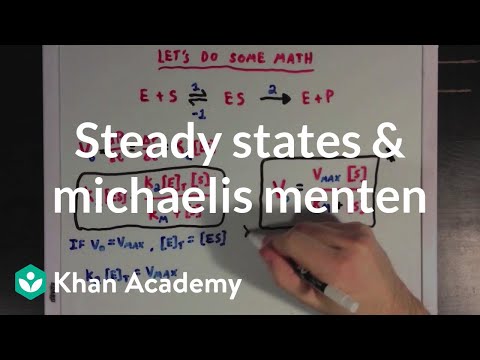
You know that moment when you’re starving, and you can smell food cooking? You hit that point where you just can’t wait anymore. That’s kinda like how enzymes work in your body – they’re all about speed and efficiency!
So, here’s the deal: Michaelis-Menten kinetics is this really cool way scientists figured out how enzymes do their thing. It’s like the recipe book for understanding how quick they react with substrates, which are basically the ingredients these enzymes work with.
Imagine baking a cake. If you throw in too much flour or sugar, it won’t rise properly, right? Enzymes need just the right conditions to do their job! This whole concept helps us understand everything from digestion to drug interactions.
So grab your favorite snack (trust me, you’ll need it), and let’s chat about why Michaelis-Menten kinetics is such a big deal in biochemistry.
Understanding the Michaelis-Menten Plot: A Key Concept in Biochemical Kinetics
So, let’s chat about the Michaelis-Menten plot. You might’ve heard this term tossed around in biochemistry classes or even in some science documentaries. The whole thing is super exciting, so buckle up!
The Michaelis-Menten equation is like a secret handshake for biochemists. It describes how enzymes work to speed up reactions by interacting with substrates. Basically, when an enzyme meets its substrate, they form a complex that helps convert the substrate into products. It’s a bit like a dance where both partners need to be in sync!
Now, here’s where the plot comes into play. The Michaelis-Menten plot graphs the rate of reaction against the concentration of substrate. Imagine plotting how fast your favorite cake bakes as you add more sugar—pretty neat, right?
When you look at the curve on this plot, it’s pretty cool! At first, as you increase substrate concentration, the reaction rate goes up. But then it starts to level off and reach a plateau. This leveling off happens because there are only so many enzyme active sites available to bind with substrates.
Now, let’s break down some key points:
So why does this matter? Well, understanding Michaelis-Menten kinetics helps scientists predict how enzymes will behave under different conditions—like when you’re baking that cake at different temperatures or humidity levels!
Here’s something interesting: If anyone ever asks you why we measure enzyme kinetics or why it’s crucial for drug design… well, here’s your answer! Knowing Km and Vmax aids in figuring out how drugs can inhibit certain enzymes related to diseases.
In summary, grasping the Michaelis-Menten plot isn’t just useful; it’s essential for many areas of research and industry! Whether you’re into pharmaceutical development or just love cooking experiments in your kitchen, this stuff connects right back to real-world applications! So next time you’re mixing ingredients or contemplating biochemical reactions—remember those enzymes doing their thing!
Leonor Michaelis: Pioneering Contributions to Biochemistry and Enzyme Kinetics
Leonor Michaelis was a remarkable scientist, and her work played a key role in biochemistry. You might have heard her name in connection with something called “Michaelis-Menten kinetics.” But what does that actually mean? Let’s break it down.
Michaelis was born in 1875 in Germany and had this passion for science from an early age. She studied medicine and became especially interested in how enzymes work. Enzymes are like tiny workers inside our cells, helping to speed up chemical reactions that keep us alive. But how do we really understand how they do their job?
In the early 1900s, Michaelis teamed up with another scientist named Maud Menten. Together, they developed a mathematical model that describes enzyme activity very clearly. Their equation helps us figure out how quickly an enzyme can convert a substrate (the substance it acts on) into a product.
The whole idea is based on two main factors: the concentration of the substrate and the enzyme’s efficiency. To put it simply:
- The more substrate you have, the faster the reaction happens—up to a point.
- That point is when all the enzyme’s busy working, and adding more substrate won’t speed things up anymore.
Michaelis-Menten kinetics gives us two important values: **Vmax** (the maximum rate of reaction) and **Km** (the substrate concentration at which the reaction velocity is half of Vmax). The **Km** tells us about an enzyme’s affinity for its substrate; if it has a low Km, it means the enzyme grabs onto its substrate tightly.
One time I read about how Michaelis faced challenges as a woman in science during her time. It must’ve been tough to be taken seriously! Yet she didn’t let that stop her from making incredible contributions. Her work laid foundations that help scientists today understand everything from metabolism to drug design.
Another cool thing about her findings? They’re not just applicable in labs! For example, when doctors prescribe medication, they often consider how enzymes will interact with those drugs based on Michaelis-Menten principles.
So yeah, Leonor Michaelis helped shape our understanding of enzymes through her pioneering work! Today, we still rely on her ideas to unravel new mysteries in biochemistry and medicine alike. It’s amazing to think how one person’s work can have such lasting effects—don’t you think?
Understanding the Michaelis-Menten Equation: Key Insights into Enzyme Kinetics in Biochemistry
The Michaelis-Menten equation is one of those things in Biochemistry that might sound super complex, but it really isn’t. If you take a moment to go beyond the terminology, you’ll see how crucial it is for understanding enzymes, those nifty little biological catalysts.
So, basically, the Michaelis-Menten equation helps us understand how enzymes work when they interact with substrates—the molecules that undergo a reaction. The equation looks something like this:
v = (Vmax [S]) / (Km + [S])
Where:
Okay, now let’s break that down a bit more. Imagine you’re baking cookies. At first, when you add flour (your substrate), your dough comes together nicely and quickly. But as you keep adding flour, there comes a point where it’s just too much for your mixing bowl—you can’t mix any more flour into that dough! That’s kind of like reaching Vmax in enzyme reactions.
Now, what about Km? This is where it gets interesting! If your mixing bowl requires just a tiny bit of flour to get started mixing effectively, that means you have a low Km. It’s almost like saying your bowl works well with just a sprinkle of flour. But if it takes loads and loads of flour to even get started—then voila! You have a high Km.
So why should we care? Well, understanding these concepts matters not only in basic science but also in medicine and drug development. Think about it: if researchers know the Km value for an enzyme related to a disease process, they can design better drugs to inhibit or enhance its activity.
Here’s another neat thing: this model assumes that once the substrate binds to the enzyme, it forms an **enzyme-substrate complex**—kind of like two dance partners finding their rhythm before moving on to create products together. The whole thing can be visualized as steps in a dance routine; first one partner joins (the substrate), then they groove together for while (the complex), and finally they produce something new!
But here’s where life gets tricky: not all enzymes follow this simple model perfectly. Some enzymes display what we call **allosteric regulation**, where their activity changes depending on other factors—like having another dancer enter the stage and change how everyone moves.
In sum, mastering this equation opens doors into deeper discussions about enzyme behavior and helps explain many biochemical processes—everything from digestion to energy production in cells! So next time you’re munching on some pizza or feeling energized after class because of that sugar rush from candy bars—just remember: there’s more happening behind those scenes than meets the eye!
Isn’t science wild sometimes?
So, let’s chat about Michaelis-Menten kinetics. It sounds super fancy, right? Like a term you’d toss around at a cocktail party to impress people. But honestly, it’s one of those concepts that can really help you understand how enzymes work in our bodies. And trust me, it’s actually quite interesting once you get past the science-y jargon.
Now, think back to that time when you were baking cookies with a friend. You know how adding too much flour can throw off the texture? Enzymes work similarly but with chemical reactions! Basically, these little guys help speed things up in our cells. Michaelis and Menten laid down the foundation for understanding this process back in 1913, which—wow—feels like ages ago!
They figured out that there’s this relationship between how fast an enzyme works and the concentration of a substrate—the stuff it’s acting on. It’s like trying to have a good conversation when there are tons of distractions; you might struggle to focus when everything around you is chaotic! There comes a point where adding more substrate doesn’t make things go faster; it just saturates the system.
One time, I was trying to cram for exams and ended up bingeing on coffee and snacks. At first, I was super energized—ready to tackle everything in sight! But after some time, my brain felt like it hit its limit. That’s kind of what happens with enzymes too! They have their maximum limit where they operate most efficiently before they just can’t keep up anymore.
The whole Michaelis-Menten model gets more complex when you consider all these factors affecting enzyme activity—like temperature or pH levels. It’s a reminder of how delicate life is; every small change can mess with the balance.
So yeah, while Michaelis-Menten kinetics may seem technical at first glance, it’s really about understanding life at its most fundamental level: those tiny interactions that keep us alive and kicking. And honestly? That’s pretty cool if you ask me!