You know, I was hanging out with some friends the other day, and we got into one of those classic “who would win” debates. You know the type — like, who’s more powerful, sunlight or chocolate? (After some serious discussions, chocolate definitely won!) Anyway, it got me thinking about how energy and heat work in our everyday lives.
That’s where thermodynamics comes in. It’s kinda like magic, but with numbers and science instead of wands and spells. One thing that really stands out in this energetic world is the Legendre transform. Sounds fancy, right? But trust me, it’s not as confusing as it seems.
The Legendre transform helps us flip between different ways of looking at energy — kind of like changing perspectives during a good movie twist. It helps scientists and engineers make sense of things in a way that can be super useful across various fields. So if you’re curious about how this transformation works and why it matters, stick around!
Understanding the Legendre Transformation in Thermodynamics: Concepts and Applications in Physics
The Legendre transformation is a mathematical tool that plays a huge role in thermodynamics. It’s one of those concepts that sounds pretty intimidating at first, but don’t worry; I’ll break it down for you!
You know how in thermodynamics we often deal with different types of energy? Like, we have internal energy, which is basically the energy stored in a system due to its temperature and molecular structure. The cool part about the Legendre transformation is that it helps us switch between different “views” of these energies depending on what we want to analyze. So instead of sticking to just one form, we can shift perspective.
One common application of this transformation is when we move from **internal energy (U)** to **enthalpy (H)**. You see, enthalpy is handy when you’re working with processes occurring at constant pressure, while internal energy is more about constant volume situations. Using the Legendre transformation makes this switch easy and keeps our equations clean.
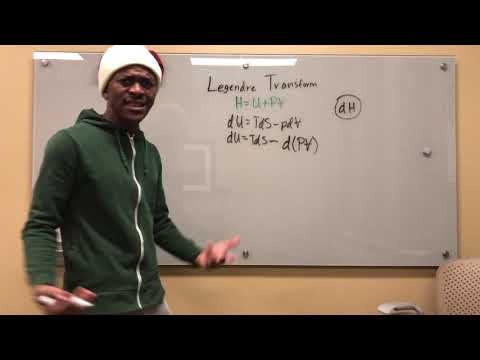
When you apply the Legendre transformation to internal energy, you can express enthalpy like this:
H = U + PV
Here, P is the pressure and V is the volume. What happens here is you’re adding work done on or by the system (PV term) to the internal energy.
Now let’s talk a bit about what this means practically. Imagine you’re cooking pasta. When you’re heating up water, you’re watching those molecules get excited—their internal energy goes up. If you’re doing this on a stove where pressure isn’t changing much (classic pot on fire), using enthalpy makes sense because you can easily track how much heat you’ve added without getting tangled up in all those other variables.
Another cool example involves moving from **Gibbs free energy (G)** to **Helmholtz free energy (F)** using similar transformations. Gibbs free energy shifts focus based on temperature and pressure conditions where work isn’t as straightforward as just volume changes.
F = U – TS
In this case, T stands for temperature and S represents entropy—basically measuring disorder within a system!
The beauty of these transformations lies not just in their elegance but also in their versatility across various applications! You can tackle problems involving phase changes, chemical reactions—really anything that deals with heat exchanges or state changes! It allows us to find stable equilibrium points or understand critical phases in systems more intuitively.
You may feel it’s complex stuff sometimes; trust me, I get it! But once you start playing around with these ideas and equations, they become quite intuitive—like figuring out how to balance your checkbook after being confused by finances for ages!
So as you’re exploring thermodynamics further, keep the Legendre transformation in your toolkit! It’s an essential stepping stone toward understanding how different physical properties interact and change under various conditions. You might end up finding it’s one of those things that makes many concepts click into place when dealing with thermal systems!
Understanding the Applications of Legendre Transform in Advanced Scientific Research
Alright, let’s chat about the Legendre Transform! You might be wondering, “What’s that all about?” Well, basically, it’s a powerful mathematical tool that helps us relate different quantities in thermodynamics and physics. It’s like having a secret key that opens up several doors in advanced scientific research.
So, what’s the deal with it? The Legendre Transform takes a function—let’s say energy—and transforms it into another function that tells you about something else, like entropy or temperature. This technique is super handy for switching between different types of variables in physical systems.
Now, here are some cool applications of the Legendre Transform:
- Thermodynamics: You know how everything around us has energy? In thermodynamics, we often start with internal energy as a function of entropy and volume. But if we want to find out pressure or temperature instead, we can use the Legendre Transform! It switches our viewpoint.
- Phase Transitions: When materials change states—like water freezing into ice—the Legendre Transform helps describe these phase transitions better. It lets scientists analyze how different conditions affect material properties.
- Statistical Mechanics: Ever thought about how particles behave in systems? The Fourier Transforms and Legendre Transforms help define things like partition functions. These functions are essential for understanding macroscopic properties from microscopic behaviors.
- Quantum Mechanics: In quantum physics, often you’re dealing with wave functions and probabilities. The Legendre Transform can be useful when switching between different representations of quantum states.
To put this in perspective: imagine sitting around a campfire with your friends. You’re trying to explain how hot the fire feels compared to the heat you’d feel on your skin or even how much wood you need to keep it going. Each friend has their own way of describing it—some talk about warmth while others talk about firewood needed! The Legendre Transform helps us articulate these varied perspectives using solid scientific terms.
Just like that campfire conversation, science loves variety! So when researchers need to switch gears from one sort of measurement to another—say from energy descriptions to momentum descriptions—the Legendre Transform is there to save the day.
In summary, this transformation isn’t just math-speak; it’s an essential bridge connecting various physical quantities across different fields. Whether it’s diving deep into thermodynamics or exploring quantum states—the impacts are vast! So next time you hear someone mention the Legendre Transform, you’ll know it’s more than just fancy jargon; it’s like a multi-tool for scientists tackling complex problems head-on!
Exploring the Applications of Legendre Equation in Scientific Research and Technology
The Legendre equation? Yeah, it sounds technical, but once you break it down, it’s kind of cool. This equation pops up in various scientific fields, especially in thermodynamics, where it helps keep things in balance.
So, what is the Legendre Transform? It’s basically a mathematical tool that allows you to switch between different variables. For instance, if you’re working with energy and want to see how pressure influences your system instead, the Legendre Transform lets you do that without losing any crucial information. Think of it as switching lenses on a camera to get a different but clearer view of your subject.
In thermodynamics, this transform comes into play when dealing with objects like engines or refrigerators. For example, consider an engine that runs on heat. The relationship between heat and work done can be tricky! By using the Legendre Transform, we can switch from looking at internal energy to entropy (which is all about disorder and energy dispersal). This makes calculations easier when figuring out how much work your engine can produce under specific conditions.
Now let’s get into its applications!
- Statistical Mechanics: Here’s where you can really see the Legendre equation shine! In statistical mechanics, the transforms help connect microstates (small configurations) and macrostates (big-picture behaviors). You know how flipping a coin gives you heads or tails? The Legendre Transform helps analyze all possible outcomes in a system!
- Black Hole Thermodynamics: Yeah, seriously! In this field, scientists use Legendre Transforms to explore properties like entropy and temperature in black holes. I mean, imagine studying something so mysterious while using mathematical tools that appear quite elegant!
- Quantum Mechanics: Another wild world where these equations come into play. They help in switching between different physical quantities in complex systems. This simplification makes things manageable when calculating probabilities and interactions.
- Economics: Believe it or not! Economists borrow concepts from thermodynamics thanks to the transformations’ ability to clarify relationships between variables like cost and revenue. Understanding these connections can influence market strategies!
So why do we care about all this? Well, without understanding transformations like these in thermodynamics and beyond, making sense of complex systems would be next to impossible. It’s like trying to cook without knowing the temperature settings—you’re left guessing!
I remember back in college when I first encountered Legendre Transforms during a particularly tough thermodynamics class. At first glance? Purely intimidating! But then my professor broke it down with everyday analogies—like switching recipes depending on what’s fresh at the market—and suddenly everything clicked! That moment made me realize how interconnected math is with real-world phenomena.
In summary, while the Legendre equation might sounds niche or overly academic at first glance—it truly has practical importance across various fields of science and technology. It’s like this hidden gem that shines brightly once you understand its potential applications!
You know, thermodynamics can be a bit of a puzzle sometimes. I remember sitting in my college class, staring at equations and trying to make sense of it all. One day, we were introduced to something called the Legendre transform. At first, it sounded like a fancy term straight out of a math book and not really related to my cozy thoughts about heat engines or refrigerators. But the thing is, it’s actually pretty fascinating once you start peeling back the layers.
So, the Legendre transform is this cool mathematical tool that helps us switch between different types of thermodynamic variables. Imagine you’re trying to bake cookies and you have a recipe that lists ingredients in terms of cups of flour but your measuring cup holds ounces—totally annoying but relatable, right? The Legendre transform lets us convert our variables so we can use what’s handy. In thermodynamics, we often deal with energy and entropy or temperature and volume—each one has its uses depending on what we’re looking at.
When you start digging into applications, things get even cooler! For instance, it helps with calculating work done by systems under varying conditions or converting different potentials like internal energy or Helmholtz free energy into something more usable for your calculations.
But here’s where it gets neat—using the Legendre transform opens up new ways to analyze processes or systems in physics and chemistry that might seem complicated at first glance. You can easily switch gears from focusing on energy used to understanding temperature effects by just transforming your variables!
Still, I’ll admit there are times when I’ve felt lost in all those equations. Yet each time I figured out how to navigate through them with concepts like the Legendre transform made me appreciate just how interconnected everything is in thermodynamics. It all hinges on this beautiful dance between heat and work—the core of our universe’s mechanics.
So yeah, this mathematical technique isn’t just abstract mumbo jumbo; it reflects the underlying relationships between all these physical properties! With this tool in hand, we move closer to understanding not just heat engines but also biological systems or environmental processes that shape our world every day. And who knows? Maybe next time you’re baking cookies (or doing something equally fun), you’ll think about how transforming ingredients can be as important as transforming variables!