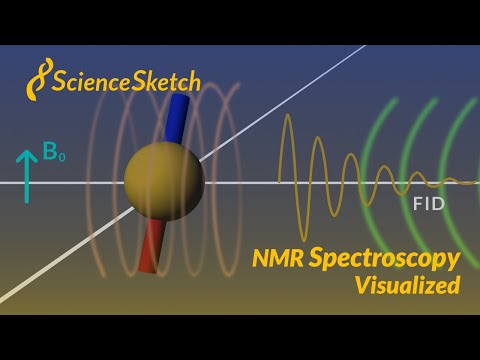
So, picture this: you’re at a party, and someone starts talking about their favorite scientific technique. You know, the type of small talk that makes you wanna roll your eyes? But then they mention nuclear magnetic resonance—or NMR for short—and suddenly it’s like they lit up a room!
Seriously, this stuff is way cooler than it sounds. It’s not just some dry lab technique; it’s actually used in everything from figuring out the structure of new medicines to analyzing wine (yes, wine!).
You might be thinking: what does nuclear have to do with magnets? And honestly, who even cares? But here’s the thing—NMR is like giving scientists superpowers. They can see what’s happening at a molecular level as if they were peering through a magical window.
Stick around, and I promise we’ll unravel this magnetic mystery together! You’ll be impressing friends with your newfound knowledge in no time.
Advancements in Nuclear Magnetic Spectroscopy: A Comprehensive Guide for Modern Scientific Research (PDF)
Nuclear Magnetic Spectroscopy, or NMR, is like a super cool spy tool for scientists. It lets them snoop on molecules without even touching them! This technology relies on the magnetic properties of atomic nuclei, especially hydrogen and carbon. Basically, when you put a sample in a strong magnetic field and zap it with radio waves, these nuclei resonate. By measuring the frequency of this response, researchers can tell so much about the structure of the molecules involved.
One of the biggest advancements in NMR is related to higher magnetic fields. The stronger the magnet, the clearer the signals and more detailed information we get. Think of it like trying to hear your friend in a noisy room; if you turn up the volume, their voice gets clearer. High-field NMR magnets are reaching fields like 1.2 GHz, making it easier to identify complex structures like proteins and other biological molecules.
Another neat development is multidimensional NMR. Traditional NMR gives you a one-dimensional view—like listening to just one instrument in an orchestra. Multidimensional techniques let scientists listen to multiple interactions at once. For example, 2D-NMR can show how atoms within a molecule are connected by creating a map of sorts that reveals these connections without complicated chemical reactions.
Sometimes samples aren’t pure or come from tiny amounts of material. But don’t worry! Microfluidic devices are becoming popular for studying samples with very low concentrations. These devices channel your sample through tiny tubes where it can interact with NMR’s powerful magnets. They provide quick results while using only minuscule amounts of materials—perfect for precious compounds!
Then there’s solid-state NMR. Most people think of NMR as being limited to liquids, but that’s changing! Solid-state techniques help study things like catalysts and polymers directly in their solid forms. This means researchers can learn more about materials that wouldn’t dissolve easily.
Let’s not forget automation! In recent times, some systems have gotten seriously high-tech with %robotics and AI integration. Imagine robots handling samples and optimizing experiments automatically while scientists focus on data interpretation instead. It’s not just sci-fi anymore; it’s happening right now!
Lastly, collaborations across fields are becoming common too! Scientists from chemistry, biology, physics—you name it—are working together to solve complex problems using these advanced spectroscopy techniques. For instance, understanding diseases at a molecular level might lead to new treatments or cures.
So yeah! With all these advancements in Nuclear Magnetic Spectroscopy, researchers continue breaking new ground in understanding molecular structures and functions across numerous scientific disciplines—not too shabby for a technique that has been around since the 1940s!
Revolutionizing Chemistry: New Insights into Nuclear Magnetic Resonance (NMR) Spectroscopy
Nuclear Magnetic Resonance (NMR) Spectroscopy is one of those techniques that you might not think about every day, but it’s like a superpower for chemists. It helps them figure out the structure of molecules and understand how they behave. So, let’s break this down.
First off, NMR works by looking at the magnetic properties of atomic nuclei. Imagine you have a bunch of tiny magnets (those are your nuclei) spinning around in your coffee cup. When you apply a strong magnetic field, some of these magnets line up, while others don’t. The energy absorbed when these nuclei are flipped into alignment gives us valuable information about the molecule itself.
How does this come into play in modern research? Well, NMR is crucial in various fields—think pharmaceuticals, materials science, and even biology! Chemists can identify unknown compounds or confirm that their synthesized molecules are what they intended to create.
Now, here’s where things get really interesting: recent advances in NMR technology are revolutionizing how we use it. For instance, researchers have been developing **higher sensitivity** techniques. This means we can detect smaller amounts of substances than ever before! Imagine trying to find a needle in a haystack; with these new methods, it’s like having a magnet that attracts only needles.
Some key improvements include:
- Ultra-high-field NMR magnets: These provide stronger magnetic fields which lead to better resolution.
- Fast magic angle spinning: This technique reduces line broadening and helps get clearer signals from solid samples.
- Pulsed field gradient NMR: Perfect for studying molecular dynamics and interactions.
The real beauty of all this is the ability to look at complex biological systems like proteins or membranes without destroying them. A few years ago, scientists were thrilled when they managed to study entire proteins using NMR alone—without needing to crystallize them first! That’s like trying to understand a giant jigsaw puzzle by seeing all the pieces scattered on the table instead of having them neatly arranged.
You know what else is pretty cool? It’s also used for understanding metabolic processes in living organisms — so you could literally help understand how our body reacts at a molecular level while doing an experiment!
One emotional story that stands out for me involves researchers who used NMR spectroscopy to uncover vital information about Alzheimer’s disease proteins. By understanding their structure better through NMR insights, they could pave paths toward treatments that might change lives forever.
So yeah, as new methodologies continue to unfold within this realm, it’s wild to think about what discoveries lie ahead—like peering into nature’s secrets through a high-tech window! In the end, Nuclear Magnetic Resonance isn’t just some fancy lab equipment; it’s aiding scientists on remarkable journeys toward unraveling life’s mysteries all around us.
Alright, let’s chat about Nuclear Magnetic Resonance (NMR) Spectroscopy. You might be thinking, “What in the world is that?” Well, let me break it down for you in a way that’s chill and relatable.
NMR is one of those fancy tools scientists use to study molecules. It sounds super technical, but really, it’s about understanding how different atoms behave in a magnetic field. Think of it like tuning into a radio station—each type of atom has its own unique frequency or “tune.” When you put a sample in an NMR machine, it basically listens for those tunes and helps scientists figure out the structure of molecules. Pretty cool, right?
I can remember the first time I heard about NMR; my professor was all excited about how it could help us figure out complex structures like proteins or even discover new drugs. I was sitting there with wide eyes thinking, “Wow, this isn’t just science—this is magic!” It felt like we were on the brink of uncovering something huge.
These days, NMR is everywhere in scientific research. It’s not just for chemists locked away in labs anymore—it’s used in biology for studying proteins or even in materials science to look at polymers and other compounds. Imagine trying to develop a new medicine; you need to know exactly what you’re working with to make something effective. That knowledge comes from techniques like NMR.
What I find especially fascinating is how interconnected everything feels through this technology. A breakthrough made using NMR could lead to advancements in medicine, environmental science—you name it! But there are moments where you realize how much work goes into these discoveries; endless hours analyzing data and tweaking experiments.
And yes, sometimes the results are unexpected or even confusing! Scientists spend countless hours trying to make sense of what their machines are telling them. It takes patience and creativity—not just raw numbers on a screen but an artist’s touch mixed with scientific rigor.
In essence—even though we’re talking about something as complex as nuclear spins and magnetic fields—the heart of NMR resonates (pun intended!) with curiosity and discovery that drives research forward today. So next time someone mentions NMR Spectroscopy at a party—or anywhere really—you’ll have the scoop on why it’s such an exciting tool in the world of modern science!