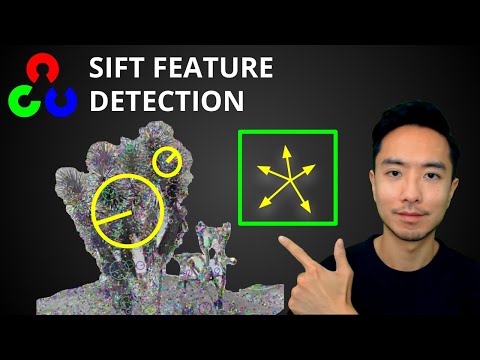
You know those moments when your phone camera just can’t handle the chaos of a family photo? Yeah, I’m talking about that awkward blur when your cousin jumps right in front of you. Classic!
Well, that’s where cool stuff like SIFT comes into play. Imagine if your camera could actually recognize faces and objects no matter how chaotic things got. Pretty sweet, huh?
SIFT stands for Scale-Invariant Feature Transform. Sounds fancy, right? But it’s all about making computer vision smarter—like giving your tech a pair of super-spectacles!
In this little chat, we’ll dig into how SIFT is changing the game in OpenCV (that’s just a toolkit for making these awesome things happen). From detecting edges to matching patterns, it’s like teaching machines to see the world through our eyes.
Comparative Analysis of SIFT and ORB: Determining the Superior Feature Detection Method in Scientific Applications
When it comes to feature detection in computer vision, two popular methods are SIFT (Scale-Invariant Feature Transform) and ORB (Oriented FAST and Rotated BRIEF). Both techniques have their own unique benefits and applications, making it essential to get the scoop on each one. Let’s break it down!
SIFT has been around since the early 2000s. It’s like the wise old sage of feature detection. What makes SIFT stand out is its ability to identify keypoints in images regardless of changes in size, rotation, or lighting. Think about that—imagine you snap a photo of your friend in bright sunlight and another one on a gloomy day; SIFT can still recognize their face. It extracts features by detecting corners and edges, then describes them using a vector representation.
On the other hand, we’ve got ORB, which popped onto the scene later as an efficient alternative. ORB is basically a mash-up of two different algorithms: FAST for corner detection and BRIEF for descriptor generation. It’s designed to be faster than SIFT while still being effective in various applications. If you’re working on real-time processing or have limited computational resources, ORB might be more your style.
Now let’s look at some critical aspects to consider when choosing between SIFT and ORB:
- Performance: In terms of speed, ORB has a clear edge over SIFT, especially on resource-constrained devices. If you’re working with mobile apps or embedded systems where every millisecond matters, ORB could be your go-to.
- Accuracy: While both methods produce good results, SIFT typically offers more precise feature matching due to its robust descriptors. This can be crucial when working with complex images where detail is key.
- Tolerance to noise: SIFT tends to perform better under noisy conditions compared to ORB. So if your images have lots of artifacts or distortions—think low-quality camera shots—SIFT may win this round.
- License issues: Here’s an interesting twist: SIFT was patented for many years but became open-source just recently. Meanwhile, ORB has always been free for everyone! Depending on what you’re doing, this might influence your choice.
There was this one time I was trying to stitch together images from my last hiking trip into a panoramic view using these two methods. I really wanted that breathtaking mountain backdrop stitched perfectly together without much hassle! When I used SIFT, it took longer but gave me amazing detail in terms of features recognized across different photos. However, when I switched over to ORB for quicker processing while on my phone… wow! The speed impressed me even if the accuracy wasn’t quite as high.
So ultimately—which method is superior? Well, that really depends on what you need it for! If precision is non-negotiable like when you’re analyzing scientific data or intricate patterns in images? Go with SIFT! But if you need something speedy that works well enough without demanding hefty computational power—for instance, real-time tracking? Then ORB might just do the trick.
In this fast-evolving field of computer vision and image processing techniques like these mean there isn’t always one clear-cut answer—it’s all about fitting the right tool for the job at hand!
Exploring the Advantages of SIFT in Scientific Research and Data Analysis
Sure! Let’s get into the nitty-gritty of SIFT, which stands for Scale-Invariant Feature Transform. It’s like a superpower in imaging and computer vision studies.
SIFT really shines when you’re trying to identify and match objects in different conditions. When you take a photo, it might change based on lighting or angle, right? Well, SIFT helps your computer recognize that same object no matter how it looks. Isn’t that cool?
Here are some of the advantages of using SIFT in scientific research and data analysis:
- Robustness to Scale Variations: SIFT detects features across various scales, so whether your object is far away or up close, you still get a solid match.
- Rotation Invariance: It doesn’t matter if an image is flipped or rotated; SIFT keeps its cool and finds similar features.
- Reliable Under Different Lighting Conditions: Whether it’s bright sunlight or dim light, SIFT can adapt and still find those key points.
- Feature Descriptors: Each feature comes with descriptors that help define them mathematically. This means you can compare features easily using algorithms.
- Application Flexibility: You can use SIFT in various fields—from medical imaging to robotics—making it versatile for scientific endeavors.
Let me share a quick story about my buddy who’s into astronomy. He was working on identifying different star formations in images taken by telescopes. The problem was that some stars looked different based on the time of night or weather conditions. So he used SIFT to pinpoint those star patterns despite the variations! It was like giving his computer a telescope too.
But here’s the kicker: SIFT isn’t just about finding points; it’s about recognizing patterns and connections among them. By analyzing these features, researchers can gather insights into complex data sets—like tracking wildlife movements through camera traps or analyzing environmental changes over time.
However, it’s got some competition out there—like ORB (Oriented FAST and Rotated BRIEF), which is faster but not quite as robust in all situations. So choosing between them really boils down to what you’re up against.
So next time somebody mentions image analysis or matching objects in science research, you’ll know that SIFT is quietly doing a lot of heavy lifting behind the scenes! It’s pretty amazing how this technique blends mathematics with practical application—it makes sense why so many scientists love it!
Mastering SIFT in OpenCV: A Comprehensive Guide for Scientific Image Analysis
So, SIFT, huh? It stands for Scale-Invariant Feature Transform. This is a super handy method in computer vision, especially when you want to analyze images scientifically. It’s all about finding and describing local features in images that remain consistent even when the image gets resized, rotated, or otherwise transformed. Pretty cool, right?
When you dig into OpenCV, which is like the Swiss Army knife for image processing in Python or C++, SIFT becomes even more powerful. First things first: SIFT helps in identifying key points in an image. You want to know where something important is? SIFT can help with that!
Here’s how it works:
- Keypoint Detection: It identifies interesting points – like corners or blobs – across different scales of the image.
- Orientation Assignment: Each keypoint gets a direction so that it can be described relative to its surroundings.
- Descriptor Generation: This part generates a unique fingerprint for each keypoint based on its local neighborhood.
Imagine you are trying to match two photos of the same place taken at different times. SIFT would help pinpoint those areas that look similar despite changes—like new buildings popping up or trees growing.
Now, let me bring this home with a little story. I remember trying to match two pictures of my childhood park from years ago for an old project. The playground changed completely; they added swings and took away some old slides. Still, thanks to SIFT features, I could identify old landmarks like trees and paths that hadn’t budged an inch over the years! It was amazing to see how technology can bridge the past and present.
In OpenCV, using SIFT is straightforward once you’ve installed OpenCV (which you can easily do with pip). You’d typically start by loading your images. Then you create a SIFT object by calling `cv2.SIFT_create()`. Next comes detecting keypoints and computing descriptors using `detectAndCompute()`.
Here’s a tiny code snippet to give you an idea:
“`python
import cv2
# Load images
img1 = cv2.imread(‘image1.jpg’, 0)
img2 = cv2.imread(‘image2.jpg’, 0)
# Create SIFT detector
sift = cv2.SIFT_create()
# Find keypoints and descriptors
kp1, des1 = sift.detectAndCompute(img1, None)
kp2, des2 = sift.detectAndCompute(img2, None)
“`
Once you’ve got your descriptors ready from both images, it’s time for matching! OpenCV provides several methods for this too—usually using FLANN or BFMatcher (Brute Force Matcher). These tools will find pairs of matched keypoints between your images efficiently.
One thing to keep in mind is that while SIFT is great for many applications—such as identifying landmarks or objects—it isn’t entirely foolproof. Factors like lighting changes or occlusions can still throw it off a bit.
Just remember: mastering SIFT means not just knowing how to use it but also understanding its limitations and strengths! Have fun playing around with it; it’s one of those tools where practice really helps improve your skills over time.
So, let’s chat about SIFT in OpenCV. You know, SIFT stands for Scale-Invariant Feature Transform, which sounds super fancy but is really all about helping computers recognize and interpret images better. It’s like teaching a computer to see the world through its own eyes!
I remember a time when I was trying to find a photo I’d taken on a hike. I had hundreds of them on my phone. Honestly, it felt like searching for a needle in a haystack! But if I’d had some SIFT magic working behind the scenes, that computer could have detected key features in each photo — like colors or shapes — and matched them with my search criteria in no time.
What’s neat about SIFT is that it picks out distinctive points in an image no matter what angle or size you’re looking at. So whether it’s my mountain view or maybe that cute puppy pic, it can find similarities even if I zoomed way in or flipped the image upside down!
Now, OpenCV is basically this open-source library that’s super popular among developers for computer vision stuff. It has made implementing SIFT techniques more accessible to everyone from hobbyists to pros. You don’t need to be some coding wizard; you just need curiosity and maybe a little perseverance.
Just think — with advancements like SIFT integrated into apps today, identifying objects and faces has become not just easier but also way faster. We see this tech popping up everywhere: from security cameras recognizing faces to apps categorizing your photos automatically without you lifting a finger.
But hey, there’s always room for growth too! While SIFT works great, it does come with challenges such as being computationally heavy sometimes, which can slow things down if you’re working on simpler devices. But that’s part of the beauty of tech evolution: people are always pushing boundaries and finding solutions.
And really, what strikes me most about developments like these is how they can change our day-to-day lives while also opening up new possibilities for creativity in art and design or even aiding scientific research! The way we interact with technology keeps evolving and reshaping how we perceive our world. So every time I snap a picture now? There’s just this hint of excitement knowing there’s so much happening behind the scenes to make sense of it all!