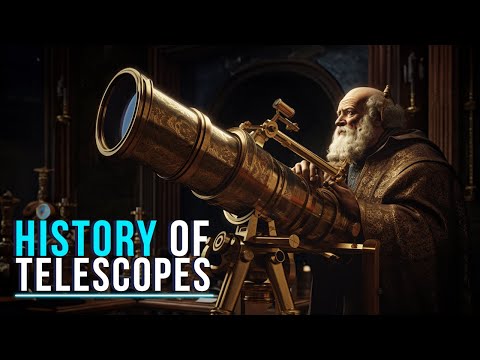
You know, I once tried to use binoculars to see if the neighbor’s cat really had a different hairstyle every week. Spoiler alert: it didn’t work, and I ended up looking like a total weirdo. But that brings up a cool point—imagine way back when, someone looked up at the stars and thought, “What if I could see those better?”
That’s where the telescope comes in. It’s like humanity’s giant pair of eyes, peering into the vastness of space. Back in the day, this invention completely shifted our view of the universe. Seriously!
From those first shaky tubes to what we have now—it’s been one wild ride for astronomers. Let’s take a fun stroll through how it all started and why it still matters today!
The Original Telescope: Pioneering Advances in Modern Astronomy and Scientific Discovery
Alright, let’s talk about the original telescope—like, you know, that gadget that totally changed the game for astronomy. Way back in the early 17th century, two Dutch spectacle makers, Hans Lippershey and Zacharias Janssen, came up with this cool idea of using lenses to see stuff far away. It was kind of like magic! They took curved glass and put it together to make a device that could magnify objects. Imagine looking at something miles away and it suddenly became bigger right there in front of your eyes!
So, what’s interesting about these early telescopes? Well, they were pretty basic. They had a simple design with a convex lens at one end and a concave lens at the other which allowed you to view distant objects. But it was good enough to see planets that were just little dots before. Like, think about how someone first looked at the moons of Jupiter through one of these things!
- Galileo Galilei: Now this guy really took it to another level in 1609. He didn’t invent the telescope but definitely improved it! He made one with a longer focal length which allowed him to spot craters on the Moon and even those four big moons orbiting Jupiter: Io, Europa, Ganymede, and Callisto. I mean wow!
- Telescope Advancements: As time went on, telescopes got better and better. You had refracting telescopes using glass lenses and later on reflecting telescopes with mirrors invented by Isaac Newton. This basically meant we could look deeper into space than ever before.
- The Hubble Space Telescope: Fast forward to nowadays, and we’re using space-based telescopes like Hubble which have taken pictures of galaxies billions of light-years away! Talk about some major upgrades from those first models.
The original telescope didn’t just change how we look at stars; it also opened up whole new fields of science! When Galileo spotted Jupiter’s moons, he helped prove that not everything revolved around Earth—a major shift in thinking called heliocentrism. That’s when you realize Earth isn’t the center of everything; instead, we’re just one planet among many!
And here’s something cool: throughout history, people have used telescopes not just for looking at stars but also for navigating oceans! Sailors could find their way by spotting celestial bodies high above them—it was like having a cosmic roadmap.
To wrap it up (well not literally!), without those early telescopes sparking our curiosity about the universe around us and paving the way for advances in technology over centuries—who knows where we’d be today? The original telescope truly set off a chain reaction that leads directly to how we explore outer space now! Kind of humbling when you think about it—right?
The Original Telescope: Pioneering Innovations and Their Impact on Modern Astronomy
The original telescope is like the great-grandparent of all the fancy gear we use in astronomy today. It was a game changer, seriously! Picture this: in the early 17th century, some clever folks started playing around with glass lenses. They wanted to see things that were far away, like, a lot further than your average squinting eye could manage.
Galileo Galilei is probably one of the first names that pops into your head when you think about telescopes. In 1609, he whipped up his version and pointed it skyward. His discoveries were mind-blowing! He saw moons orbiting Jupiter and realized Venus had phases like our Moon. That was groundbreaking because it supported the idea that not everything revolved around Earth, which was pretty radical back then!
Now, let’s break down why these early telescopes were so impactful:
- Improved Observation: Before telescopes, people relied on the naked eye for astronomy. The telescope opened up a whole new universe—literally!
- Support for Heliocentrism: Galileo’s observations helped challenge long-held beliefs that Earth was at the center of the universe.
- Foundation for Future Designs: Early designs set the stage for more advanced instruments. Newer telescopes built on these ideas and improved upon them.
- Cultural Shift: The ability to observe celestial bodies shifted how society viewed its place in the cosmos.
But it wasn’t just Galileo who played with lenses; there were others too! Johannes Kepler, for example, improved telescope design by introducing a better arrangement of lenses that brought clearer images into view. This was super important because as astronomers dug deeper into space, they needed sharper images.
Fast forward to today, and it’s wild to think about how far we’ve come from those first wooden tubes with glass! Modern telescopes like Hubble have massive mirrors instead of simple lenses and can capture incredible images from across the universe.
Honestly, I remember being in school staring at pictures from space telescopes and thinking how magical they looked. It made me realize just how much innovation has shaped what we know about space now. The original telescope paved the way for collecting data and unraveling cosmic mysteries—like black holes or galaxies billions of light-years away!
So next time you look up at the stars or hear about a new discovery in astronomy—even if it feels untouchable—think back to those simple glass lenses that kicked everything off. They truly changed our understanding of not just what’s out there but also who we are in this vast universe!
Galileo and the Telescope: Revolutionizing Astronomy Through Scientific Innovation
Galileo Galilei was a name that rocked the scientific world back in the 17th century. He didn’t just build on what others had done; he basically took a telescope, which was kinda new tech back then, and blew everyone’s minds with it. You know how sometimes you see a new gadget, and you just wanna test it out? That’s exactly what he did.
So, let’s talk about this shiny new tool—the telescope. The original idea came from earlier experiments with lenses. You could say they were like baby steps into the cosmic dance floor! But when Galileo got his hands on one in 1609, everything changed. He made his own version with a magnification of around 20 times! Imagine looking at something far away and seeing detail you never thought possible.
Now, here’s where it gets super interesting. With this telescope, Galileo did something revolutionary: he turned it toward the heavens. What did he see? Oh man, let me tell you! He spotted **Jupiter’s moons**, realized Venus had phases like our moon, and even noticed sunspots—a clear sign that the sun wasn’t this perfect orb everyone thought it was.
All these observations were a big deal because they challenged the established view of the universe, which held that everything revolved around Earth—a concept known as geocentrism. But Galileo wasn’t shy about sharing his findings; he published them in “Sidereus Nuncius” (Starry Messenger). People were excited—and some a bit terrified!
His work laid the foundation for modern astronomy by paving the way for more advanced telescopes later on. Think about today: we have telescopes that can gaze deep into space like it’s no big deal! Hubble and its successors owe a lot to what Galileo started when he squinted through his handmade craftsmanship.
Another cool fact is how his findings prompted discussions about scientific method. Before Galileo, people often relied on ancient texts or authority figures for answers. But here comes our guy questioning everything through observation and experimentation—groundbreaking stuff!
One emotional moment in this saga is how Galileo faced severe backlash from religious authorities for his views. Being put under house arrest must have been tough for someone so passionate about sharing knowledge. Yet he persevered in his studies and continued to influence generations of scientists after him.
In essence, while Galileo didn’t invent the telescope itself, he revolutionized its use in astronomy and opened our eyes to an entirely new perspective of our universe…no biggie! Isn’t it incredible how one person’s curiosity set off centuries of discoveries? Science isn’t just about facts; it’s also this amazing journey driven by passion and wonder—something we can all relate to if you think about it!
So next time you gaze at a starry sky or read about distant galaxies, remember that humble beginning with Galileo’s little eye piece—it truly rocked our cosmic world!
You know, when you think about telescopes, it’s easy to picture those big, fancy machines we see in observatories or the sleek designs that sit in backyards. But let’s rewind a bit to where it all began. The original telescope was a pretty simple device, just a couple of glass lenses stuck together. Seriously! Can you imagine people looking through those for the first time? It must’ve felt like opening a door to a whole new universe.
In 1608, Hans Lippershey—a Dutch spectacle maker—had this lightbulb moment and created the very first patent for a telescope. Just picture him experimenting with lenses in his workshop when he accidentally realized he could magnify objects far away. I mean, wow! That discovery caught the attention of folks like Galileo Galilei. He took it further and turned that basic idea into something remarkable: he pointed it at the night sky and saw Jupiter’s moons for the first time. Talk about mind-blowing!
Fast forward to today and it’s amazing how much we owe to Lippershey’s little invention. Modern astronomy has exploded in tech and capability thanks to telescopes, which have gone from simple glass tubes to being fitted with advanced technology that can detect galaxies billions of light-years away. I once read about astronomers who’ve captured images of cosmic events right after they’ve happened—like supernovae—which is just wild!
But here’s what gets me: even with all this incredible tech, that same curiosity that drove those early astronomers still drives us today. We still look up at the stars wondering about life beyond Earth and trying to understand our place in this vast cosmos. It’s like we’re all part of a long story—a never-ending quest for answers.
And yeah, sometimes you can feel lost staring up at the night sky; it’s overwhelming just how big it is! Yet that wonder is what keeps us going as both amateur stargazers and serious scientists alike. Those original telescopes didn’t just help us peek at the stars—they ignited our imagination and taught us that there’s always more out there waiting to be discovered.
So next time you look through a telescope—whether it’s an old-school one or something cutting-edge—just remember its humble beginnings. It’s an invitation to explore not just space but also our endless curiosity as human beings!