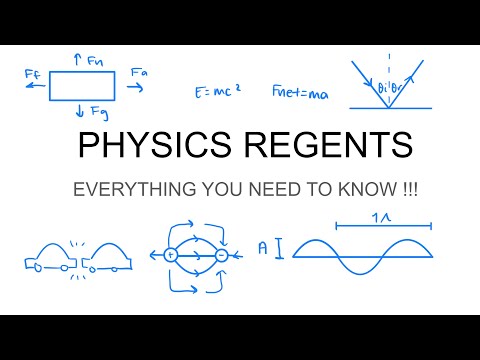
You know that feeling when you’re staring at a physics problem, and it looks like hieroglyphics? Yeah, I’ve been there. It’s like, “Why is there a hamster in this equation?” But seriously, physics can feel like a whole other universe sometimes.
But here’s the thing: preparing for the Physics Regents doesn’t have to be this monumental task. With a little know-how and some smart strategies, you can totally tackle those tricky questions. You know what they say—practice makes perfect!
So, if you want to breeze through those exams and maybe even impress your friends with your newfound knowledge about motion and energy, stick around. We’re about to break down what it takes to make sense of all those formulas without losing your mind. Trust me; it can be fun!
Essential Guide to Succeeding in the Physics Regents Exam: Key Concepts and Study Tips
So, you’re gearing up for the Physics Regents Exam, huh? That can feel like a big mountain to climb, but don’t sweat it! Let’s break it down into bits you can tackle.
Key Concepts to Focus On
Firstly, understanding the core concepts is crucial. You’ll want to make sure you grasp these areas:
- Newton’s Laws of Motion: These are the foundation of classical mechanics. Newton had three laws; the first one tells us about inertia, while the second relates force to acceleration.
- Energy and Work: Understand the work-energy principle—work done equals change in energy. Remember that kinetic energy (energy of motion) and potential energy (stored energy) are big players here.
- Waves: Look at properties like wavelength, frequency, amplitude, and how they relate to sound and light waves. This is not just textbook stuff; you encounter waves every day!
- Electromagnetism: This area deals with electric charges and magnetic fields. You might want to understand how circuits work and how magnetic fields can create electric currents.
- The Laws of Thermodynamics: These laws explain energy transfer in systems. The first law is about conservation—energy can’t be created or destroyed.
You see? Knowing these concepts isn’t just for passing an exam; they’re the building blocks of understanding how our universe works!
Study Tips That Work
Now that we’ve covered some essentials, let’s talk about how to study effectively for this exam. Here are some strategies:
- Create a Study Schedule: Make a timeline leading up to the exam date. This helps you cover all topics without cramming at the last minute.
- Practice Problems: Physics involves a lot of problem-solving. Work through problems from your textbooks or past exams and try unsolved examples!
- Group Study Sessions: Sometimes explaining things out loud to friends helps solidify your understanding. Plus, you can share tips and tricks!
- Tutorials & Videos: Sometimes a visual explanation is all you need! Sites like Khan Academy can be super helpful for tricky concepts.
- Tackle Past Exams: Get your hands on previous Regents exams. They often repeat question formats or topics which can give you a huge advantage!
And hey, don’t underestimate taking breaks! Seriously, your brain needs time to recharge.
An Emotional Anecdote
Let me tell you something personal—I once had this friend who was convinced he would never pass his physics class. He put so much pressure on himself that he almost gave up! Then one day he decided he’d approach it differently—he began creating fun flashcards and even found silly ways to remember laws by making up songs.
Guess what? By the time exams rolled around, he wasn’t just passing; he was acing every test! It’s amazing what a little creativity—and less stress—can do.
So there you go! Prep well, keep those key concepts in your mind, and use those study tips wisely. You’ll be ready for that Physics Regents Exam before you know it!
Mastering A-Level Physics: Essential Strategies to Achieve an A*
Mastering A-Level Physics can feel like a massive mountain to climb, right? But don’t worry! With the right strategies, you can definitely reach the peak and snag that A*. Let’s break it down into some key areas that’ll help you along the way.
- Understand the Syllabus: Before anything else, get cozy with your syllabus. It’ll tell you what topics to focus on and which ones are weighted more heavily in exams. Knowing this helps you prioritize your study time.
- Conceptual Clarity: Physics isn’t just about memorizing formulas; it’s about understanding concepts. When I was studying, I often visualized problems or used everyday examples to make sense of tricky ideas. Like, think of electricity flowing like water through a pipe!
- Practice Problems: Seriously, do as many practice problems as you can. This is where theory meets reality. Start with easier ones to build confidence before moving onto tougher questions. Plus, working through problems gets you familiar with how they present questions in exams.
- Use Resources Wisely: There are tons of resources out there—YouTube channels, online quizzes, and revision guides. Find the ones that resonate with you. I personally loved watching demo experiments; they made concepts come alive!
- Create a Study Schedule: Time management is everything! Break down your study sessions into manageable chunks. Maybe focus on one topic per day or week—whatever works best for you.
- Form Study Groups: Don’t underestimate the power of discussing topics with your peers. Explaining concepts to others helps reinforce your own understanding and might even fill in gaps in what you know.
- Solve Past Papers: This is huge! Past exam papers not only show you the type of questions asked but also help gauge your timing and pressure management during tests. Make it a habit—like clockwork!
- Breathe and Stay Positive: Stress can be a real killer when studying for exams. Remember to take breaks, breathe deeply, and keep a positive mindset while preparing for physics exams.
If there’s one thing I wish someone had told me back when I was gearing up for my physics exams: It’s okay to not get everything right away! Stick with it, keep asking questions—even if they feel silly—and approach each concept like a puzzle waiting to be solved.
Your journey towards an A* in A-Level Physics is absolutely achievable! Just remember: stay curious, practice relentlessly, and don’t hesitate to get help when needed. The finish line will be worth all that effort!
Essential Strategies for Effective Physics Exam Preparation: Mastering Concepts and Boosting Your Success
Okay, so you want to ace those Physics exams? Let’s break it down into a few really helpful strategies. Seriously, mastering physics isn’t just about memorizing formulas. It’s about understanding the concepts behind them!
Understand the Basics. You know, physics is built like a house. If your foundation is shaky, the whole thing could collapse! Start with fundamental concepts like force, energy, and motion. Make sure you really understand these before moving on to more complex stuff.
Practice Problems Regularly. Nothing beats practice! Try tackling problems from past exams or textbooks. Don’t just read through solutions—work through them yourself! For example, when practicing projectile motion, set up real-world scenarios, like throwing a ball. What happens? Go through the math and see it in action.
Create Study Groups. Teamwork can seriously up your game. Gather some friends or classmates and dive deep into tricky topics together. Explaining concepts to each other is a great way to cement your understanding. Like, if one of you gets stuck on circuits while another understands them, swap knowledge!
Use Visual Aids. Physics can be super abstract. Draw diagrams or charts to visualize problems better—think of it as creating a roadmap for the brain! If you’re studying waves, sketch out waveforms. Seeing how they interact helps make things clearer.
Flashcards for Terms and Formulas. These little guys are lifesavers! Make flashcards for important terms and key formulas. Review them frequently; this will help keep everything fresh in your mind right before the exam.
Seek Help When Needed. Don’t hesitate to ask for help if you’re struggling with something specific! Teachers love when students seek clarification—it shows commitment! Plus, they might give you tips that aren’t in textbooks.
Simulate Exam Conditions. Before exams roll around, find out how long they last and practice under similar conditions. Set a timer and tackle problems like it’s game day! This way you’ll get used to pacing yourself during the real thing.
Take Care of Yourself. Yeah, seriously! Don’t forget to eat well, sleep enough, and take breaks while studying. Overloading your brain without breaks is counterproductive—you’ll just end up more confused than ever!
In short: mastering physics takes dedication but breaking it down makes it manageable. Keep these strategies in mind and stay committed throughout your study sessions—it’ll pay off big time on exam day! Keep pushing yourself; you’ve got this!
So, you’ve got the Physics Regents coming up, huh? I remember when I was in your shoes, staring down a stack of notes and books that felt like they were taller than me. It can be super overwhelming, and let’s be real: that pressure to perform well can feel intense. But here’s the thing—preparation doesn’t have to be all doom and gloom.
First off, it’s about finding a balance. Sure, cramming a night before isn’t the way to go. Trust me, I learned that the hard way! Instead, think of studying as a little daily ritual. You know what worked for me? Setting aside just half an hour each day to go over concepts that stumped me in class or practicing problems from past exams. That regular touchpoint really helped clarify things over time.
And you gotta tap into your resources! Like, don’t hesitate to reach out to your teacher or friends if something’s just not clicking. Collaboration really helped my group understand tricky topics—and sometimes even resulted in surprising friendships. You follow me? And let’s not forget about online resources; there are so many awesome videos and forums where folks break down complex ideas in ways that just make sense.
But here’s my favorite part—practice tests! They simulate the actual test experience pretty closely and help you get comfy with the format. It’s a bit like training for a race; you wouldn’t just show up unpracticed hoping for the best, right? Plus, they show you where you might need more practice without any real stakes.
And hey, don’t ignore your mental health during this time either! Give yourself breaks and allow moments of relaxation. Seriously! Go hang out with friends or binge-watch that show you’ve been dying to see. It sounds trivial but those little recharges can do wonders for keeping your mind fresh.
Finally—and this might sound cheesy—believing in yourself is half the battle. Everyone will tell you physics is tough; but if you put in some effort and keep your head up, you’ll surprise yourself with what you can achieve on test day! Just remember: it’s not only about getting through the exam; it’s also about understanding how things work in our world.
So go ahead and tackle those Regents with confidence! You got this!