So, picture this: you’re at a party, right? You spot two friends having an intense argument about which superhero is the strongest. Turns out, it’s a pretty heated debate! But here’s the kicker: what if I told you that in the tiny world of particles, there are heroes too?
Enter the pion particles. Yep, they’re not exactly household names like Batman or Wonder Woman, but they play a major role in holding everything together—like glue for protons and neutrons.
You know how some things just vibe perfectly together? That’s pions with the strong nuclear force. They help keep atomic nuclei stable and prevent everything from flying apart!
So, if you’ve ever been curious about what keeps your atoms cozy and snug, let me spill the beans on these little powerhouses.
Understanding Pions in Nuclear Physics: Their Role and Significance in Particle Interactions
Alright, so let’s chat about **pions**! These little guys are super important when we’re talking about nuclear physics. You know how everything in the universe is made up of tiny particles? Well, pions are one of those particles that help stick everything together!
First off, what are pions? Basically, they’re mesons, which is a fancy term for particles that are made up of a quark and an antiquark. So, think of them as the middleman in the particle world. They’re not as heavy as protons or neutrons but play a huge role in how these heavier particles interact with each other.
You see, within atomic nuclei, protons and neutrons hang out together. They need something to keep them from flying apart due to their natural repelling forces—like magnets that just don’t want to be near each other. This is where pions come into play! They act like little messengers that carry the strong nuclear force. This force is one of the four fundamental forces in nature and basically keeps those protons and neutrons glued together.
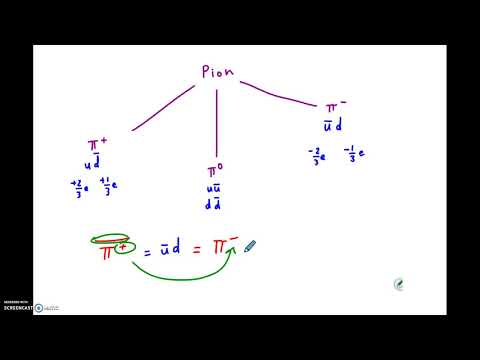
- Pion Types: There are three types of pions: positive (π+), negative (π-), and neutral (π0). Each has its own quirks and roles during interactions.
- Interaction Example: When two nucleons (that’s protons or neutrons) interact, they exchange pions. Imagine tossing a ball back and forth; that’s similar to what happens with pions facilitating these nuclear interactions.
- Particle Stability: Without these handy messengers, nuclei would be unstable. Pions help make sure everything stays nice and tidy inside an atom!
A little story for you—when I first learned about pions, I was totally mind-blown by how such small things could have such big implications! It reminded me of being a kid playing Jenga; if you pull out just the right piece at just the right time, the whole tower stands strong or comes crashing down! Pions are like those perfect pieces holding atomic structures together!
Pions also have a relatively short lifespan; they’re here one moment and gone the next—kind of like that time when my friend blinked during a game of hide-and-seek! Even though they disappear quickly after doing their job in mediating strong forces, it doesn’t make them any less significant.
The study of pions helps physicists understand not only the nucleus but also contributes to our knowledge about fundamental interactions at larger scales. They play a key role in particle physics experiments too since scientists often look at how pions behave when smashing particles together at high energies.
So in short, without pions hanging around doing their job as carriers of strong force interactions between nucleons, our understanding of matter—and even life itself—would be way different. They might be tiny players on this gigantic cosmic stage but don’t underestimate their impact!
Exploring the Particles of the Strong Interaction: A Deep Dive into Quantum Chromodynamics
So, let’s talk about the strong interaction—kind of a heavy topic but stick with me. It’s one of the fundamental forces in nature, and it’s responsible for holding the tiny particles in an atom’s nucleus together. Without it, protons and neutrons would just flail around like confetti in a breeze!
At the heart of this interaction is a field known as Quantum Chromodynamics (QCD). This is basically the theory that describes how quarks and gluons interact, sort of like how gravity keeps us grounded but way weirder. You see, quarks are these tiny building blocks that make up protons and neutrons, while gluons are the little messengers that carry the strong force between quarks.
Now, here comes the exciting part: in this QCD playground, we have these particles called pions. Pions are not your average particles—they’re crucial players when it comes to mediating the strong nuclear force. They’re still pretty tiny themselves but pack a punch in their role!
So why are pions important? Well, think of them as carriers of energy between nucleons (that’s just a fancy term for protons and neutrons). When they exchange pions, it helps keep everything stable in the nucleus. Imagine two friends tossing a ball back and forth—that ball is like a pion helping them stay connected!
Here’s something cool: pions come in three varieties—positive, negative, and neutral. The positive pion carries a positive charge while its negative counterpart carries a negative charge. The neutral pion? Well, it plays it cool without any charge at all. Each type contributes differently to those interactions happening inside an atomic nucleus.
The strength of the strong nuclear force is no joke either; it’s way stronger than electromagnetism or gravity at short distances. But here’s where it gets wild—it also has this quirky property called confinement. This means that quarks and gluons can’t exist freely on their own; instead, they form larger particles like protons or neutrons bound tightly together by their mutual love for those pions floating around.
Ever felt overwhelmed by something complex? I once tried to explain this stuff to my younger cousin who was convinced atoms were made up of “miniature suns.” While he was slightly off track—no suns involved—it reminded me how hard it can be to grasp these tiny elements! So if you’re scratching your head too, don’t worry; you’re not alone!
To put things into perspective, let’s say you have a jar filled with marbles representing protons and neutrons—and then add some rubber balls as pions flying around doing their thing. If you keep tossing those rubber balls back into the jar (the strong force), everything stays together nicely without exploding out all over your kitchen counter!
In summary:
- The strong interaction holds atomic nuclei together.
- Quantum Chromodynamics (QCD) describes how quarks and gluons interact.
- Pions are essential for mediating this interaction.
- Pions come in three varieties: positive, negative, and neutral.
- The strength of this force is powerful but has quirks like confinement.
So there you have it—a brief journey through one heck of a fascinating topic! From tiny quarks to robust pions keeping them aligned just right—you’ve got yourself an amazing dance happening on scales that are hard to imagine. And even if piecing all this together can be tricky at first glance, just remember that science is all about curiosity and unraveling mysteries bit by bit!
Peon vs. Pion: Understanding the Distinct Roles in Scientific Terminology and Physics
So, let’s break down the terms peon and pion. These two words often get mixed up, but they refer to totally different things—one is from pop culture, and the other is a key player in physics.
A peon, in everyday language, usually refers to a low-ranking worker or someone without much power. It’s a term you might hear when talking about office politics or social hierarchies. But when we step into science, things get way cooler!
Now, we have the pion. This little guy is a particle that plays a crucial role in the strong nuclear force. You know, that force that holds protons and neutrons together in an atom’s nucleus? Yeah, it’s kind of important! Pions are part of what makes everything around us stable.
Pions come in three varieties: positive, negative, and neutral. These particles are involved in mediating interactions between quarks—the building blocks of protons and neutrons. Isn’t that neat? They actually help keep everything glued together inside atomic nuclei.
- Pions are mesons: This means they’re made up of a quark and an antiquark pair. They’re not just floating around though; they interact with other particles all the time.
- The strong nuclear force: It’s one of the four fundamental forces of nature; without pions, this force wouldn’t work properly! Think about how essential this is for keeping atoms stable.
- Lifetimes: Pions don’t stick around forever; they’re unstable particles and decay very quickly into other particles. The positive and negative ones can decay into muons and neutrinos!
An interesting anecdote here: When I first learned about pions back in school during physics class, it blew my mind! Just imagining these tiny particles buzzing around like busy bees inside an atom made me realize how complex our universe is—even if we can’t see it directly!
The physics world uses pions even more than you might think. In particle accelerators like CERN, scientists smash particles together at incredibly high speeds to study what happens when these forces come into play; it’s like recreating the conditions of the universe right after the Big Bang! Pions pop up during these experiments quite often.
Sooo… to wrap this up: when you hear “peon,” think social hierarchy—someone low on the totem pole. But when you say “pion,” you’re diving deep into nuclear physics with vital roles in keeping matter stable through fundamental forces. Both terms are pretty significant but totally different realms!
So, let’s talk about pions for a minute. You might not think much about these little guys, but they’re, like, essential for holding together the protons and neutrons in an atom’s nucleus. Seriously, without pions, our entire universe would look pretty different—maybe even nonexistent!
Now, hear me out. Imagine being a kid playing with building blocks. You stack them up nice and tall—looks super cool until, bam! They topple over because there’s nothing keeping them together. That’s how nuclei would behave without the strong nuclear force. The strong force is what keeps protons and neutrons stuck together despite the fact that protons don’t really like each other (they’re both positively charged and that means they repel each other). Cozy relationship, right?
Enter pions! These particles act as messengers in this whole nuclear dance. They carry the strong force between protons and neutrons. It’s kind of like how you might pass a note between friends to share secrets or plan where to meet up—all while keeping everything flowing smoothly in the friend group.
There are three types of pions: positively charged pi-plus (π+), negatively charged pi-minus (π−), and neutral pi-zero (π0). Each has its own role in this big party of particles. They pop in and out of existence so quickly that it’s hard to imagine them just hanging around.
You know one time I went to a science fair with my little niece? She was there showing off this cool model she made about atoms, and it hit me how amazing it is that something so tiny can be so powerful. Seeing her excitement reminded me of how essential these little particles are—they make our world work the way it does!
So yeah, if you ever find yourself pondering why matter sticks together—or if you’re stuck at a trivia night—just remember: pions are those unsung heroes behind the scenes making everything happen at an atomic level without asking for any credit. How cool is that?