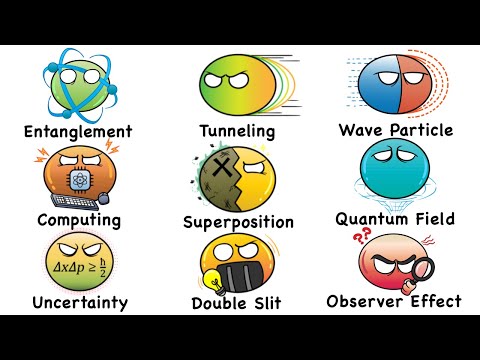
So, the other day, I was chatting with a buddy about some mind-blowing stuff in physics. You know, the kind that makes your head spin a bit?
We ended up laughing about Schrödinger’s cat! Like, who thought of putting a cat in a box to explain quantum mechanics? Seriously, talk about a weird dinner party conversation!
But here’s the thing — quantum physics isn’t just for scientists in lab coats. It’s got all these wild ideas and concepts that make you rethink everything you thought you knew about reality.
Ever wonder how particles can be in two places at once? Or why your phone works when it seems like magic? Well, those questions are where quantum physics comes into play.
So if you’re curious and ready to explore this quirky universe of tiny particles and bizarre behaviors, let’s jump into it together!
Exploring the 7 Most Intriguing Unanswered Questions in Physics: A Deep Dive into the Mysteries of Science
Physics is full of mind-bending mysteries, and some of the biggest questions out there still keep scientists scratching their heads. Like, how can two particles be connected over vast distances, or what’s really going on inside a black hole? Let’s check out a few of these intriguing unanswered questions in physics that really get your brain buzzing.
- What is dark matter? So, about 27% of the universe is thought to be dark matter. We can’t see it, but we know it’s there because of its gravitational effects. It’s like having a friend at a party that you can’t see but you can feel their presence when they bump into you. Scientists have yet to figure out what dark matter actually is!
- What is dark energy? This one’s even wilder! Dark energy makes up around 68% of the universe and seems to be responsible for its accelerating expansion. Imagine blowing up a balloon: at first, it feels tight, but as you keep blowing, it expands faster and faster! That’s what the universe is doing right now.
- Are we alone in the universe? Oh man, this question leads to so many debates! With countless planets out there, it’s hard not to wonder if other life forms are hanging out somewhere beyond Earth. Scientists are searching for signals from extraterrestrial life. If we find something one day, imagine how that would vibe with our understanding of physics!
- What happens inside black holes? Black holes are these crazy regions in space where gravity is so strong that nothing can escape from them—not even light! It’s like falling into an abyss where time and space get all funky. What happens past that event horizon (the point of no return) is still a huge question mark!
- Why does time exist? Time feels super real to us; we live by schedules and clocks every day. But physicists wonder why time has this flow—why do events seem to move from past to present to future? Some think it could be connected with entropy (the idea that disorder increases over time), but there’s still no solid answer.
- Can we unify general relativity and quantum mechanics? General relativity explains gravity on a large scale while quantum mechanics deals with teeny-tiny particles. These two big theories don’t seem to talk well together; they’re like conflicting roommates in the same apartment! Finding a way to unify them into one cohesive theory could unlock some serious secrets about our universe.
- What is consciousness? The human mind is another giant puzzle piece for physics—and science in general! How does our brain create thoughts, emotions, or awareness? Some physicists think exploring consciousness could lead us closer to understanding reality itself.
So yeah, these questions give us just a taste of the vast unknowns in physics right now. Each mystery holds the potential for groundbreaking discoveries—and who knows what we’ll uncover next? Isn’t it exciting? The journey through science truly never ends!
Exploring the Most Challenging Concepts in Quantum Physics: A Deep Dive into the Mysteries of Science
Quantum physics, huh? It’s like the universe’s secret playground, where things get really weird and fascinating. The thing is, it challenges everything you thought you knew about reality. You might find yourself scratching your head a lot, but don’t worry—that’s totally normal!
Let’s start with superposition. Imagine you have a coin. In the classical world, it can either be heads or tails. But in quantum physics, that coin can be both heads and tails at the same time until you look at it! This idea is called superposition. It sounds crazy, but it’s like having many possibilities existing all at once. When we finally check, the coin “decides” on just one face.
Another mind-bending concept is entanglement. Picture two puppies that were raised together; if one gets excited, the other starts wagging its tail even if they are miles apart! In quantum terms, when particles become entangled, their states become linked. Change one particle and instantly—poof—the other reacts. It’s as though they’re communicating faster than light! But how? That remains a mystery.
Then there’s quantum tunneling. It sounds like something out of a sci-fi movie. Essentially, particles can pass through barriers they shouldn’t be able to cross based on classical physics rules. Imagine trying to jump over a tall fence; normally you’d need to climb over or go around it. But in quantum tunneling, you can just… appear on the other side without ever climbing! This phenomenon is what makes certain technologies like tunnel diodes work.
And let me tell you about the wave-particle duality. Take light for example—it acts like both a wave and a particle depending on how we choose to observe it! Think of waves rippling through water versus tiny particles flying around; light does both dance moves! This duality shows us that our observations influence what we see in quantum mechanics.
The crux of all these concepts is that reality behaves differently at tiny scales compared to what we see in everyday life. You might feel confused by this stuff sometimes—and that’s okay! Even seasoned physicists continue unraveling these mysteries every day.
Quantum physics isn’t just theoretical fluff; it’s super practical too! Technologies like lasers and semiconductors rely heavily on quantum principles to function properly. Without understanding these wacky behaviors of nature, we wouldn’t have our smartphones or even GPS!
So why does all this matter? These concepts not only push the boundaries of science but also broaden our understanding of existence itself—what it means to *exist* in a universe that’s far more mysterious than we ever imagined.
If you felt your brain doing somersaults while reading this: good! That means you’re engaging with some seriously profound stuff that challenges your perspectives.
Like I always say: questioning is an essential part of learning!
Mastering Quantum Physics: A Comprehensive Guide to Self-Education in Science
So, quantum physics, huh? It’s one of those fields that might sound super complicated, but it’s really just about understanding the tiniest bits of our universe. You know, like atoms and particles that are way smaller than anything you can see with your eyes. So, if you’re curious and want to start learning about this mind-bending subject, let’s break it down together.
First things first: what is quantum physics? Well, it’s the branch of physics that dives into the behavior of matter and energy on the atomic and subatomic levels. Think of it as the rulebook for how tiny things operate. Unlike classical physics, which deals with everyday objects (like a ball rolling down a hill), quantum physics is all about weird phenomena like particles being in multiple places at once or behaving like waves.
You might be wondering why this stuff matters. Imagine you’re playing with building blocks as a kid. Each block is like an atom. In classical terms, you can stack them neatly; they have their own spot. But in the quantum world, things are messy! Sometimes those blocks can be in two places at once until you actually peek at them—that’s called superposition.
- The Uncertainty Principle: This idea means we can’t know both the position and momentum of a particle perfectly at the same time. It’s kind of frustrating but also fascinating!
- Entanglement: When particles become linked or entangled, changing one instantly affects the other—even if they’re light-years apart! It feels like magic but it’s just science.
- Tunneling: Sometimes particles can pass through barriers they shouldn’t be able to cross. Imagine trying to walk through a wall—sounds impossible until you realize quantum particles do this all the time!
If you’re keen on self-educating in this field, there are plenty of ways to start without needing fancy degrees or tons of cash!
Books: Grab some beginner-friendly books on quantum physics. Titles like *Quantum Physics for Beginners* or *The Quantum World* break down concepts into bite-sized pieces without sounding too intimidating.
YouTube Channels: There are fantastic creators who explain complex ideas simply and visually (looking at you, Veritasium!). Seriously, watching these videos can make things click in your mind.
Coding Simulations: If you’re into coding at all—check out tools that simulate quantum mechanics! Playing around with code while seeing instant results helps solidify your understanding.
- Khan Academy: They offer courses on physics that include sections on quantum concepts—you should check them out!
- Nerdy Podcasts: There are so many science podcasts focusing on topics from black holes to quantum computing—perfect for learning while commuting or chilling at home.
I still remember when I first tried to wrap my head around entanglement—it blew my mind! I mean, how could two particles talk across vast distances? It felt unreal! But that curiosity kept me digging deeper into articles and videos until I started connecting those dots.
A journey into quantum physics is not going to happen overnight—it takes time and patience (and probably a few cups of coffee). But each little discovery opens up even more questions! Feeling overwhelmed? That’s okay; it means you’re thinking deeply and engaging with this incredible subject.
The big thing here is staying curious and open-minded. Science evolves all the time; new discoveries are made every day that challenge our understanding even further. So get ready for an adventure—it’ll surprise you more often than not!
So, quantum physics, huh? It’s like the magic show of the science world. You know, I’ve always found it kind of mind-boggling how this whole field basically flips everything we think we know about reality on its head. I remember sitting in a college lecture—my friend had dragged me there—and the professor started talking about particles that can be in two places at once. I mean, come on! What does that even mean?
The basics of quantum physics tap into some pretty wild concepts like superposition and entanglement. Superposition is like that moment when you flip a coin, and it’s spinning in the air – it could be heads or tails. But until it lands, it’s kind of both at once. That idea can feel super weird because we’re used to thinking in black-and-white terms; something is either one thing or another. But not here!
And entanglement? Dude, that’s where things get even cooler (or spookier). Two particles can become linked in such a way that if you change one, the other one instantly changes too—no matter how far apart they are! Imagine having a best friend who lives thousands of miles away but still knows exactly what you’re feeling at any moment. It’s like they have their own version of instant messaging but on a cosmic level.
What really gets me is how weird these ideas challenge our understanding of reality itself. I mean, if particles can act in ways that seem to defy logic, what does that say about our perceptions? It makes you think twice about everything around you—like when you’re walking down the street and see people rushing by without a clue that they’re made up of little bits spinning and swirling around!
It’s kind of poetic when you think about it: we’re all connected through these tiny bits of energy doing their own thing while we just go on with our daily lives. So next time someone brings up quantum physics at a party—and trust me, it happens—you might just impress them with your newfound curiosity! Who knew science could feel so interconnected with life itself?