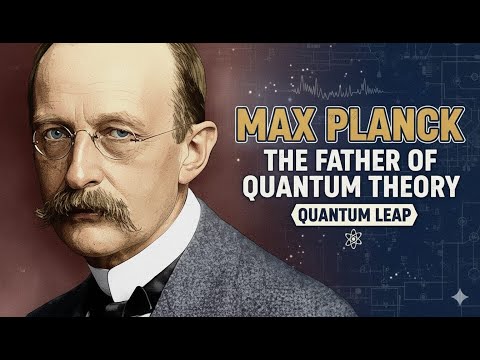
So, here’s a funny thing: did you know that the universe can be both a wave and a particle? Yeah, it’s like the universe has split personalities!
This wild idea is all thanks to this dude named Max Planck. Imagine a time when people thought everything was solid and predictable, like your favorite Lego set. Then bam! Planck strolls in and says, “Wait a sec, things are way trippier than they seem!”
He basically kicked off what we now call Quantum Theory. It’s not just some geeky science stuff; it’s about how tiny particles dance around in ways that totally mess with our heads. Want to know how this guy changed the game forever? Stick around!
Understanding Max Planck’s Quantum Theory: A Cornerstone of Modern Physics
Max Planck is like the granddad of modern physics. His work laid down some serious groundwork for what we now call quantum theory, which honestly, changed everything about how we see the universe. So, let’s break this down, shall we?
First off, back in the late 1800s, physicists were struggling with a major conundrum called the ultraviolet catastrophe. Basically, when they tried to understand how objects emitted light based on temperature, things didn’t add up at all. The predictions said that as you heated something up, it would emit infinite energy at shorter wavelengths. Yeah, total nonsense! Instead of a smooth curve, it was going crazy at higher frequencies. Super frustrating for these scientists!
Then came Max Planck in 1900 with his revolutionary idea: instead of thinking of energy as a continuous flow, he suggested it comes in tiny bits called quanta. Imagine you’re trying to eat a pizza—if you think about it as one big slice, it can get messy. But if you take it bite by bite? Much easier! Planck realized that light and heat could be broken down into these discrete packets.
His famous formula for black-body radiation showed that the energy (E) of these quanta is related to its frequency (ν) by the equation E = hν, where h is Planck’s constant—a super tiny number but crucial to everything quantum. This was mind-blowing at the time! It meant that light could behave both like a wave and like a particle.
And here’s where things get even cooler: this concept messes with our everyday understanding of reality. For instance, particles can exist in multiple states at once until you look at them—a phenomenon known as superposition. Think of Schrödinger’s cat—a thought experiment where a cat can be both alive and dead until someone opens the box to check.
But wait! There’s more: Planck’s ideas helped set off an entire movement in physics leading us to quantum mechanics. This field explains stuff like why atoms bond and how electrons behave around them. Ever heard about quantum entanglement? That’s another wild concept that says particles can be instantly connected regardless of distance.
In wrapping this up (kind of), Max Planck wasn’t just some guy in a lab; he kicked off changes that let us understand lasers, computers—you name it! His quantum theory opened doors to new technologies and insights into our universe that we still explore today.
It’s kind of amazing when you think about how one person’s thoughts can ripple through time and change everything we know about reality itself! Like planting a seed that grows into something magnificent.
Max Planck: The Founding Father of Quantum Theory and His Impact on Modern Science
Max Planck is one of those names that pops up whenever you’re talking about the building blocks of modern science. Seriously, this guy is like the grandfather of quantum theory, which is kind of a big deal when you think about how it changed our understanding of the universe. The foundations of quantum theory began to take shape because of his groundbreaking work in the early 1900s.
So, let’s set the stage a bit. Imagine it’s 1900, and scientists are scratching their heads over something called blackbody radiation. This is just a fancy way of describing how objects emit light when heated—like a warm piece of metal glowing red as it gets hotter. People were puzzled because classical physics couldn’t explain why the intensity of this emitted light dropped off at certain frequencies. Enter Planck.
Planck proposed that energy isn’t released in a continuous flow, but rather in tiny packets called quanta. You could say he was like the first person to discover that energy has a stop-and-go nature. Each packet, or quantum, is proportional to its frequency—the higher the frequency, the more energy each quantum carries. This thought was revolutionary! What Planck essentially did was take a leap into what we now call quantum mechanics.
Now, you might wonder what all this means for us today. Well, consider how pivotal Planck’s findings have been for modern technology—think about lasers and semiconductors! These wouldn’t exist without his initial insights into energy quantization. It’s kind of mind-blowing to realize that things we use every day rest on this one guy’s ideas.
Let’s break down his impact even further:
- Bridge to Modern Physics: Planck’s work laid the groundwork for later giants like Einstein and Niels Bohr who expanded on these concepts.
- The Quantum Revolution: His theories led to a new understanding of matter and energy interactions at microscopic levels.
- Philosophical Changes: The shift from deterministic views—where everything could be predicted—to probabilistic models changed how we think about nature itself.
- Technological Advancements: Quantum theory has given rise to innovations we take for granted today like GPS and MRI machines.
One quick anecdote comes to mind while talking about him: there’s this story where Planck would attend lectures on physics long after he stopped being an active researcher himself—showing just how passionate he was about learning and discovery. It’s inspiring to see someone so devoted—even when they already changed the world!
In short, Max Planck didn’t just stumble onto something interesting; he ushered in an entirely new era in science that continues to affect our lives today. He may not be as famous as some other scientists, but without his curiosity and willingness to challenge established norms, who knows where we’d be? Quantum theory isn’t just another concept in textbooks; it’s woven into our reality, all thanks to him!
Unraveling Quantum Theory: The Pioneering Discovery by Max Planck
Max Planck was like that curious kid in class who just wouldn’t stop asking questions. In the late 19th century, scientists were really puzzled about how light and heat worked. You know, they were trying to figure out what happens when objects get warm and start glowing. So, Planck decided to tackle this problem head-on.
What he found was pretty mind-blowing. He introduced the idea of quanta, which are basically tiny packets of energy. Imagine if you could only buy cookies from a vending machine in sets of two; you can’t just grab one! That’s kind of how energy works at a tiny level, according to Planck.
- Before him, scientists thought energy could be divided endlessly, like slicing up a pizza into tiny pieces.
- Planck said no, energy comes in chunks—like those cookies from that vending machine!
- This was the birth of quantum theory, which changed everything we thought we knew about physics.
Now, let me tell you this story that really shows how bold Planck was. When he first shared his ideas at a scientific meeting in 1900, many people were skeptical. They couldn’t believe what he was saying! But he persisted, and after a while, others started to see the sense in his ideas.
He developed what’s called Planck’s Law, which explains how objects emit radiation depending on their temperature. Think about it: when you heat something up, it glows brighter and changes color as it gets hotter—planets forging stars or an electric stove heating up are great examples!
- The cooler an object is, the lower its energy output and longer its wavelength.
- As it gets hotter? The wavelengths shorten and shift toward the visible spectrum.
This whole thing paved the way for other supercool discoveries in physics. People like Albert Einstein picked up on Planck’s ideas and ran with them! It laid down some serious groundwork for technology we use today—from lasers to semiconductors!
If you ever feel overwhelmed by all this quantum stuff out there today—don’t stress! Just remember Max Planck and his revolutionary thoughts about energy being made up of little packets or quanta. It’s like opening a door to a whole new universe where things don’t always act the way we expect them to. Kind of exciting, right?
So, you know, when you hear the name Max Planck, what pops into your head? For me, it’s this kind of brilliant scientist who just turned our understanding of the universe on its head. Picture this: It’s the late 1800s, and everyone is thinking about physics in a pretty straightforward way. Energy was seen as this continuous thing. Then, bam! Enter Planck with this wild idea that energy is actually made up of tiny packets called quanta. Like little energy nuggets.
I remember reading about how he came up with this theory to solve a problem called “black body radiation.” It sounds super technical, right? But basically, scientists were struggling to explain how objects emit light and heat at different temperatures. It was driving them nuts! Planck really just wanted to make sense of it all. And in doing so, he stumbled upon something revolutionary.
When he suggested that energy could be quantized—like it comes in discrete chunks instead of flowing smoothly—it must’ve been like a light bulb moment for him! Can you imagine that feeling? You’re grappling with a massive puzzle, and suddenly it clicks. It’s like those moments when you finally figure out a tricky riddle or solve that impossible math problem in school.
What Planck did was open the door to quantum mechanics. Not only did he challenge how we viewed light and energy but also paved the way for other great minds like Einstein and Heisenberg to expand on his ideas. This quantum revolution changed everything—not just physics but how we perceive reality itself!
And here’s where it gets really interesting: Planck was not just some distant genius; he had personal struggles as well. He lost his son during World War I, which hit him hard. For someone who changed the world in such profound ways yet faced personal tragedy, there’s something deeply human about that juxtaposition.
So now when I think about Max Planck and what he brought to the table with quantum theory, it feels more than just science; it’s about curiosity mixed with perseverance and resilience. And that’s pretty motivating if you ask me! You realize that behind all those formulas and theories are real people trying to make sense of existence—just like us in our everyday lives.