You know that moment when you’re poking around in your attic, and you find an old box of toys? You’re not really sure what’s in there, but you’re curious to dig it out? Well, that’s kind of how scientists feel when they use Rutherford backscattering.
Imagine this: You’ve got a beam of particles zooming into a sample. It’s like sending a tiny spy on a mission to uncover the secrets hidden inside materials. It’s super cool!
This technique is like the ultimate magnifying glass for material science. It helps researchers check out structures at an atomic level. You’d be amazed at what they can find!
So, let’s unpack this fascinating tool and see why it’s such a big deal in the world of materials. We’re diving deep, but don’t worry—no need for scuba gear!
Understanding Rutherford Backscattering: A Key Technique in Materials Science and Surface Analysis
So, let’s talk about Rutherford Backscattering, or RBS for short. It’s a really cool technique in materials science that lets us peek inside materials at the atomic level. Imagine you’re trying to see what’s inside a dense cake without cutting it open—you’d need something pretty powerful, right? Well, that’s basically what RBS does for materials!
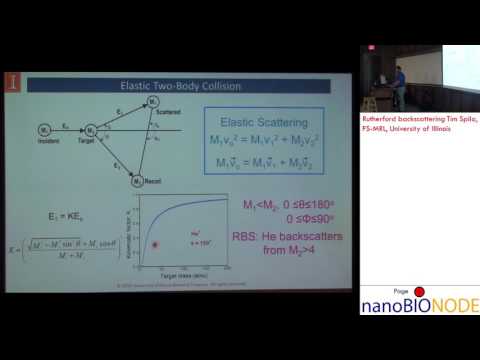
The whole thing is named after **Ernest Rutherford**, who was a pioneer in understanding atoms. RBS works like this: you shoot high-energy particles—usually helium ions—at a material. When these ions collide with atoms in that material, they bounce back, or “scatter,” and that’s where the fun begins! By measuring how many ions come back and at what energies, scientists can get a detailed picture of what’s going on inside.
Here are some key points about how RBS works:
- Ion Acceleration: The helium ions are accelerated using an ion source. They’re kind of like tiny darts being shot at the atoms.
- Scattering Events: When these ions hit target atoms, they either bounce back or get absorbed. It’s sort of like a game of dodgeball!
- Energy Measurement: The energy of the backscattered ions is measured using detectors. The energy tells us about the mass of the atom they bounced off.
- Depth Profiling: By changing how deep you shoot those ions into a material, you can gather info on different layers within it.
So why do we care? Well, RBS is super useful for understanding thin films and coatings on various materials—like those shiny layers on your favorite gadgets or solar cells. Have you ever wondered why some metals corrode faster than others? RBS can help figure that out by revealing what’s really going on at the surface.
Let me share an example that might resonate with you: Imagine your friend has a cool new phone case made from multiple layers of different materials. You might wonder how those layers interact and hold up over time under wear and tear. Using RBS to analyze it could show how well each layer protects against scratches or impacts.
And here’s another thing—RBS isn’t just for shiny gadgets; it also plays a crucial role in **semiconductors** and even nuclear physics! It’s like this secret weapon for scientists trying to develop new technologies.
So next time you hear about Rutherford Backscattering, remember: it’s not just some fancy lab technique; it’s a key player in helping us understand the materials all around us—from cutting-edge tech to everyday objects. Pretty neat, huh?
Exploring the Applications of Rutherford Scattering in Nuclear Physics and Material Science
Sure! Let’s take a closer look at the fascinating world of Rutherford scattering and its applications in nuclear physics and material science.
So, what is Rutherford scattering? You could say it’s like a game of cosmic billiards. In this technique, we send a beam of particles—usually alpha particles—into a target material. When these particles hit atomic nuclei, they can bounce back or scatter. The way they scatter tells us about the structure and composition of that material, kinda like how you’d analyze where the balls go after hitting them on a pool table.
Why is this important in nuclear physics? Well, it’s super useful for studying the properties of atomic nuclei. By examining how the alpha particles scatter off different materials, scientists can figure out how heavy or tightly packed those nuclei are. This contributes to understanding the forces that hold atoms together and helps us explore reactions that occur inside stars or during radioactive decay.
And it goes beyond just nuclear physics! When we talk about material science, Rutherford scattering really shines. You see, materials often have layers or coatings with varying properties. Using this technique, researchers can analyze thin films or coatings on surfaces without messing them up. Imagine trying to understand how well a protective layer on your phone holds up against scratches; that’s where this method comes in handy!
Here’s a rundown of some key applications:
- Characterization of thin films: Scientists can measure thickness and composition accurately.
- Surface analysis: It helps investigate surface contaminants or defects.
- Irradiation studies: Understanding how materials behave under radiation exposure is crucial for developing safer nuclear reactors.
- Nanotechnology: In this field, it aids in studying nanoscale materials and their interactions.
You know when you see those shiny new materials in tech? That’s partly thanks to Rutherford scattering! Researchers use it to explore advanced materials that might lead to better batteries or stronger lightweight composites.
And here’s something interesting: while Rutherford scattering was first used over a century ago by Ernest Rutherford himself, it still plays an essential role today. It evolved into techniques like Rutherford backscattering spectrometry (RBS). This allows scientists to get even more precise measurements about elemental composition and depth profiling of layers in the material.
It’s funny how something so simple can unravel such complex truths about our universe and technology! Just imagine holding an ancient meteorite in your hand, then using Rutherford scattering to uncover its story from billions of years ago—now that’s cool!
So basically, whether you’re peering into atomic structures or checking if that new gadget holds up against wear and tear, Rutherford scattering is there like an unsung hero in both fields. It’s amazing how much you can learn just by watching how tiny particles move around!
Understanding the Principle of Backscattering in Scientific Research
Backscattering, huh? Sounds a bit technical, but it’s actually super cool once you get into it. So, let’s break it down, shall we?
What is Backscattering?
Basically, backscattering is when particles—like atoms or subatomic particles—bounce off a surface and come flying back towards the direction they came from. Imagine throwing a ball against a wall and it comes right back at you. That’s kind of what happens with backscattering.
Now, this is particularly important in scientific research. Especially in material science, where we want to know what stuff is made of and how it’s structured. It’s like having X-ray vision! You can see inside materials without damaging them.
Rutherford Backscattering Spectrometry (RBS)
Let’s talk about Rutherford Backscattering for a sec. This technique uses high-energy ions to probe materials. When these ions hit the target material, they scatter off the atoms within that material. Some of these ions bounce back toward the detector—this is where we get that “backscattering” magic.
Why do scientists care? Well, the energy and angle at which these ions come back give us super important information about the composition and structure of the material being studied.
Key Points About RBS:
- Sensitivity: RBS can detect elements present in very small amounts, even down to one atomic layer thick!
- Depth Profiling: It can provide info on how elements are distributed at different depths within a sample.
- Non-destructive: Unlike some other methods, RBS doesn’t destroy your sample. You can test multiple times if needed.
Let’s throw in an anecdote for flavor! So once I was at this lab where they were studying thin films used in electronics. They needed to analyze multiple layers without messing them up. Thanks to RBS, they could take measurements all day without wrecking their precious samples. Just thinking about their excitement makes me smile!
Now you may wonder about its applications… Well, RBS helps folks develop new materials for everything—from electronics to medical devices! By understanding compositions at an atomic level, researchers can tailor properties for specific uses.
One more thing: the data collected from RBS doesn’t just sit there; researchers use sophisticated models to interpret results and make predictions about how materials behave under various conditions.
In summary, backscattering, especially via techniques like Rutherford Backscattering, plays a crucial role in exploring the microscopic world around us. It’s all about understanding materials better so we can innovate and create amazing new technologies!
You know, I’ve always found it kind of cool how we can peer into the invisible world of atoms. Rutherford Backscattering Spectrometry (RBS) is one of those fascinating techniques that lets us do just that. So, basically, it’s about sending a beam of ions—like high-energy helium nuclei—towards a material and listening to what happens when they bounce back. Seems simple enough, right?
Let me tell you a little story. I remember the first time I saw RBS in action at a lab open day during college. The guy running the machine was super passionate about how he could analyze different materials with just those little bouncing nuclei. He pointed at this display showing deep layers in a sample, and my mind was blown! Each tiny bump or wiggle on that screen told us something significant about what was going on in there. It felt like we were detectives uncovering secrets hidden inside materials!
Now, the important part about RBS is how it plays into material science. You see, understanding the composition and structure of materials at such a small scale is crucial for pretty much every field—from electronics to engineering to nano-tech. If you want to develop stronger alloys or create better semiconductors, knowing exactly what’s happening at the atomic level helps scientists make informed decisions.
And here’s where it gets really interesting: RBS can tell us not just what elements are present but also their concentrations and even how deep they go into a material. This means you can analyze layers in thin films or coatings without destroying anything! Imagine trying to figure out whether your favorite non-stick pan is actually as safe as it claims without tearing it apart—it’s like magic for scientists.
But hey, it’s not perfect! There are limitations; for example, if you’re dealing with very light elements like hydrogen or lithium, RBS struggles a bit because they bounce away too easily—if they even get caught in the first place! That said, researchers are always innovating and finding ways around these challenges.
In essence, Rutherford Backscattering isn’t just an academic exercise; it’s shaping how we understand and create materials for our everyday lives. Who knew that bouncing particles could have such a profound impact? It’s wild to think about all those tiny interactions leading to breakthroughs in technology and science we use today… It really makes one appreciate the unseen complexities of our world!