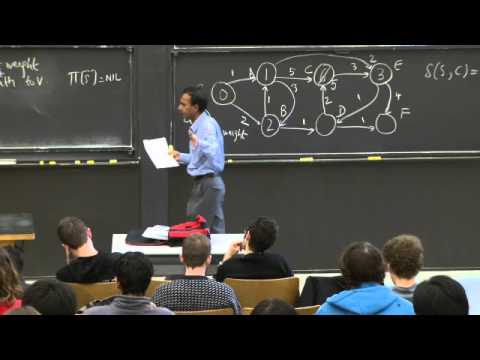
You know that feeling when you’re lost in a new city? You’ve got a destination, but the streets are a confusing maze. Yeah, I’ve been there. Once, I ended up at a donut shop instead of the art gallery—best mistake ever!
But back to paths. In science and everyday life, finding the shortest route can be super tricky. It’s not just about driving from Point A to Point B. Sometimes, it’s like figuring out the quickest way to connect ideas or even people.
So let’s chat about this whole shortest path thing. We’ll see how it pops up in everything from Google Maps to brain networking! Ready to unravel this maze together?
Mastering the Shortest Path Problem: Scientific Approaches and Practical Solutions
The shortest path problem is a classic issue in science and mathematics. Basically, it’s all about finding the quickest route between points. You know, like when you’re trying to get from one side of town to another without hitting all the traffic lights? That kind of deal.
The main idea here is to minimize distance or time. This can, like, apply to different fields—transportation, computer networks, and even biology! So let’s break it down a bit.
Graph Theory: The shortest path problem is often tackled using graph theory. Think of it as a map where points are connected by lines. Each point (or vertex) represents a location, while each line (or edge) represents the distance or cost between them. Pretty neat, huh?
There are several methods used to find that shortcut:
- Dijkstra’s Algorithm: This one’s super popular for finding the shortest path in graphs with non-negative weights. If you’ve got a map with various distances marked between places, Dijkstra’s helps you figure out the fastest way to your destination.
- A* Algorithm: A little more advanced than Dijkstra’s. It uses heuristics—kind of like educated guessing—to speed things up. So if you’re navigating through a maze or something similar, this algorithm is like having a hint about where the exit is.
- Bellman-Ford Algorithm: This one’s useful when edges can have negative weights. Think of scenarios where some paths provide shortcuts but could also incur costs—Bellman-Ford handles that situation well.
Now, why should we care about this? Well, imagine you’re using Google Maps or any GPS app—the algorithms behind those apps are working tirelessly to give you the best route based on traffic conditions and distances!
Other practical applications include network routing in computers. Like when data packets need to travel through different routers and switches—it’s crucial they take the most efficient paths. Less time traveling means faster internet for streaming your favorite shows!
And there’s even an emotional twist here! I once got lost during a hiking trip because I didn’t have good maps—what should’ve been an easy path turned into an exhausting detour. If only I’d known how these algorithms worked back then to find my way back more effectively!
So yeah, mastering the shortest path problem isn’t just some nerdy math game; it’s about making our lives easier every day! Whether it’s enhancing navigation systems or optimizing resources in various fields—understanding these algorithms opens up so many doors for practical solutions we encounter regularly!
Real-Life Applications of the Shortest Path Problem in Scientific Research and Analysis
The shortest path problem is pretty fascinating, right? At its core, it’s all about figuring out the most efficient way to get from point A to point B. This concept goes beyond just getting directions on your phone; it’s a big player in scientific research and analysis too.
First off, let’s think about transportation networks. When scientists are analyzing traffic management systems, they use algorithms that solve the shortest path problem to reduce congestion. The routes that emergency vehicles take can be optimized for quick response times, potentially saving lives during crucial moments.
Next up is neural networks. You might not realize it, but when researchers are designing artificial intelligence systems that mimic how our brains work, they often lean on the shortest path problem. By figuring out the quickest way to connect data points, AI can learn more efficiently and make decisions faster.
Now, consider genomics. In this field, scientists often model genetic pathways to understand how genes interact with one another. Using shortest path algorithms helps clarify which genetic connections are most significant for certain diseases. That’s a game-changer for personalized medicine!
Oh! And we can’t forget about social network analysis. When studying how people are connected on social media or within communities, researchers apply these algorithms to find the shortest link between individuals. Understanding these connections can reveal important social dynamics and influence patterns.
And then there’s bioinformatics, where scientists study biological data using computational tools. These tools can help identify the fastest pathway through complex biological processes like metabolic reactions or protein interactions. It makes understanding disease mechanisms way easier.
In environmental science, shortest path algorithms come into play too! They can help model wildlife migrations or track pollution dispersal paths in ecosystems. It aids in creating conservation strategies by revealing which routes species might take during migrations or how pollutants spread through water systems.
So yeah, from transportation and AI to genomics and environmental science—this problem isn’t just an academic exercise; it plays a crucial role in navigating real-world challenges across many scientific fields. It’s like having a trusty compass guiding discovery and innovation!
Exploring Alternatives to Dijkstra’s Algorithm: A Scientific Analysis of Pathfinding Efficiency
When you think about finding the shortest route between two points, Dijkstra’s algorithm is often the first one that pops into mind. It’s like the classic go-to when you’re trying to navigate a maze or plan your road trip. But, like, it’s not the only player in town! There are some nifty alternatives that can sometimes be faster or more efficient, depending on what you need.
1. A* Search Algorithm
So, let’s kick things off with the A* search algorithm. It combines features from Dijkstra’s and another method called greedy best-first search. Basically, it uses a heuristic to estimate how close you are to your destination. It’s like having a friend with a map who can point out the quickest way to get there based on where you’re currently at. This makes A* super efficient for pathfinding in games or robotics.
2. Bellman-Ford Algorithm
Then there’s the Bellman-Ford algorithm, which also finds shortest paths but does so by relaxing edges step by step. It can handle graphs with negative weight edges—that’s pretty cool if you’re dealing with certain real-world situations, like optimizing travel routes where some paths could have “penalties.” It doesn’t outperform Dijkstra’s if all edge weights are positive, but hey, it’s versatile!
3. Floyd-Warshall Algorithm
Now let’s talk about the Floyd-Warshall algorithm! This one is a bit of a heavyweight champ; it finds shortest paths between all pairs of vertices instead of just one source node. Imagine trying to figure out how to get from every city in your state to every other one—that’s what this bad boy does! It’s great when you need that complete info rather than just one route.
4. Johnson’s Algorithm
Next up is Johnson’s algorithm—a combo of Bellman-Ford and Dijkstra’s methods! It works brilliantly when you want an efficient way to find shortest paths between all pairs of nodes in sparse graphs—that means graphs with relatively few edges compared to the number of nodes.
Alright, let’s wrap this up by noting how these algorithms shine in different scenarios:
- Dijkstra’s: Best for non-negative weights and single-source searches.
- A*: Awesome for scenarios needing heuristics—think video games!
- Bellman-Ford: Go-to for negative weights and single-source searches.
- Floyd-Warshall: Perfect for getting all pairs’ data.
- Johnson’s: Great for sparse graphs needing multiple routes calculated.
So remember that while Dijkstra’s shines bright as a pathfinding star, exploring these alternatives can seriously save time and resources depending on your specific needs or graph configurations. Each algorithm has its own flavor and strengths which make them unique tools in a computer scientist’s toolkit!
You know, there’s something kind of poetic about finding the shortest path from one place to another. I mean, we all use that concept in our daily lives without even realizing it. Like, remember the last time you were headed somewhere? You probably had a mental map calculating how to get there quickest. Whether you took a shortcut through a park or avoided that crazy traffic jam—it’s all about efficiency, right?
Now, when we talk about the shortest path problem in science and beyond, it’s a bit more than just picking the fastest route. In mathematics and computer science, it’s actually this big deal involving graphs—those cool diagrams with nodes and edges. Each node is like a point you want to visit, and the edges represent the paths connecting them. So figuring out how to get from one node to another using the least distance or cost is basically what we’re dealing with.
Reflecting on this makes me think of my friend Sarah. She’s an engineer and once told me this story about working on a project involving urban transport systems. All these buses were zigzagging around town, wasting time and fuel because they weren’t following optimal paths! Sarah’s team used algorithms—not that I fully understand what they are—to analyze routes. They trimmed down travel times dramatically by finding those shortest paths.
But here’s where it gets interesting: this concept isn’t just confined to transportation or math nerds in labs. Seriously! It pops up everywhere—in networking, where data needs to hop from one server to another as quickly as possible; in logistics for delivery companies; even in biology when researchers track pathways in cellular processes! It feels like there’s something almost universal about it that transcends disciplines.
So when you think about it, navigating life can be seen through this lens too. We often find ourselves balancing between various choices—like paths on a graph—sometimes getting tangled up along the way but always yearning for efficiency in our decisions: be it personal relationships or career moves.
In essence, while the algorithms may be complex behind closed doors of tech offices, at its core lies that simple human desire for connection—the urge to find our most direct route through life’s maze. And isn’t that what makes these ideas resonate so much? It’s all connected!