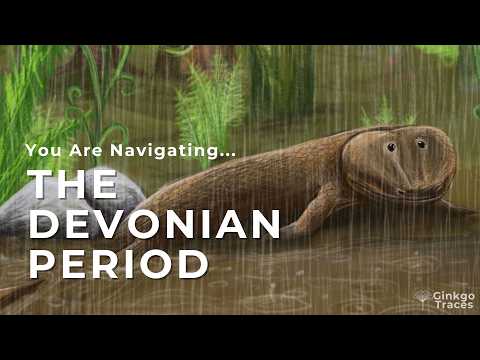
Okay, so picture this: a time when giant fish ruled the oceans, and the land was still figuring itself out. Weird, right? That’s like a scene straight out of a sci-fi movie!
Welcome to the Devonian Era, also known as the “Age of Fishes.” This was millions of years ago—like 419 to 359 million years back. If you think today’s underwater life is cool, just wait till you hear about the creatures that swam around back then.
So here’s the kicker: during this era, fish were basically the rockstars of the planet. They were evolving in all sorts of crazy ways, and guess what? Some even started crawling out onto land! Can you imagine being one of those early explorers?
Anyway, let’s take a quick dive into this fascinating period and check out how it shaped life as we know it today. You with me?
Unveiling the Devonian Period: Understanding Why It is Known as the Age of Fishes in Paleontology
The Devonian Period is like this super exciting chapter in Earth’s history, mostly because of its nickname: **the Age of Fishes**. This era lasted from about 419 to 359 million years ago, which is a seriously long time. But what does it mean for something to be called the “Age of Fishes”? Let’s break it down.
First off, you need to visualize a planet filled with oceans. The Devonian was mostly underwater. You’d find vast marine ecosystems buzzing with life. It was during this time that fishes really started to thrive and evolve into some pretty cool forms.
Why are fish the stars of this age? Well, it all comes down to variety and innovation. There were jawless fishes like **agnatha**, which were pretty basic but essential for the food chain, and then there were jawed fishes, or **gnathostomes**, beginning to show up too. You had early sharks and bony fishes making a splash—literally! But that’s not all; they didn’t just sit around looking pretty.
- **Diverse habitats**: These fishes ventured into all sorts of environments—from deep waters to shallow reefs.
- **Body structures**: Some had developed amazing adaptations like strong fins and sturdy skeletons made from bone instead of cartilage.
- **Predators and prey dynamics**: This created complex food webs where different species interacted in fascinating ways.
You know what’s even cooler? Some fish began venturing onto land! Yeah, you heard that right! They were the ancestors of modern amphibians and reptiles. Fancy that—fish flirting with the idea of living on dry land.
Thinking back to my childhood, I remember watching documentaries about big ancient creatures swimming around like titans of the sea—that feeling still amazes me. Imagine diving into waters filled with giant placoderms or seeing early coelacanths darting around! The Devonian was like a wild underwater adventure playground.
There were also some substantial changes happening on land during this period, with primitive plants starting to pop up along riverbanks and shorelines as well. You could almost picture these fish looking curiously at these green newcomers while figuring out their own way forward.
But not everything was smooth sailing; there were environmental shifts too! Towards the end of the Devonian, things got a bit rocky—not literally—but you know what I mean? Changes in climate led to some extinction events that affected marine life significantly.
To wrap it up, the Devonian Period stands out not just for being rich in fish diversity but also for laying crucial foundations for life on land as we know it today. It set off an evolutionary chain reaction that’s still felt millions of years later! Isn’t nature just mind-blowing?
Evolutionary Advancements in Fish During the Devonian Period: A Scientific Exploration
The Devonian period, often called the Age of Fishes, was a time when fish were not just important; they were thriving and evolving like crazy. This era lasted from about 419 to 359 million years ago. It’s wild to think how much has changed since then, huh?
During this period, fish adapted in some really interesting ways. There’s something beautiful about seeing life evolve to survive in different environments. Imagine ancient oceans filled with all sorts of fish, many of which looked completely different from what we see today.
One major advancement was the development of jawed fish. Before the Devonian, most fish were jawless, kind of like modern-day lampreys. Then came these jawed wonders that could grab and hold onto prey much better. It really opened up new food options for them. It’s like when you finally learn how to ride a bike with gears—suddenly, you can go places at speeds you never thought possible!
Another big deal was the evolution of fins that allowed for more sophisticated swimming techniques. Fish weren’t just flapping around anymore; they were navigating their aquatic world with finesse. They developed pectoral and pelvic fins that helped them maneuver through water with ease. Think about a professional swimmer gliding through water—they’re using the same principle!
And let’s not forget about the rise of lobe-finned fishes, like *Coelacanth*, which is still around today (can you believe it?). These guys started developing stronger limb-like structures which eventually led some species onto land millions of years later. It’s almost poetic—fish having dreams of exploring new frontiers beyond their watery homes.
Some interesting adaptations also included body armor and specialized scales for protection against predators, making them tougher than ever before! Imagine these armored warriors swimming through ancient seas—that’s pretty epic!
In addition to all this, there was a huge explosion in diversity during the Devonian as various species evolved to fill different niches in their ecosystems. You can think of it as nature’s version of a talent show where every contestant is trying out something unique—some became filter feeders, while others became fierce predators.
So yeah, the Devonian wasn’t just an age; it was a time of incredible transformation for fish and life in general! The advancements made during those millions of years set the stage for everything that followed—even us humans! Isn’t it cool to see how our own story is tied back to those ancient waters?
Exploring the Devonian Period: Key Features and Its Significance in Earth Science
The Devonian Period is like a thrilling chapter in the Earth’s history, kind of like that epic season of a show where everything changes. It lasted from about 419 to 359 million years ago. This time frame is often called the “Age of Fishes,” and trust me, there’s a good reason for that.
So, what makes the Devonian stand out? For starters, it was a time when fish really took the spotlight. You had all sorts of fish swimming around, some with bony structures and others with cartilage—kind of like sharks today. The diversity was mind-boggling. Early sharks, for instance, started appearing during this period.
And oh man, the landscape! The Earth during the Devonian wasn’t just water and fish. There were also incredibly lush forests filled with primitive plants. Imagine giant tree-like plants reaching for the sky! These plants were some of the first to venture onto dry land which helped change our planet’s atmosphere by producing oxygen. Can you believe how that would affect everything?
But let’s not forget about those brave little pioneers who decided to take their first steps on land; early amphibians began to emerge from the water. These creatures were like science fiction characters coming to life! They had characteristics of both fish and early land animals. It’s fascinating how they adapted over time.
Now, about those environmental shifts—things weren’t always smooth sailing. Throughout this period, there were significant changes in climate and sea levels. This led to various ecological zones evolving all over the planet. Some areas became perfect for marine life while others transformed into vast wetlands.
So you’re probably wondering why we should even care about this ancient period, right? Well, what happened then laid down some serious groundwork for life as we know it today! The developments made during this era in terms of biodiversity set the stage for later evolutionary milestones.
It’s also worth noting that these fossils give scientists clues on how life adapted through changing conditions—much like we’re facing today with climate change and habitat loss. There’s literally so much we can learn from looking back at this time!
In summary:
- The Devonian lasted from 419 to 359 million years ago.
- It’s known as the “Age of Fishes” due to diverse aquatic life.
- Primitive plants began colonizing land during this period.
- Early amphibians started emerging as they adapted from water to land.
- Environmental shifts influenced both marine and terrestrial ecosystems.
So yeah, exploring the Devonian Period isn’t just about fishes or old rocks—it’s a window into Earth’s past that helps us understand our own place in it all!
So, let’s chat about the Devonian Era for a minute. It’s this remarkable period in Earth’s history—spanning from around 419 to 359 million years ago—when the planet was like a giant underwater wonderland. Seriously, it was known as the “Age of Fishes,” and you can probably guess why.
Imagine diving into an ocean teeming with all sorts of fish, from tiny ones darting around to massive predators patrolling the depths. There were jawless fish flapping around like ancient vacuum cleaners and some of the first lobed-finned fish that eventually gave rise to amphibians. How cool is that? The whole vibe back then was like an epic aquatic adventure, just filled with life!
I remember once reading about giant placoderm fish—these armored critters that looked like they were dressed up for a medieval battle. They were tough and could grow up to ten feet long! Picture that beast hovering near you in the water. Scary stuff! It makes me think about how diverse life was then compared to a lot of what we see today.
Now, besides fishes, the Devonian wasn’t just aquatic mayhem; it had its share of land developments too. Plants began spreading across continents, creating habitats on land for insects and early amphibians venturing out from water. This transition is pretty monumental if you think about it—the move from watery realms to dry ground.
But here’s something that really gets me: all this vibrant life eventually led to some major extinction events at the end of the Devonian period. Like, what a rollercoaster! Just when everything seemed rad, nature threw a curveball and knocked out many species.
Sometimes I think about how those ancient ecosystems might have looked and felt—the colors, sounds (or lack thereof), and even scents must’ve been surreal compared to today’s world filled with car horns and bustling city noise. It really puts into perspective our own existence in time; we’re just tiny blips among millions of years where so much has changed—and yet some themes remain constant: adaptation, survival, and diversity.
So yeah, when you hear “Devonian Era,” think beyond just fish swimming around. Take a moment to appreciate that magical chapter in Earth’s story where life exploded in creativity beneath waves while daringly creeping onto land—and how those ancient tales still resonate today!