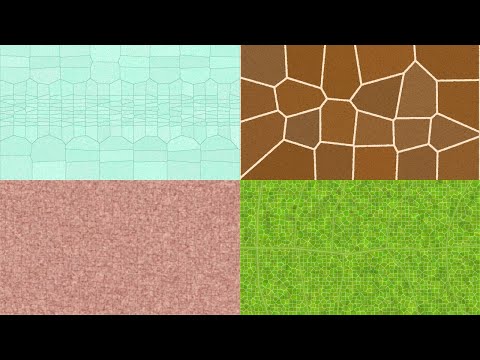
You know how when you look at a honeycomb and think, “Wow, that’s kinda cool”? Well, there’s this whole science behind it! It’s called Voronoi patterns.
Imagine walking through a park and spotting these funky shapes in the grass—like nature’s own quirky artwork. Pretty wild, right?
The thing is, these patterns pop up everywhere! From snowflakes to animal markings and even city layouts. Seriously, it’s like nature has its own unique design team.
So what gives? How do all these shapes come together? Let’s break down the magic of Voronoi designs and see why they’re so fascinating. It’s gonna be fun!
Understanding the Voronoi Pattern in Design: Applications and Implications in Scientific Research
The Voronoi pattern is super cool, and once you start to dig into it, you see how it’s literally all around us. You might not notice it at first, but this geometric design shows up in so many places in nature and science. The basic idea? It divides a space into cells based on distances to a specific set of points. You can think of it like how you’d split up a pizza among a group of friends—each person gets the slices closest to their seat.
So let’s break down what a Voronoi diagram looks like and where we can find it.
- Beehives: Have you seen how bees construct their hives? The hexagonal shapes they create are influenced by Voronoi patterns. Each cell is as efficient as possible for storing honey and pollen.
- Geology: In studying mineral deposits, geologists use Voronoi diagrams to model how resources are distributed across an area. It helps them understand where the most valuable minerals are located.
- Urban Planning: City planners use these diagrams when designing layouts for parks or public services. They can visualize service areas and ensure residents have equal access to facilities.
This also has some pretty significant implications in scientific research. For instance, when looking at ecosystems, understanding the distribution of species using Voronoi patterns helps ecologists figure out how species interact with one another and their environments. I once read about researchers who used this to study plant growth in fragmented landscapes—it was fascinating!
Now, let’s talk about applications beyond just nature. In computer graphics, Voronoi diagrams are used for texture generation and procedural modeling—like in video games or animations—that create realistic landscapes without drawing every detail by hand. Can you imagine trying to design every single rock or tree individually? What a headache!
Apart from that, scientists also apply Voronoi patterns in fields like meteorology where they analyze weather data. By mapping out weather stations using these diagrams, researchers can better predict local weather patterns because each cell represents the area influenced by that station’s measurements.
The implications really stretch far and wide! By breaking things down into these natural patterns, we get better insights into complex systems across different disciplines—from biology to meteorology and beyond! So next time you’re outside or look at your favorite video game map, keep an eye out for those amazing Voronoi designs doing their thing; they’re way cooler than they seem at first glance!
Exploring Real-Life Applications of Voronoi Diagrams in Science
Voronoi diagrams might sound fancy, but they’re honestly just a way to divide space into regions based on distances. Imagine you have a bunch of points, like cities or flowers in a field. Each point gets its own area, called a Voronoi cell. The cool part? These cells help us understand patterns in nature and have real-life applications across various fields.
One of the most obvious uses is in geography. When mapping populations, Voronoi diagrams can show how regions relate to service locations. For instance, if you want to find out which hospital serves which neighborhood best, a Voronoi diagram can illustrate that. The areas closer to each hospital belong to it, revealing how resources are spread out. Such insights can improve emergency response times!
Then you’ve got biology! Seriously, these diagrams pop up everywhere in nature. Take bees and flowers; they seem random at first glance but follow patterns similar to Voronoi cells. Each bee visits its closest flower patch more often than not. This behavior helps maximize their foraging efficiency—less flying around means more nectar.
In technology, Voronoi diagrams are super helpful in computer graphics and simulation models. When game developers create landscapes or city layouts, they use these diagrams for realistic terrain generation or even optimizing network coverage for wireless signals! By creating diverse yet organized layouts, they ensure smoother gameplay and better interactions within virtual worlds.
And let’s not forget materials science! Researchers use Voronoi patterns when studying crystal formations or even designing new materials with specific properties. By controlling how particles organize at a small scale using these principles, scientists try to enhance everything from strength to heat resistance in materials.
Check this out: Voronoi diagrams aren’t just math; they’re becoming essential tools in urban planning too! Planners use them to determine where new parks should go by analyzing space and accessibility for residents. They aim for balanced green spaces that everyone can enjoy without overcrowding—pretty thoughtful!
So there we have it! From biology to computer graphics and even urban planning, Voronoi diagrams provide fascinating insights into our world and help solve real problems creatively. It’s all about understanding the relationships between points—who knew geometry could be so handy?
Exploring Voronoi Patterns in Nature: Key Examples and Scientific Implications
Voronoi patterns are seriously intriguing. They’re these cool geometric shapes that pop up all over nature and they basically help us understand how different things spread out in space. Think of it like this: if you have a bunch of points, Voronoi patterns help visualize how the space around each point is divided among them. It’s like a game of dibs!
Key Examples in Nature
You can find Voronoi patterns in many natural arenas. Here are some real-life examples:
- Cells: If you look at a tissue sample under a microscope, the cells often form Voronoi-like structures. This division helps optimize space and resources.
- Plants: Ever notice how seeds or flowers are arranged? The layout tends to follow Voronoi principles to maximize sunlight and nutrients.
- Animal Territories: Animals tend to mark territories based on resources and spacing that resemble Voronoi diagrams. This is crucial for understanding competition and survival.
- Crystallography: The arrangement of molecules in crystals can also show Voronoi-like patterns, influencing how materials behave.
This is just a peek! You could stumble upon these patterns in so many unexpected places.
The Science Behind It
So, how does this all come together scientifically? The main idea is optimizing resources. In nature, organisms want the most advantageous position for light, water, or food—like plants leaning toward the sun or animals claiming their patch in the forest.
What’s super fascinating is how these patterns can actually predict things too! For example, they’ve been applied in fields like urban planning. When city designers use Voronoi diagrams, they can figure out where schools or parks should go by analyzing population densities.
And here’s where it gets even cooler: researchers are now using computer simulations to study these patterns further. They’re creating models that mimic natural systems to understand complex interactions over time—like predicting climate change impacts on habitats.
In conclusion—or rather as we wrap this up—Voronoi patterns teach us so much about efficiency and organization in nature. Next time you’re out and about, see if you can spot these magical shapes playing out! You might look at your surroundings with new eyes; isn’t that exciting?
So, let’s chat about this thing called Voronoi designs, which sounds all fancy but is really just nature’s way of making sense of the world. You know those times when you’re lying on the grass, staring at a bee buzzing around flowers? Well, if you take a closer look at how things are spaced out—like where the flowers are versus where the bee goes—you’re tapping into some pretty cool science.
Voronoi patterns are basically about dividing space into sections based on distance. Imagine you have a few points on a map, like your favorite coffee shops in town. A Voronoi diagram helps figure out which areas belong to each shop. So if you’re closer to one than another, that spot is “yours.” Nature does something similar with plants and animals. Think about how trees spread out in a forest or how cells organize themselves in our bodies. Every organism has its own turf!
I remember walking through a park once and noticing how flowers seemed to cluster together without stepping on each other’s toes—and no one told them how to do this! It was like they instinctively knew not to overcrowd their neighbors while still reaching for sunlight. That’s Voronoi magic right there!
These designs show up everywhere—not just in plants but also in animal territories and even in human-made structures. Ever seen the crazy patterns on a turtle’s shell or the way certain crystals grow? Yup, all Voronoi stuff! It speaks volumes about how life organizes itself efficiently, using limited resources smartly.
But it doesn’t stop there; scientists have even used these patterns to tackle complex problems, from computer graphics to urban planning. So next time you’re outside enjoying nature or just chilling with friends at that coffee shop down the street, take a moment to appreciate these little divisions that make life not just organized but downright beautiful. It kind of makes you feel connected to everything around you, doesn’t it? Just sitting there can spark thoughts about patterns and order amidst what sometimes feels like chaos. Life’s neat that way!