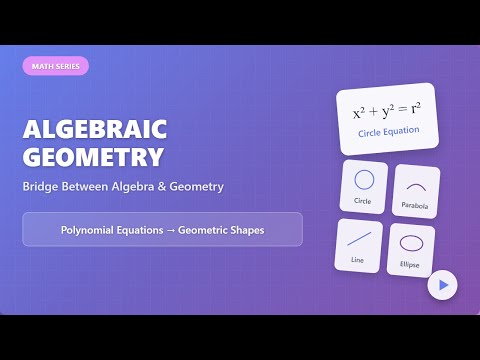
You know that moment when you’re trying to make sense of something that feels completely out of reach? Like the first time you realized that two plus two didn’t just equal four—it also meant something deeper?
Well, here’s the thing about algebra and geometry. They’re like two friends at a party who just don’t get each other. Algebra loves numbers and equations, while geometry is all about shapes and spaces. They hang out in their own corners, but when they come together… magic happens.
Now toss in a little topological twist—seriously, it’s not as complicated as it sounds! Imagine stretching a donut into a coffee cup without tearing anything. Sounds weird, right? But that’s basically what topology is all about. It’s like the ultimate team-building exercise for math concepts.
So if you’ve ever felt puzzled by these subjects or thought they were just for mathletes, stick around! We’re gonna bridge that gap and go on a fun journey where numbers swirl with shapes. You ready?
Exploring the Challenges of Topology: Is It the Most Difficult Branch of Mathematics?
So, let’s talk about topology—a branch of mathematics that focuses on the properties of space that are preserved under continuous transformations. You know, stretching and bending things without tearing or gluing them? It’s got some seriously mind-bending concepts!
Now, when people say topology is super difficult, they’re not joking. It introduces some really abstract ideas. Like, have you heard of a donut and a coffee cup? In topology, they’re considered the same because each has one hole. Weird, right?
But here’s the catch: while topology can be tough to grasp at first, it’s not necessarily the most difficult. There’s a lot that you need to wrap your head around before you get comfy with it.
- Topology often requires a good grasp of logic and set theory.
- The ideas are sometimes counterintuitive—for instance, think about how we define distances!
- You really need to get comfortable with abstract thinking; visualizing concepts isn’t always straightforward.
This brings us to how topology bridges algebra and geometry. There are these cool connections between shapes in space (geometry) and algebraic structures (think equations). For example, a topological space can represent points in space that connect through paths—yeah, like how you’d get from point A to point B by taking different routes. Understanding these links can be like piecing together a puzzle!
I remember when I first encountered this idea during my math courses. It was frustrating yet exhilarating! One minute I was staring blankly at these abstract shapes on a board, and the next I was discovering how they interacted. It’s kind of like completing your favorite jigsaw puzzle—you start seeing the whole picture gradually!
The truth is: while topology is challenging for many folks, it’s also incredibly rich. Each problem in topology can lead to new avenues of thought and discovery. You could tackle a question for months and still find new layers to peel back!
In summary, is topology the hardest? Well, it might feel that way sometimes due to its abstract nature and its requirement for sharp logical skills. But remember that any field has its own hurdles. So when you’re navigating through these funky shapes and spaces, just keep in mind that it’s all part of the beautiful journey math offers us!
Exploring the Connection Between Geometry and Topology in Scientific Research
So, geometry and topology, huh? They sound kinda similar but they’re really not. Imagine geometry as that clean-cut friend who loves measuring angles and presenting shapes, while topology is more like that free-spirited buddy who’s just interested in how things connect. You feel me?
Now, here’s the thing: both math fields are super useful in scientific research. They help us tackle complex problems in areas like physics, biology, and computer science. Basically, they give us tools to understand the universe better.
Geometry is all about shapes and sizes. You know those triangles and circles you learned about in school? That’s geometry giving you the basics to measure lengths, areas, and volumes of different figures. When scientists need to describe something concrete—like the surface of a planet—they lean on geometry.
But then we have topology. This is more about the properties of space that remain unchanged even when you stretch or twist them. Imagine a coffee cup versus a doughnut; they’re totally different shapes geometrically but topologically they’re equivalent because you can transform one into the other without cutting or gluing anything together!
Here’s a fun bit: topology helps scientists understand things like how networks connect or how molecules behave. Some researchers are using topological concepts to explore new ways of creating materials with unique properties—like superconductors that carry electricity without losing energy.
Now let’s explore some key connections between these two fields:
- Bridging Algebra and Geometry: You know how algebra gives us equations? Well, sometimes we can use these equations to describe geometric shapes and even delve into topological spaces.
- The Shape of Data: In data science, topology helps analyze high-dimensional shapes of data sets which might look messy at first glance.
- Applications in Physics: Quantum physics often employs topological ideas to describe particles in ways that wouldn’t make sense if we only relied on traditional geometry.
An emotional example might be from early computer graphics. Back in the day when designers were creating 3D models for movies, understanding both geometry for realistic shapes and topology for how those shapes connect made all the difference between a flopped character design and an icon we still remember today.
In essence, exploring the connection between anatomy (geometry) and connectivity (topology) opens up endless possibilities for scientific research. It’s kind of wild when you think about it! So next time you’re playing around with shapes or complex networks in your favorite app or project—remember there’s a whole world behind it fueled by these fascinating concepts!
Exploring the Intersection of Topology and Algebra in Modern Scientific Research
Exploring the intersection of **topology** and **algebra** is like discovering a secret passageway in a huge castle. You know, one minute you’re wandering the halls of abstract mathematics, and the next, you stumble upon something new that just makes everything click. So, let’s break it down a bit.
Topology is the study of shapes and spaces, but not in a rigid way. Imagine playing with clay. You can squish it or stretch it without tearing it; that’s topology for you! It focuses on properties that stay the same even when things get morphable. Think about how a mug and a donut are considered the same in topology because they both have one hole.
On the other hand, algebra deals with numbers and symbols, looking at how they interact under different operations. You know, adding, subtracting, multiplying—basic stuff like that but with structures instead of just plain numbers. When we start bridging algebra with topology, amazing things happen!
One cool concept here is *algebraic topology*. This blends these two fields by using algebraic tools to study topological properties. Picture it like using a treasure map (the algebra) to explore an uncharted island (the topology). For instance, when we think about shapes in algebraic terms, we can use something called *homology*. It’s like counting the different holes or voids in a shape to understand its structure better.
And here’s where it gets super interesting! By applying algebraic methods in topology, researchers can tackle complex problems in various scientific fields. For example:
- Studying data: Topological data analysis uses these ideas to find patterns in huge datasets.
- Quantum physics: In this realm, topology helps explain particle interactions.
- Biology: It helps analyze spaces between proteins and their functions.
This crossover isn’t just theoretical fluff; it affects real-world problems too! Scientists look at cellular structures or even network connectivity through this lens to understand how things are linked or separated.
But there’s more! The language spoken across these fields resonates profoundly within modern research dynamics. You’re not just looking at numbers on paper anymore; you are visualizing relationships between concepts themselves. It’s pure magic how these connections unfold!
So yeah, exploring this intersection means diving into uncharted territories of knowledge where math becomes more than logic; it becomes an adventure! And who knows? Maybe this blend will lead us to breakthroughs we can’t even imagine yet. That’s exciting stuff right there!
You know, when I think about algebra and geometry, they kind of feel like distant cousins at a family reunion. Algebra is all about numbers and operations—like solving for x or crunching equations. Geometry, on the other hand, is more visual. It’s shapes and sizes, angles and curves. But then there’s this cool thing called topology that kind of brings them together in a surprising way.
I remember back in high school, struggling with math homework late at night. My brain was frying from trying to visualize these shapes while also juggling equations. I was frustrated until one day, my teacher introduced us to topology. It felt like a light bulb went off! Suddenly, these abstract ideas started dancing together. Topology gave me this perspective where distance and shape weren’t the only players in the game; properties that stay the same even when you stretch or bend things came into play.
So what exactly is topology? Imagine you have a rubber band; you can twist it into all sorts of shapes without breaking it. That’s topological thinking! In topology, we don’t care about how long or short something is but rather about its connectivity and boundaries. For instance, when you think of a coffee cup and a donut (like one you’d find at your favorite bakery), they’re actually considered the same in topological terms because they have one hole each.
But here’s where it gets fun: these concepts can be applied in algebra too! When you’re working with algebraic structures called “topological spaces,” you’re blending those numbers and shapes together. This interplay helps mathematicians understand continuity and limits better than ever.
It’s like realizing that even though algebra loves its numbers and geometry adores its angles, there’s this beautiful common ground where they can meet—and it’s through how we perceive space itself! The mix of both allows us to explore dimensions beyond just lines or curves; we dive deep into this vibrant world where structure has no bounds.
So next time you’re grappling with those math problems—whether they’re funky equations or curious shapes—think about topology as that bridge connecting two worlds that seem so different but are really intertwined in remarkable ways!