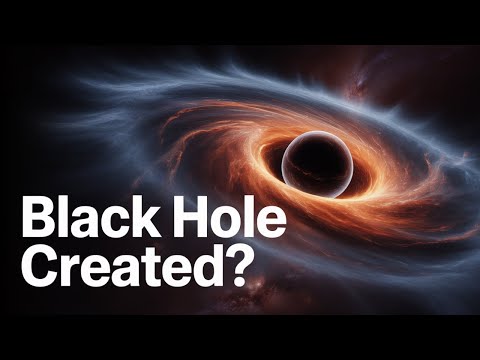
So, picture this: you’re on a completely normal day, sipping your coffee, and you stumble across a video of scientists trying to create artificial black holes. And you’re like, wait—what?! I mean, who wouldn’t want to whip up a tiny black hole in their lab? Not your average weekend project, right?
But seriously, the idea of making black holes is way more than just some sci-fi fantasy. It’s a wild mix of cutting-edge physics and imagination. Scientists are exploring some crazy concepts that could change our understanding of the universe.
You know how you sometimes feel like everything’s connected? Well, that feeling isn’t so far from what these researchers are chasing! They’re probing the mysteries of space and time in ways that sound straight outta a movie script. It’s all about playing with nature’s extreme rules and figuring out what makes the universe tick.
Buckle up! We’re about to take a ride through some mind-bending ideas that could lead us to breakthroughs we can’t even fathom yet. Excited? So am I!
Exploring the Feasibility of Artificially Creating Black Holes: A Scientific Perspective
So, let’s get into this whole idea of artificially creating black holes. Sounds like a sci-fi movie plot, doesn’t it? But the truth is, it’s a topic that scientists have actually started to explore.
Now, **black holes** are these crazy dense regions in space where gravity gets so strong that not even light can escape. We’ve got stellar black holes that form from collapsing stars and supermassive black holes at the center of galaxies. Creating one in a lab? Well, that’s a different beast entirely.
One thing you have to understand is the sheer amount of energy involved when dealing with black holes. One dimension we often talk about is the **Hawking radiation**. It’s this theoretical prediction made by physicist Stephen Hawking, suggesting that black holes can actually emit radiation and lose mass over time. This could mean they aren’t just great cosmic vacuum cleaners but could eventually evaporate completely.
Now, to artificially create a black hole, at least on a small scale, you’d need to manipulate *extreme conditions*. Think about how particle colliders work—like the Large Hadron Collider (LHC) in Switzerland. They smash particles together at incredibly high speeds, which creates conditions similar to those right after the Big Bang! Some scientists think that under such conditions— who knows? Maybe mini black holes might pop into existence for just a fraction of a second!
But here’s where it gets wild: these would be microscopic black holes! And they wouldn’t gobble up everything around them; they would evaporate almost instantly due to Hawking radiation. Imagine creating something so powerful yet so fleeting! It’s like making an ultra-rare snowflake; it exists just for a blink before melting away.
Still, there are huge hurdles to consider:
- Energy Requirements: The energy needed to create even tiny versions of black holes is off the charts—way beyond what humanity can currently harness.
- Safety Concerns: You might wonder if creating even small black holes could pose dangers. Theoretically speaking, if they were stable (which they aren’t expected to be), they could attract surrounding matter.
- Ethical Implications: Should we try something as extreme as this? There are moral questions lurking about what happens if things go wrong.
And then there’s the issue of our current understanding of physics itself. What we know is built on years of observations and theories combined with experimental data. If you think about trying to create artificial black holes, it would push our understanding in ways we can’t even imagine yet!
It reminds me of this story I once heard during one of those late-night talks with friends about physics and space exploration—we were debating whether humanity should ever venture out to other planets or start messing with dangerous cosmic events like these. One friend said something simple and profound: “If we reach for the stars one day—let’s not grab them too hard.” Those words stuck with me because they echo our responsibilities as explorers.
So yeah, while the idea sounds thrilling—and let’s be honest here, pretty mind-blowing—we’re not quite ready for artificial black hole creation just yet. For now, exploring their nature through high-energy physics experiments will keep us busy enough! Who knows what wild discoveries lay ahead as we keep pushing those boundaries?
Understanding Time Dilation: The Impact of Black Holes on One Minute in Space
So, let’s talk about time dilation. It’s a wild concept that messes with our understanding of time. Basically, it means time can run at different speeds depending on where you are in the universe. Really! If you’re near something super heavy—like a black hole—it can stretch your experience of time compared to someone far away from it. Kinda mind-bending, huh?
Now, imagine you’ve got a minute. Just 60 seconds. For you, standing in your living room, it’s standard fare. But if you’re close to a black hole? That minute might feel way longer.
Here’s how this plays out: **black holes** are these incredibly dense objects in space with gravity so strong even light can’t escape them. When something gets close enough, like matter or light, they get pulled in and distorted by that gravity. This effects time itself!
- Affect on Time: Time moves slower for objects falling into a black hole compared to someone who is further away.
- The Event Horizon: This boundary around a black hole marks where this strange stuff really kicks in.
Let’s break it down using an example: Imagine two siblings, Alice and Bob. Alice stays on Earth while Bob flies his spaceship right near a black hole. If they both have clocks set to the same time and Bob spends what he thinks is just one minute near the black hole, when he comes back to see Alice? She might have aged several years while he appears unchanged! Talk about sibling rivalry!
This leads us to another interesting idea—creating artificial black holes. Scientists have been dabbling with concepts that could mimic the effects of real black holes without needing one floating around space. The goal isn’t just for fun; it could unlock insane possibilities in physics and help us understand more about our universe.
You know what’s cool? When thinking about artificial black holes or simulations of them, researchers can look at how gravity affects things like particles and light without having to travel across galaxies. They’re not exactly building mini-black holes yet; it’s still theoretical stuff for now!
But here’s where this ties back into our original chat on time dilation: by studying those effects—even in controlled environments—we can gather insights into how gravity operates on a fundamental level.
So next time you hear someone mention black holes or time dilation? Remember Alice and Bob! And keep pondering just how bizarre—and awesome—our universe really is!
Exploring the Role of AI in Unlocking the Mysteries of Black Holes
Alright, let’s talk about black holes and the role of AI in helping us understand these cosmic enigmas. Black holes are these super heavy regions in space where gravity is so strong that nothing—not even light—can escape from them. Pretty mind-boggling, right?
Now, you might be thinking, “What does AI have to do with black holes?” Well, AI can analyze vast amounts of data really quickly. This is super important because observing black holes typically involves processing a ton of information from telescopes and simulations. The patterns they reveal can be complicated to decipher.
You see, when astronomers look at black holes, they often collect data from things like gravitational waves or x-ray emissions from material falling into them. That’s where AI steps in! With machine learning algorithms, scientists can train models to recognize specific signatures that indicate the presence of black holes or their behavior.
- For instance, researchers have used AI to process data from the LIGO observatory, which detects gravitational waves created by colliding black holes. The algorithms help identify these events faster and with more accuracy than humans could alone.
- Another cool application is in imaging techniques. When researchers captured that famous image of a black hole’s shadow in the galaxy M87, AI played a crucial role in reconstructing the image from scattered data collected by a global network of radio telescopes.
Anecdotally speaking, I remember reading about how one astronomer joked about feeling like they were working with “cosmic CSI” when using AI to sift through mounds of data. It’s like hunting for fingerprints left by galaxies far away!
Also, AI isn’t just sitting around waiting for data. It’s actively helping us understand theories about how black holes form and how they interact with their surroundings. By running simulations at lightning speed, scientists can test different models against real-world observations.
An exciting example comes from research into creating artificial mini-black holes using particle accelerators. Although this sounds like science fiction, modeling those scenarios with AI could lead to groundbreaking insights into fundamental physics and possibly open doors to new theories outside general relativity.
So yeah, the advancements in artificial intelligence are leading us deeper into the mysteries surrounding black holes. It’s not just tech for tech’s sake; it’s really reshaping our understanding of some of the most extreme phenomena in the universe.
The thing is—AI is becoming a partner for scientists exploring these cosmic wonders! Who knows what other secrets await us as technology evolves? The universe might be shouting its secrets already; we just need better ears (or brains) to hear them clearly!
Creating artificial black holes? Wow, that sounds like something straight out of a sci-fi movie, right? But it’s one of those wild ideas that scientists are actually exploring. Picture this: you’re sitting with friends, chatting about the cosmos, and someone throws in the idea that we might one day understand and even replicate the mind-boggling phenomena of black holes. It kinda makes your head spin, doesn’t it?
So first off, let’s not get too lost in the vastness of space just yet. A black hole is a region where gravity pulls so much that nothing—not even light—can escape. They form from collapsing stars, which is a pretty dramatic way for celestial bodies to end their lives. But here on Earth? Well, creating something like that isn’t about smashing stars together; it’s more about understanding fundamental physics.
Scientists have been experimenting with ways to simulate some effects of black holes in particle accelerators or supercooled atoms. Basically, they try to mimic certain behaviors but not create actual black holes (phew!). It’s sort of like how we can create mini tornadoes in a lab by spinning air around really fast but without the destruction.
What’s amazing about these experiments is they could give us insights into quantum mechanics and gravity—two huge pillars in physics that don’t quite play nice together yet. You know? It’s like trying to fit two jigsaw pieces together that just don’t mesh no matter how hard you try.
But there’s an emotional side to all this science too. I remember lying on a blanket under the stars as a kid, feeling both small and infinite at the same time. That sense of wonder—you know what I mean? It’s why folks pursue these lofty ideas; there’s something magical about understanding our universe and pushing boundaries.
Still, creating artificial black holes carries its risks. Like anything powerful, it can lead to questions about ethics and safety—what if we accidentally opened a doorway to who-knows-where? And while that’s mostly hypothetical for now (thank goodness!), it shows just how important balance is when exploring innovative ideas.
So yeah, while we might not be getting our own personal black hole anytime soon (breathe easy!), the research sparks curiosity and gets us thinking bigger and bolder about what lies beyond our grasp. And who knows? Maybe one day we’ll unlock secrets buried deep in the fabric of spacetime itself!