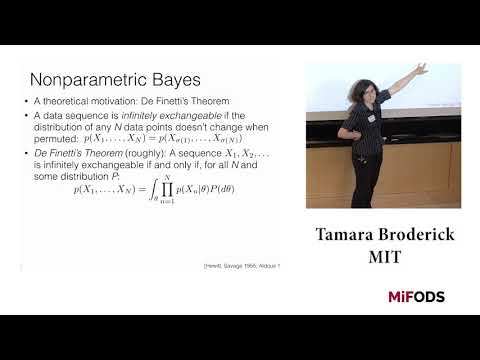
So, picture this: You’re at a party, right? Someone brings up statistics, and suddenly, everyone’s eyes glaze over. But hang on a second! What if I told you that there’s a fancy-sounding thing called Bayesian Nonparametrics that could totally spice up that boring convo?
Yeah, I know—it sounds like something only math nerds care about. But it’s actually a pretty cool tool in modern scientific research! You might be wondering why should you care about it? Well, imagine trying to understand complex stuff without getting bogged down by rigid rules and limits.
That’s where Bayesian Nonparametrics comes in. It’s like having the freedom to explore ideas without those pesky boundaries holding you back. Pretty neat, right? So let’s break it down together! I promise it’ll be more interesting than your friend’s uncle’s fishing stories!
Exploring Bayesian Nonparametrics: A Comprehensive Guide for Modern Scientific Research (PDF Download)
Bayesian Nonparametrics might sound a bit intimidating at first, but hang on. When we break it down, it’s actually pretty interesting and useful in a bunch of different fields. It’s all about making sense of data without needing to put it into a strict mold or framework. Think of it like being able to explore the wild instead of just sticking to a marked path.
So, let’s get into it! At its core, Bayesian Nonparametrics allows you to create models that grow in complexity as your data increases. Unlike traditional parametric models that require you to assume a fixed number of parameters ahead of time, nonparametric methods let the data speak for itself. This flexibility is why they’re becoming more popular in modern scientific research.
You see, in many scientific fields — like biology or economics — the data can be messy and unpredictable. Imagine trying to measure how much a plant grows under different conditions. If you only used fixed equations based on previous studies, you might miss out on new growth patterns unique to your situation. That’s where Bayesian Nonparametrics comes in! It helps accommodate evolving patterns without forcing them into boxes.
Now, the Bayesian part is super important too! Basically, it means you start with some prior beliefs about your data and then update these beliefs as new evidence comes in. So if your research starts showing unexpected results, this method helps you adjust your model on the fly rather than having to toss everything out.
Let’s chat about some key concepts:
- Dirichlet Process: This is one of the building blocks of Bayesian Nonparametrics. It allows for an infinite number of possible distributions — which means your model can adapt as more data appears.
- Gaussian Processes: These are another type that provides a flexible way to model functions directly from observed points. They’re great for smooth predictions over continuous spaces.
- MCMC (Markov Chain Monte Carlo): This is often used in conjunction with Bayesian methods for sampling from complex distributions when it gets tricky mathematically.
Now here’s something fun: think back to school science fairs where kids would show off their science experiments — there was always that kid who built an elaborate project that changed when they added more LEGO blocks because they found something new! That’s kind of what Bayesian Nonparametrics does for researchers; it opens doors for discovery as more information comes in.
In modern scientific research, these methods are applicable across various areas including machine learning, climate science, and even genomics. For instance, if scientists want to model genetic variations across populations without assuming a specific distribution shape beforehand, this method totally shines.
In summary, exploring Bayesian Nonparametrics gives researchers tools that are flexible and dynamic—like an endless toolkit waiting for them to uncover something amazing with every new dataset they gather. And honestly? That’s pretty exciting stuff!
Bayesian Nonparametrics: Transforming Scientific Research Through Advanced Statistical Methods
Bayesian nonparametrics might sound like a complex term, but don’t worry, it’s not as intimidating as it seems! Basically, it’s a way of doing statistics that gives researchers a flexible framework to draw conclusions from data without making strict assumptions about the underlying distribution. Let’s break this down.
First off, traditional statistical methods often rely on fixed models. Think of these models like putting your data into a box with specific dimensions. But what if your data doesn’t fit that box? That’s where Bayesian nonparametrics comes in. It allows for infinite dimensional models, which means you can adapt to the complexity of the data without being stuck in that tiny box. You follow me?
So, how does this actually work? Well, Bayesian nonparametrics uses something called prior distributions. This basically means you’re starting with some beliefs about what your data might look like even before you see it. After collecting data, you update those beliefs using Bayes’ theorem. And here’s the cool part: instead of just saying “my model has two parameters” or “three categories,” you can let the data tell you how many parameters or categories there should be.
The most popular example is probably the Dirichlet Process. It helps in clustering problems where you don’t know beforehand how many clusters exist in your data. Imagine trying to categorize your friends into groups based on interests when you don’t even know how many groups there are! The Dirichlet Process helps figure that out by allowing for an unknown number of clusters based on the data at hand.
You might be curious about real-life applications and why scientists are buzzing about this approach so much. Picture a clinical trial studying a new drug’s effects across different demographics. Instead of assuming everyone fits neatly into predefined categories (like age groups), researchers can use Bayesian nonparametrics to understand how effects vary within populations they didn’t expect or even discover new subgroups altogether!
Also, think about machine learning. Many machine learning algorithms can benefit from a Bayesian approach because they thrive on flexibility and adaptability. That means better predictions without getting stuck trying to force things into rigid frameworks.
Alright, so what are some challenges? Even though Bayesian nonparametrics is super powerful, it requires computational resources and can be tricky to implement compared to traditional methods. Not every researcher has access to high-end computing power or expertise in these advanced methods—yet!
In summary, Bayesian nonparametrics transforms research by embracing complexity and adaptability rather than forcing data into predetermined boxes. Its flexibility allows scientists to explore patterns and relationships more freely than ever before—pretty amazing stuff! So next time someone mentions Bayesian nonparametrics at a party (which could happen!), you’ll know exactly what they’re talking about!
Bayesian Nonparametric Models for Analyzing Heterogeneous Treatment Effects in Zero-Inflated Data Settings
So, let’s break down this whole thing about Bayesian Nonparametric Models and how they help analyze heterogeneous treatment effects, especially in those tricky zero-inflated data settings.
You might be scratching your head wondering what all that means. No worries—I’ll try to keep it simple! To start, when we’re talking about heterogeneous treatment effects, we’re really just saying that different people or groups react differently to the same treatment. For instance, think about a new weight loss drug; some folks might shed pounds while others see no change at all. That’s where these models come into play.
Zero-inflated data? Now that sounds fancy, but it’s just a situation where you have way more zeroes in your dataset than you’d ordinarily expect. Like imagine a survey about rare diseases where most people report zero instances because they don’t have the disease at all! It can be tough to make sense of such datasets because traditional methods often struggle with all those zeroes.
This is where Bayesian Nonparametric Models come in handy. They allow for more flexibility in modeling by not assuming a fixed number of parameters ahead of time—hence “nonparametric.” This is super helpful when we’re faced with complex situations like our friend the zero-inflated data!
- Flexibility: With Bayesian Nonparametrics, you don’t have to stick to rigid preconceived notions about how many parameters you’ll need. This adaptability allows the model to grow as more data comes in, capturing nuances better.
- Hierarchical Structures: These models can deal with multi-level data pretty well. So if you’re looking at different groups within your dataset—the urban versus rural populations, for example—you can structure your analyses accordingly without losing sight of individual differences.
- Priors: Using prior information effectively is key! In Bayesian analysis, you bring existing knowledge and beliefs into the model as “priors.” This can help refine estimates and improve predictions when there’s limited data.
An example might help here: imagine you’re studying the impact of an educational program on student performance across various schools. Some schools might see huge boosts while others barely budge. If you’ve got a mix of urban and rural schools—and maybe even low- vs high-income backgrounds—you’d want a model that captures those differences well without being too rigid. A Bayesian Nonparametric approach lets you do this by adapting based on what’s actually happening rather than forcing it into pre-set categories.
The combination of addressing heterogeneous treatment effects and zero-inflated settings provides researchers with powerful tools to make sense of complex real-world scenarios. Plus, it invites more nuanced interpretations that could lead to better decision-making down the line!
In essence, using Bayesian Nonparametric Models gives you room to maneuver when dealing with diverse treatments and peculiar datasets filled with zeros. It’s not just statistics; it’s like having a flexible friend who adapts as life throws curveballs your way!
You know, when you hear the term “Bayesian nonparametrics,” it can sound pretty intimidating at first. Seriously, it’s like a secret club for statisticians or something. But once you peel back the layers a bit, it actually opens up some super interesting avenues in modern scientific research.
I remember a time when I was trying to analyze some messy data from an experiment. No joke, I was pulling my hair out trying to find the right model—one that would fit without being too rigid but still give me meaningful insights. That’s where Bayesian nonparametrics comes into play. It’s like having this flexible toolkit that adapts as your data pours in.
So, here’s the gist: traditional statistical models often assume a fixed number of parameters. You pick your model and stick with it, right? But what if your data wants to tell you something different? Enter Bayesian nonparametrics! Instead of saying “here’s how many parameters I need,” it allows the data itself to guide that decision. Kind of cool, huh?
This adaptability means you can handle all sorts of complex situations—like when your data isn’t just one thing but is made up of multiple groups or clusters. Think about how messy real-world data can be—like different species in an ecosystem or various patient responses in a clinical trial. With these methods, researchers don’t have to force their observations into a predetermined box; they can let the patterns emerge naturally.
But wait; it’s not just about flexibility. There’s also this whole idea of uncertainty baked into Bayesian statistics. It acknowledges that we don’t know everything and lets us quantify our beliefs based on what we’ve seen so far. This aspect is crucial in scientific research where decisions often have big implications.
Still, it’s not all sunshine and rainbows—there are challenges too! The math can get pretty intense, and sometimes people shy away because they think it’s too complicated or beyond them. But honestly? Once you get past that initial barrier, it really feels liberating.
In today’s world of massive datasets and complex problems—from public health crises to climate change—the power of Bayesian nonparametrics is like having an artist with a versatile brush instead of just one fixed toolset. It’s all about painting a clearer picture from intricate details while respecting the uncertainty lurking behind every curve.
So yeah, contemplating how these methods shake up traditional thinking in science really gets me excited! It not only enhances our understanding but makes space for creativity in analysis—a little reminder that even in research, you don’t have to stick with the status quo if there’s more room for exploration!