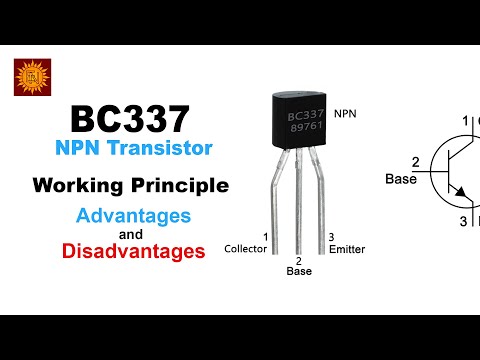
You know that moment when you press a button and something cool happens? Like turning on a light or firing up your favorite gadget? Well, that’s where transistors come in. They’re like tiny superheroes of the electronics world.
Take the BC337 transistor, for example. It’s a little component that packs quite a punch. Seriously, this thing can switch or amplify electrical signals like it’s nobody’s business.
I remember once making a simple radio with my buddy in high school—it was just a bunch of wires and some plastic parts—and when we got it to work, we felt like geniuses! All thanks to tiny things like the BC337 helping us out, you know?
So let’s chat about why this little guy is such a big deal. From everyday gadgets to cutting-edge tech, its applications are pretty wild!
Understanding the Applications and Functions of BC337 Transistors in Electronics
Transistors are like the tiny switches of the electronics world, and the BC337 is a popular type. It’s a bipolar junction transistor (BJT), which means it helps control current flow. The thing with BJTs is they can amplify signals or switch them on and off. So what’s so special about the BC337? Well, let’s break it down.
You’ll find BC337 transistors in lots of everyday gadgets. They’re not just sitting on the shelf waiting to be picked up; they’re out there in action! You know those remote controls for your TV? Yep, there’s a good chance they have a BC337 inside helping to send those signals.
Applications of BC337 transistors include:
- Amplification: They can take a weak signal and make it stronger. Think about your favorite music being played louder.
- Switching: These transistors can act like light switches but for electronic signals. When you push a button, the BC337 can turn things on or off.
- Signal Modulation: It helps in encoding information onto carrier waves, like what happens with radio broadcasting.
So how does this all work? Imagine you’re working on an old DIY project—like that time you tried to build a small radio at home. You probably needed something to boost the audio signal so you could actually hear the music over static noise. That’s where the BC337 comes into play.
Also, these little guys come with some neat features! They can handle current quite well—up to about 800 mA. This makes them ideal for driving loads like small motors or light bulbs without overheating too much.
Now, while they do have their perks, there are limits too. For instance, if you’re working with high frequencies—like in video applications—you might want something else because BC337 doesn’t perform as well up there. But for most hobbyist projects and gear that doesn’t require ultra-high-speed operation? It’s spot on!
In real life scenarios, connecting two BC337s together might give you even more capabilities—like creating push-pull amplifier circuits that offer even better sound quality in audio setups. Seriously cool stuff when you think about how much these little components influence your experience without you even realizing it!
So yeah, whether you’re tinkering with projects at home or exploring more complex electronic systems, understanding how transistors like the BC337 work gives you an edge in making things happen!
Understanding the Differences Between BC547 and BC337 Transistors: A Comprehensive Guide for Electronics Enthusiasts
Sure! Let’s break down the differences between the BC547 and the BC337 transistors in a way that makes sense. They’re both commonly used BJTs (Bipolar Junction Transistors), but they have their own unique traits that make them special.
Basic Overview
So, here’s the thing: both transistors are part of the NPN family, meaning they’ve got three layers of semiconductor material—one being an N-type (negatively charged) and two being P-type (positively charged). The main difference lies in their specifications and how they’re used in circuits.
Key Differences
- Current Rating: The BC547 is typically rated for a maximum continuous collector current of about 100mA, while the BC337 can handle up to 800mA. This means if you’ve got something that needs a bit more power, like driving a small motor, you’d probably lean towards the BC337.
- Voltage Ratings: When it comes to voltage, the BC547’s maximum collector-emitter voltage (Vce) is around 45V. In contrast, the BC337 can go as high as 50V. It’s not a massive difference, but hey, every volt counts when you’re building something!
- Gain Values: They have different current gain values (hFE). The hFE for BC547 generally falls between 110 and 800, while for BC337 it’s slightly lower—around 100 to 630. This makes a difference in how effectively they can amplify signals.
- Package Type: Both transistors usually come in standard TO-92 packaging; however, sometimes you might spot slight variations based on manufacturers or specific designs.
Applications
Alright, let’s talk about where you’d use these guys.
If you’re tinkering with something low-power at home—like building an amplifier or switching devices—a **BC547** fits right in. You know those small projects where you just need to light up an LED? Perfect!
But if you’re thinking bigger and want to control motors or relays—especially in robotics or higher-power applications—the **BC337** is your buddy. It’s robust enough to manage heavier loads without burning out.
Anecdote Time
I remember my first hands-on project with transistors—it was a simple LED circuit using a BC547. I was so excited watching it light up! But then I tested it with a stronger power supply without realizing its limits – yikes! The transistor fizzled out pretty quickly. That taught me about understanding specs better and really appreciating what each component can do.
Wrapping Up
In short, whether you’re going with the **BC547** or the **BC337** really depends on your project needs. Always keep those current ratings and application scenarios in mind! So next time you’re choosing between them for your next electronics build, think about what you’re powering and how much juice you’ll need.
Happy building!
Exploring Common Applications of Bipolar Junction Transistors in Modern Science
Sure thing! Let’s break down the world of bipolar junction transistors (BJTs), specifically the BC337 transistor, and how they make our modern gadgets tick. It’s actually pretty cool!
Bipolar junction transistors are these little components that can amplify electrical signals or act as switches. The **BC337** is a *NPN* type transistor, which means it helps control and switch electronic signals and power in circuits. You know, I remember the first time I took apart an old radio—there were all these tiny pieces inside, but the transistors were like the unsung heroes. They do so much for us without getting any credit!
In terms of applications, let’s talk about some common uses for BJTs like the BC337:
- Amplification: These transistors can take a small signal and make it bigger. For example, in audio equipment, they help to amplify sound signals so you can jam out to your tunes.
- Switching: BJTs are excellent at turning things on and off. Think about your computer or your smartphone; they use BJTs to manage power efficiently. When you hit that power button, it’s likely a BJT doing its thing!
- Signal Modulation: In communication devices, BJTs help modulate signals for things like radio frequencies. They ensure that we get clear audio when listening to our favorite stations.
- Control Circuits: From simple toys that light up to complex industrial machines, BJTs serve as crucial components in control circuits that regulate operations based on specific conditions.
- LED Drivers: Want those colorful lights in your electronics? The BC337 can drive LEDs by providing enough current while keeping them safe from overloading.
So what does this mean for modern science? Well, BJTs like the BC337 have revolutionized technology over the past few decades. They’re used in everything from consumer electronics to medical devices—you name it!
I’ll give you an example: imagine a nurse using a portable ultrasound machine during a check-up. Inside that machine are countless intricate components working together smoothly. The reliability of those gadgets often comes down to BJTs handling various tasks efficiently.
And here’s something neat—BJTs have some competition with other types of transistors, like Field Effect Transistors (FETs). But their ability to handle high currents makes them super valuable for many applications.
All this stuff may sound complex at first glance but think of it this way: every time you enjoy music from your phone or rely on medical equipment at a clinic, there’s probably a trusty BC337 (or other similar transistor) quietly ensuring everything works flawlessly.
So yeah! Transistors are everywhere around us! They might be tiny components but play enormous roles in enhancing our day-to-day technology experiences. Pretty rad when you think about it!
The BC337 transistor, huh? It may seem like just another electronic component in a vast sea of gadgets and gizmos, but there’s so much more to it. I mean, imagine a tiny piece of technology that plays a huge role in everything from your smartphone to remote-controlled cars. It’s wild how something so small can have such a big impact on our daily lives.
When I first learned about transistors, it honestly felt like diving into an ocean of wires and circuits. But then, I remember putting together my first simple circuit. There was this exhilaration when the light bulb lit up for the first time! That moment was pure magic, you know? And at the heart of it was a little guy like the BC337. It’s fascinating—this little transistor acts as a switch or amplifier, helping to control electrical signals. So it’s like that friend who always knows when to step back and let others shine while still playing an essential role in keeping things running smoothly.
Now, let’s talk applications. From amplifying audio signals in your favorite songs to managing power in complex systems, the versatility of the BC337 is impressive. It’s often used in low-power applications; think battery-operated devices or even some LED lights that you might use at home. When you flip that switch and see those lights come on? Yup! Thank the BC337 (and its buddies).
And you might see it pop up in innovations too! So many cool projects rely on this little transistor—like creating DIY robots or automating garden watering systems with Arduino boards. It’s incredible how everyday folks are embracing technology with components like this one, bringing creativity into engineering.
But here’s where it gets interesting: as technology advances—like with AI or smart devices—the way we use transistors is evolving too! We’re talking about improvements in efficiency and miniaturization that make devices not only smarter but also more eco-friendly. Seriously, just think about building sustainable gadgets using these little heroes!
In all honesty, whenever I come across stories of inventors and makers using components like the BC337 for innovative projects or solutions to real-world problems—it just fills me with hope! Like there’s this sense of community among tech enthusiasts who share ideas and skills.
So yeah, while transistors might not get all the limelight they deserve, it’s clear they’re pivotal players on our tech team. They help us connect ideas with reality—and if you ask me, that’s pretty darn cool!