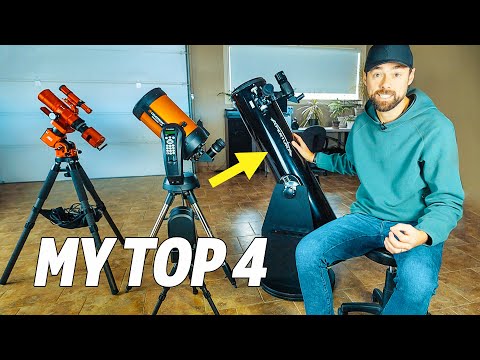
You know that moment when you first see Saturn’s rings through a telescope? Like, your jaw drops, and you’re left wondering if your eyes have deceived you. Seriously, it’s like peeking into another world.
So, if you’re just getting into astronomy, a good refractor telescope can be your best buddy. They’re super user-friendly and give you some crisp views of the cosmos without much fuss. Plus, no need to worry about complicated setups or techy stuff that would make anyone’s head spin, right?
Whether you’re dreaming of spotting distant galaxies or just want to impress your friends at the next stargazing night, there’s a perfect scope out there with your name on it. Let’s chat about some top picks that’ll make those starry nights unforgettable!
Top Telescopes for Astronomy: A Comprehensive Guide to Finding the Best Option for Stargazing
When you think about stargazing, the image of a telescope likely pops into your mind. Telescopes are the magical instruments that let you peek into the vast universe. If you’re just starting in astronomy, it’s super important to choose the right one for your needs, especially when it comes to refractor telescopes.
Refractor telescopes use lenses to gather and focus light. They’re like the classic choice for many enthusiasts because they give clear images and are pretty easy to use. Imagine setting up on a clear night with friends, feeling that excitement as you point your telescope towards the stars!
Now, there are different kinds of refractors out there. Here are some points to consider:
- Aperture Size: This refers to how big the main lens is. A larger aperture means more light can come in, leading to brighter and clearer views of distant objects. For beginners, something like a 70mm or 80mm aperture is often recommended.
- Portability: If you plan on taking your telescope on trips or want to set it up in your backyard, weight and size matter! Some telescopes fold down quite compactly which can make life easier.
- Mount Type: There are mainly two types: altazimuth (up-down and side-to-side) and equatorial (aligned with Earth’s axis). Beginners might find altazimuth mounts easier to work with at first.
- Price Point: Budding astronomers don’t need to break the bank! You can find decent refractors in various price ranges. Just remember that sometimes paying a bit more can get you better quality!
You might be wondering about some specific models that fit these criteria. Well, there are a few out there worth mentioning! The Celestron Astromaster 70AZ, for instance, is lightweight, has a 70mm aperture, and offers great portability—you could easily take this one camping! Another option is The Sky-Watcher ProED 100 mm, which is fantastic for more serious sky-watchers who want sharp images of planets and star clusters.
The fun part about using a refractor telescope is how engaging it makes stargazing! Picture yourself gazing at Jupiter’s bands or Saturn’s rings through a well-aligned lens—pure magic if you ask me! And here’s a little tip: try using smartphone apps that help with tracking constellations; they can really enhance your experience.
The most important thing? Pick something that excites you—after all, stargazing isn’t just about looking; it’s about connecting with the cosmos!
If you’re starting this journey into astronomy, take your time exploring options. Remember why telescopes spark curiosity—they open doors to worlds beyond our own! Whether you’re viewing breathtaking nebulae or simply marveling at the moon’s craters, each moment spent under that vast sky makes all the difference.
Reflecting vs. Refracting Telescopes: A Comparative Analysis in Professional Astronomy
Reflecting vs. Refracting Telescopes: A Comparative Analysis
When you’re peering into the vast universe, the type of telescope you use makes a big difference. Reflecting and refracting telescopes each have their unique features, and knowing what sets them apart can enhance your astronomical adventures.
Refracting telescopeswork on a super simple principle: they use lenses to bend light to create an image. Basically, light comes in through the front lens, called the objective lens, and gets focused down to a point where you can see those beautiful celestial objects clearly. Imagine looking through a glass of water and seeing how the light bends—kind of like that!
On the flip side, you’ve got reflecting telescopes. These bad boys use mirrors instead of lenses. Light hits a curved mirror at the back, which then reflects it up to another mirror or directly to your eye through an eyepiece. It’s like shining a flashlight at a shiny wall—everything bounces around until it reaches where you want it to go!
Both styles have their strengths and weaknesses. For instance:
- Cost: Reflectors are generally cheaper for larger apertures because making large lenses is super expensive.
- Aberration: Refractors are less prone to color distortion known as chromatic aberration. This is when different colors of light don’t focus at the same point.
- Maintenance: Reflectors require regular alignment (collimation) since mirrors can shift out of place over time. Refractors need much less tinkering.
- Weight: Lenses can be hefty, so large refractors tend to be heavier than reflectors with similar aperture sizes.
Here’s where it gets interesting! When I was a kid, I remember my dad taking me out for our first stargazing night with his old reflecting telescope. The way it opened up vast star-fields was just magical! But on our trip to an observatory later on, we used this sleek refractor that gave us sharp detail on Jupiter’s moons. Both experiences were incredible but really different!
Now let’s get into more nitty-gritty details.
Reflectors usually have larger apertures because they gather more light—this means you get clearer images of faint objects like distant galaxies or nebulae. If you’re after deep-sky observing, reflectors might be more your speed.
Conversely, if you’re more into planetary viewing or double stars where crisp images are essential, refractors often take the cake here due to their sharper views.
In terms of size restrictions for amateur astronomers, most beginners lean toward refractors for their user-friendliness and clarity for viewing planets and bright stars right off the bat! They’re often lighter too, so lugging them around isn’t such a hassle.
So basically, when choosing between reflectors and refractors for astronomy—like any good story—it comes down to personal preference and what you want out of your night under the stars! You follow me? Whether you’re dazzled by dazzling planets or hunting elusive deep-sky wonders depends on which type will spark joy in your stargazing sessions!
Exploring the Limitations of Refractor Telescopes in Astronomy: Drawbacks and Challenges
So, you’ve probably heard of refractor telescopes, right? These nifty instruments use lenses to gather and focus light, allowing stargazers to see distant celestial objects. But, like everything in life, they have their limitations. Let’s explore some of the drawbacks and challenges these telescopes face in astronomy.
Cost: Refractor telescopes can get pretty expensive! The quality of the glass and lens manufacturing needs to be top-notch. High-quality glass helps ensure clear images, but that comes with a hefty price tag. So if you’re just starting out with astronomy, you might need to budget a bit if you want a decent refractor.
Size: Now, here’s something interesting. The size of the lenses matters a lot. Bigger lenses can collect more light but also weigh a ton! Moving around a heavy telescope isn’t exactly what you want when you’re itching to observe the night sky. Just imagine setting up a big one after hiking out to your favorite viewing spot; tiring, right?
Chromatic Aberration: Okay, so this is where things get a little technical but stick with me! When white light passes through the lens, different colors bend at different angles. This leads to what we call chromatic aberration—basically colorful halos around bright objects like stars or planets. It’s kind of like looking at those old pictures where the colors are all messed up; frustrating when all you want is clarity!
Field of View: Another point worth mentioning is that refractors generally have a narrower field of view compared to other types like reflectors. This means they’re not always great for viewing large star clusters or nebulae—you’re likely going to miss some stunning cosmic scenes if you’re only peering through one. It’s like trying to take a panoramic shot with your phone but only having space for a close-up!
Maintenance and Collimation: Generally speaking, refractor telescopes are pretty low maintenance since there aren’t mirrors that need adjusting (thank goodness!). But even they aren’t totally maintenance-free. Lenses can get dirty over time or develop scratches—you don’t want that since it messes with your visibility.
So yeah, while refractor telescopes are amazing gadgets for budding astronomers eager to gaze into the night sky, they do come with their fair share of challenges and limitations. If you’re curious about space but also want an easy-going experience without breaking the bank or your back—be sure to weigh these factors before diving headfirst into buying one!
So, you’re getting into astronomy, huh? That’s awesome! I remember the first time I looked through a telescope. It was at my uncle’s place, and he had this old but trusty refractor. Just seeing the craters on the moon and the rings of Saturn blew my mind. It felt like stepping into another world.
Now, if you’re thinking about diving into your own stargazing adventures, refractor telescopes can be a pretty good start. They’re like those old-school glasses that make everything clearer, you know? Instead of mirrors that bounce light around (like in reflectors), refractors use lenses to gather and focus light, which generally gives you super sharp images.
When searching for one, there are definitely a few models worth considering. For instance, those beginner-friendly ones that don’t break the bank but still give you great views of planets and some deep-sky objects are probably where you wanna start!
A popular choice is the 70mm or 80mm models; they’re lightweight and portable—which is key when you’re lugging gear out to catch a glimpse of stars or comets. And they have decent optics for crisp views of celestial bodies. You can actually see details on Jupiter’s bands or spot some star clusters on a clear night!
But here’s the thing: not all refractors are created equal. Some can get really pricey with fancy coatings and all these cool features meant for serious astrophotography. For someone just starting out, it might be easier to stick with something more straightforward until you’ve figured out what you’re really into.
And don’t forget about mounts! A good mount is essential for keeping your view steady while you marvel at the cosmos. Trust me—a shaky view can quickly turn that awe into frustration.
I mean, there’s something magical about pointing your telescope at the sky and finding those glittering stars or even tracking down Mars when it’s shining bright. Just imagine sharing that experience with friends or family—showing them not just spots in the night sky but actual hints of distant worlds!
So yeah, while delving into telescopes might feel daunting at first glance—especially if you’re unsure what to pick—you’ll figure it out along the way. The joy is in discovering not just what’s up there but also what resonates with you as an aspiring astronomy buff!