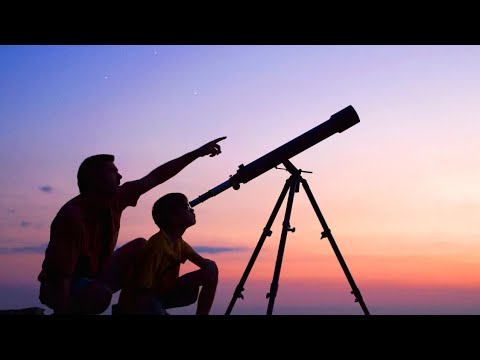
Okay, so picture this: you’re lying on your back in the grass, staring up at the night sky. The stars are twinkling, and suddenly, you spot a shooting star. You make a wish—maybe for a new car or to stop your neighbor from blasting music at midnight. But… what if you could wish for something way cooler? Like figuring out what’s actually out there beyond our little planet?
Seriously, space is like that vast ocean of mystery that just keeps calling to us. And guess what? We’ve got some super fancy gadgets zooming around up there—space telescopes! They’re like giant eyes peeking into the universe, helping us see all sorts of mind-blowing stuff.
From discovering distant galaxies to picking up light from stars that burned out ages ago, these telescopes are game-changers. So let’s chat about how they’re unraveling the cosmos and flipping our understanding of everything upside down!
Exploring the Cosmos: The Impact of Telescopes on Our Understanding of the Universe
Exploring the cosmos is like opening a giant, mysterious book. And telescopes? They are our magical glasses that help us read this cosmic story. It’s incredible how these devices have transformed our understanding of the universe!
First off, let’s talk about how telescopes work. Basically, they collect light from distant stars and galaxies and focus it so we can see what’s out there. This isn’t just about seeing pretty pictures in space, though; it’s about gathering vital information that can change everything we think we know!
One of the most famous telescopes is the Hubble Space Telescope. Launched in 1990, Hubble has given us stunning views of nebulae and galaxies far, far away. Its ability to capture clear images outside Earth’s atmosphere has been a game changer. Imagine looking at a picture taken millions of light-years ago! That’s like peeking into the past.
Then there are ground-based telescopes, which have their own perks. They can be massive—like the Keck Observatory in Hawaii with its twin telescopes that are among the largest optical/near-infrared telescopes on Earth. They use adaptive optics to correct for atmospheric distortion, making images sharper than ever before.
But we’re not just sticking to visible light! Telescopes like the Chandra X-ray Observatory, which observes high-energy regions of space like black holes and supernovae remnants, have opened our eyes to a whole different side of the universe. X-rays provide a peek into extremely hot places where things get wild!
And hey, let’s not forget about radio telescopes! The Arecibo Observatory, which was sadly decommissioned in recent years, played a vital role in understanding pulsars and mapping galaxies. It captured signals like a cosmic ear listening for whispers from across the universe.
These advancements have brought forth some seriously exciting discoveries:
- The expansion of the universe: Edwin Hubble found that galaxies are moving away from us, leading to our current understanding of cosmic expansion.
- The existence of exoplanets: Telescopes have detected planets orbiting other stars, expanding our view on where life might exist.
- The nature of dark matter: Observations through various types of telescopes have revealed clues about this mysterious substance making up most of our universe.
The impact goes beyond science, too! There’s something deeply emotional about looking up at the stars and knowing we’re part of this vast cosmos. I recall lying on my back one summer night with friends at a campfire, gazing up at those sparkling dots scattered across the sky while sharing stories about distant worlds. It felt good—real good—to think that some humans out there were working hard to understand what those little lights actually are.
In short? Telescopes play an essential role in unraveling the mysteries surrounding us. Their ability to collect light across different wavelengths gives scientists tools to build knowledge brick by brick—because every picture tells a story, you know? And as technology advances further with new projects like the James Webb Space Telescope, who knows what more secrets we’re yet to uncover?
Unveiling Cosmic Secrets: The Telescopes That Revolutionized Our Understanding of the Universe’s Expansion
So, let’s talk about telescopes. You might think they’re just fancy tubes that make stars look bigger, but they’ve actually changed everything we know about the universe. Seriously! The way we understand our cosmic neighborhood took a major turn thanks to these incredible tools.
First off, let’s get into what telescopes do. Basically, they collect and magnify light from distant objects in space. That means they can show us stuff that’s super far away and super dim. Imagine trying to watch a movie from across the street—hard to see the details, right? Well, telescopes are like those giant screens that bring everything into focus.
One of the most famous telescopes is the **Hubble Space Telescope**. Launched in 1990, Hubble has given us breathtaking images and loads of data about galaxies, nebulae, and even exoplanets—planets outside our solar system. You know how people used to think we were alone in the universe? Hubble helped change that by showing just how vast and diverse it is out there.
And let’s not forget about the **Kepler Space Telescope**. This little guy was focused on finding new planets. It spent nine years staring at one patch of sky in search of tiny dips in starlight caused by planets crossing in front of their stars. Thanks to Kepler, we found thousands of potential exoplanets! If you had asked a scientist 30 years ago if there were other Earth-like planets out there, they might’ve scratched their heads—now we know there are plenty!
Now you might ask yourself why these discoveries matter. Well, when scientists figured out that the universe is expanding—like blowing up a balloon—it changed everything about how we see our place in it. That idea came from observing distant galaxies moving away from us; the farther away they are, the faster they’re moving! This was backed by telescopes making precise measurements of galaxy redshifts.
Then there’s the **James Webb Space Telescope**, which just launched recently and has already made waves with its ability to observe faint objects like never before. This telescope uses infrared light to peer through dust clouds that hide so much cosmic activity—including star formations and even potential signs of life on distant worlds!
To sum it up:
- Telescopes have revolutionized our understanding by allowing us to see further and clearer.
- Hubble offered stunning imagery that helped redefine our view of galaxies.
- Kepler discovered thousands of exoplanets, challenging our notions of life’s possibilities.
- James Webb continues this trend with cutting-edge technology for deeper exploration.
- The concept of an expanding universe is now well-established thanks to observations from these instruments!
It’s almost emotional when you think about it—the curiosity driving human exploration and how each discovery makes us feel smaller yet more connected within this giant cosmos! It’s a wild adventure out there—and telescopes are our window onto its secrets!
Exploring the Cosmos: The Most Advanced Space Telescopes in Modern Astronomy
Alright, let’s talk about space telescopes! These amazing machines are like our eyes in the cosmos, letting us peer into the depths of the universe. They help us uncover secrets about distant stars, galaxies, and even maybe some planets that could host life. So here’s what makes some of the most advanced space telescopes out there super cool.
Hubble Space Telescope
You might have heard about the Hubble Space Telescope. Launched in 1990, this bad boy has been taking breathtaking images of space for decades now. It orbits Earth at around 547 kilometers above our heads. Seriously, it has a clear view of stuff that’s billions of light years away! Hubble’s sharp vision has allowed us to explore cosmic phenomena like supernovae and black holes. It’s a real game changer for astronomy!
James Webb Space Telescope (JWST)
Then there’s the new kid on the block: the James Webb Space Telescope, or JWST for short. Launched in late 2021, JWST is designed to see even farther than Hubble by observing infrared light. You know how you can’t see your hand in a pitch-black room? Well, infrared lets us see things obscured by dust clouds or those super far away galaxies! Imagine peeking behind curtains that used to block our view.
Chandra X-ray Observatory
Don’t forget Chandra! This telescope is unique because it observes x-rays. So while regular telescopes look at visible light, Chandra helps us study extremely hot and energetic objects like x-ray binaries, which are actually stars sucking material from their neighbors. It’s kind of like watching a cosmic drama unfold!
Parker Solar Probe
Now let’s get up close and personal with our own star—the Sun—with the Parker Solar Probe. Launched in 2018, this little spacecraft is traveling through the Sun’s atmosphere to gather data about solar winds and magnetic fields. It’s flying closer than any spacecraft has ever gone—think roasting marshmallows at a bonfire close!
Spitzer Space Telescope
Another cool telescope was Spitzer, which got retired not too long ago but still did a fantastic job studying exoplanets and cosmic dust. Spitzer worked well in infrared too, helping scientists spot things that are just too dim or hidden from plain sight.
So next time you gaze up at those twinkling stars and think about where your place is in all this vastness—just remember: those telescopes are working hard to answer some of humanity’s biggest questions about existence itself! The universe is huge and complex but thanks to these tools we’re getting closer every day to understanding it better!
When you think about space telescopes, it’s easy to get lost in the sheer awesomeness of what they do. I mean, these big machines are literally peering into the depths of the universe, capturing light that’s traveled millions or even billions of years just to reach us. It blows my mind every time!
I remember reading an article about the Hubble Space Telescope when I was a kid. They shared this breathtaking image of a swirling galaxy that looked like it belonged in a sci-fi movie. I felt tiny and incredibly curious all at once. How can something so far away look so beautiful? That moment lit a spark for me, you know? It made me want to learn everything about space and our universe.
Fast forward to today, and we’ve got some really impressive telescopes out there! Take the James Webb Space Telescope, for instance. Launched not too long ago, it’s been giving us views that Hubble simply couldn’t. With its infrared capabilities, it can look through dust clouds and see star formations or even catch glimpses of distant galaxies merging together. Imagine witnessing the universe as it was forming—it’s like seeing history unfold right before your eyes!
What really gets me is how these telescopes help us answer those giant questions we often ponder: Where did we come from? Are we alone out here? The more we learn from these high-tech wonders, the more pieces we get to fit into this enormous cosmic puzzle.
Then there’s the Chandra X-ray Observatory, which helps us understand black holes and supernovae by observing X-ray emissions from some of the most energetic places in our universe. It sometimes feels like science fiction while still being one hundred percent real! We’re learning about things that were once just theories or wild ideas scribbled down by astronomers centuries ago.
But what’s even cooler is how these discoveries make science feel less isolated and more connected to all of us. Whenever new findings come out—like potential exoplanets that could harbor life—I can’t help but feel excited! It feels personal every time scientists announce they’ve found something extraordinary.
The thing is, these telescopes don’t just improve our knowledge; they remind us how vast and mysterious our universe is! Each new detail we uncover pulls back another layer on this grand cosmic game of hide-and-seek. Honestly? It’s thrilling to think that there are still billions of stars and planets waiting for someone—or something—to notice them.
So yeah, whether it’s with a legacy telescope like Hubble or a cutting-edge one like Webb or Chandra, each discovery adds another thread to this incredible tapestry we’re all part of. You know what I mean? It’s almost poetic when you consider how these machines are helping us piece together mysteries that have stumped humanity for ages!