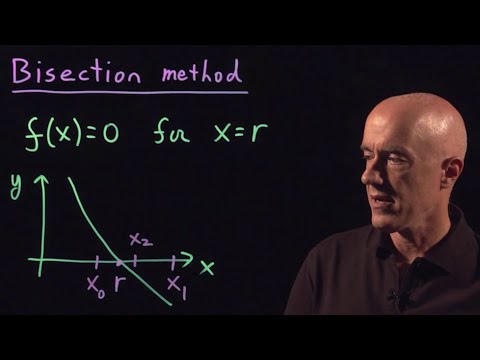
Ever tried to find the quickest way to split a pizza between friends? It’s not as easy as it sounds! You’ve got to make sure everyone gets an equal slice, right? Well, that’s kinda what the bisection method is about but for math and science problems.
Picture this: you’re staring at an equation that looks like a monster, and you have no idea where to start. But the bisection method swoops in like your hero, helping you find solutions without all the fuss of complex calculations.
It’s like having a reliable buddy who says, “Hey, just split it in half and see what happens!” Seriously though, it’s all about breaking things down into bite-sized pieces—literally. Let’s dive into how this simple yet powerful tool works and why it’s such a lifesaver in problem-solving!
Real-World Applications of the Bisection Method in Scientific Problem Solving
The Bisection Method is one of those handy mathematical techniques that can solve all kinds of problems. Seriously, it’s like a secret weapon for scientists and engineers alike. So, what’s the deal with it? Well, the method is used to find roots of continuous functions. In simpler terms, if you have an equation and you want to know where it hits zero, this method helps you figure that out.
One of the coolest things about the Bisection Method is its simplicity. It works by taking a continuous function and dividing an interval in half repeatedly until you hone in on that elusive root. Imagine trying to find a lost item in your room by checking half the room first, then half of that half if you still can’t find it. You get what I mean?
Now, let’s dig into some real-world applications of this method:
- Engineering: Engineers often need to calculate stress points in materials or structures. By finding roots of equations related to stress-strain relationships, they can predict when materials will fail under pressure.
- Aerospace: In designing aircraft or rockets, it’s crucial to solve equations related to aerodynamics. The Bisection Method helps determine optimal shapes or configurations for minimizing drag and maximizing efficiency.
- Environmental Science: Scientists modeling climate change might work with complex functions that describe temperature or pollution levels over time. The Bisection Method allows them to find critical points that indicate changes in trends.
- Finance: In finance, various models predict market behavior using complex functions. The root-finding ability of this method comes in handy when trying to determine interest rates or investment returns.
- Physics: When dealing with equations related to motion—think velocity and acceleration—the Bisection Method helps physicists identify crucial points where conditions change dramatically.
I remember back when I was studying physics; we had this group project where we needed to model how a pendulum swings under different forces. We had these equations that looked like a complete mess at first glance! But using the Bisection Method made finding roots—like when the pendulum settled—so much easier than tackling them head-on.
So here’s the thing: because this method is so reliable and straightforward, many people turn to it when they’re stuck with more complicated algorithms or tools. It’s like having an old-school toolbox filled with basic but essential tools for tough jobs.
What some folks don’t realize is how powerful such a simple method can be across different fields! It stands as a testament that sometimes keeping it simple pays off big time in science and engineering. That makes it invaluable for people tackling real-world problems every day!
When to Utilize the Bisection Method in Scientific Problem Solving
The bisection method is like one of those trusty tools in your toolbox that you reach for when things get tricky. It’s a simple yet powerful technique for finding roots of continuous functions. You know, like figuring out where a function crosses the x-axis. But when should you actually use it? Let’s break it down.
When to Use the Bisection Method
First off, this method shines when you have a continuous function and need to find a root between two points where the function changes signs. If ( f(a) ) and ( f(b) ) have opposite signs, by the Intermediate Value Theorem, there’s at least one root between ( a ) and ( b ).
Why is this important? Because many real-world problems can be modeled with equations that are continuous but not easily solvable algebraically. So, if you’re stuck on an equation and know it’s continuous over an interval, consider bisection!
Another point to think about is precision. If you’re looking for a result within a specific tolerance level, the bisection method allows you to control how accurate you want your root to be. Each iteration halves the interval size, narrowing down on that elusive root. Pretty neat, right?
Also, this method is particularly useful for functions that are complicated or don’t have an algebraic solution. For instance, if you’re dealing with something like ( e^x – x^2 = 0 ), good luck solving that directly! But apply the bisection method over an interval where you know it crosses zero, and you’ll be able to find it without much fuss.
Limitations
But hey, it’s not all sunshine and rainbows. The bisection method does require some upfront knowledge about your function—you need those two points where it changes sign! Plus, it’s not always the quickest way to find a root compared to other methods like Newton’s or secant methods; however it’s more reliable since it always converges as long as your initial conditions are met.
In summary, consider using the bisection method when:
- You have a continuous function.
- You’re looking for roots between two points with opposite signs.
- You want controlled precision in your result.
- The function’s complexity makes direct solving impractical.
So next time you’re faced with a stubborn equation in your scientific work or hobby project, think about pulling out that good old bisection method from your mental toolbox!
Mastering the Bisection Method: A Step-by-Step Guide to Solving Equations in Scientific Research
The bisection method is a super handy technique in math and science for finding roots of equations—those points where the function equals zero. Basically, if you’ve got an equation like f(x) = 0, and you can’t find an exact solution, this method helps you zero in on the answer.
How Does It Work? Here’s the deal: You start with two guesses, let’s call them a and b. These two points should be on opposite sides of the root, meaning one will give you a positive value for the function (f(a) > 0) and the other gives a negative one (f(b) Step-by-Step:
- Identify Your Interval: Choose values for a and b so that f(a) and f(b) have opposite signs.
- Find the Midpoint: Calculate c as (a + b)/2. This is your new guess.
- Evaluate: Check f(c). If it’s close to zero, you may have found your root!
- Narrow it Down: Depending on whether f(c) is positive or negative, decide which half to keep investigating—either [a, c] or [c, b].
- Repeat: Keep repeating this process until you get as close to the root as needed.
Now, let me throw in an example because sometimes numbers make things clearer. Say we’re working with f(x) = x^2 – 4. You’d start with something like a = 1 (where f(1) = -3) and b = 3 (where f(3) = 5). Since these outputs have opposite signs, we’re good to go!
Calculate c:
– c = (1 + 3)/2 = 2
Evaluate:
– f(2) = 0! Boom! We just found our root! If we hadn’t, though, we would keep narrowing our search interval until getting really close.
This method is cool because it guarantees convergence if your initial guesses are correct. You’ll always narrow down to where that pesky root lies. Just remember that it can be slow compared to other methods, especially if you’re searching for roots in complex polynomials.
A personal story? Once I helped a friend tackle some tough calculations for their science project using this method. They were ready to give up after countless tries with more complicated techniques! But once I showed them how simple it could be with bisection—just following those steps—it was like watching them unlock a door they didn’t even know was there.
So yeah, mastering the bisection method can really make solving equations less daunting. You don’t need some fancy tool; just good ol’ reasoning and patience will do!
You know, the bisection method always makes me think of that time I was trying to find a lost dog in my neighborhood. I remember pacing back and forth, calling his name, feeling frustrated. I had to break down the area into smaller sections, checking one part at a time until finally—bam! There he was, wagging his tail under someone’s porch.
This story kind of mirrors what the bisection method does in mathematics and science. It’s all about narrowing things down, you see? When you have a problem—like finding the roots of an equation—it can feel overwhelming at first, kinda like looking for that lost pup in an endless sea of bushes and alleys. The bisection method breaks it down by systematically slicing the problem in half over and over.
Let’s say you wanna find where a function crosses the x-axis. You start with two points that sandwich that root—the point where the function changes from positive to negative (or vice versa). From there, it’s just about halving the distance between them until you zoom right into that sweet spot where your answer lies.
It’s not just for math nerds either; this approach shows up everywhere—from physics problems to engineering challenges. Anytime you need to home in on a solution without guesswork, this method can really save your bacon.
Sometimes, it feels like solving math problems is all about trial and error or intuition. But with the bisection method, there’s this comforting structure—a way to cut through uncertainty bit by bit and reach clarity. It reminds us that even when we feel lost or confused—whether it’s looking for a dog or solving complex equations—we can find our way by taking it step-by-step.
So next time you’re facing something daunting, just break it down! There’s always gonna be a path forward if you slice through those big problems into manageable pieces. And who knows? Maybe you’ll uncover some answers you didn’t even see coming!