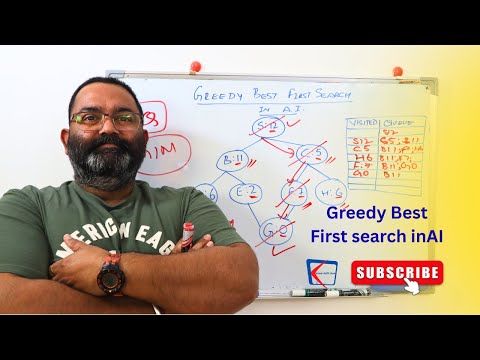
Alright, picture this: you’re playing a game of hide and seek, but instead of friends, you’re searching for the best way to solve a tricky scientific problem. It’s like being on an epic treasure hunt but with equations and data instead of maps and X marks the spot. Fun, right?
Now, imagine if there was a way to always head straight toward the treasure without getting distracted by all those shiny dead ends. That’s where Greedy Best First Search comes in! It’s like having a super useful compass guiding you through the maze of options.
Basically, it looks for the path that seems best at each step—like choosing the shortest route to your favorite pizza place instead of wandering around town. You know? It gives us scientists a punchy way to tackle complicated questions without getting lost in all that nitty-gritty detail.
So, let’s break it down together! You ready?
Applications of Greedy Best-First Search in Scientific Research and Problem Solving
Greedy Best-First Search (GBFS) is a search algorithm that’s, well, pretty smart about how it finds solutions to problems. Basically, it aims to reach a target as quickly as possible by expanding the most promising nodes first. This method can be super useful in various fields of scientific research and problem solving.
When researchers are trying to solve complex issues, they often face huge decision trees. Think of navigating through a labyrinth where every turn could lead you closer or further away from the exit. GBFS helps by evaluating which path might be best based on heuristics—those are basically educated guesses about how close you’re getting to the goal.
- Computational Biology: In computational biology, GBFS can be utilized for sequence alignment problems. When comparing DNA sequences, it’s essential to find the most relevant similarities quickly. By using heuristics that estimate closeness based on known evolutionary relationships, GBFS can streamline this process.
- Robotics: Robotics often involves pathfinding tasks where a robot needs to navigate through an environment filled with obstacles. Here, GBFS can help the robot find the quickest route from point A to point B by focusing on paths that look promising at each step—like avoiding walls and heading toward open spaces.
- Network Routing: In computer networks, efficient data packet routing is crucial. GBFS can assist in choosing paths for data packets that minimize latency or maximize bandwidth usage by evaluating potential routes based on dynamic network conditions.
- Chemical Compound Discovery: Scientists searching for new compounds or reactions might use GBFS to explore chemical databases. By prioritizing compounds that appear more likely to have desirable properties based on previous experimental data, researchers can narrow down options faster.
Oh! And let’s not forget that while GBFS is quick and resourceful, it does have its downsides too. You see, it doesn’t always guarantee finding the best solution; sometimes it gets stuck in local optimums—like when you think you’ve found the best pizza joint only to discover there’s a better one two blocks away.
But don’t let that discourage you! There are techniques like combining GBFS with other algorithms or implementing modifications that could help tackle those limitations.
In summary, Greedy Best-First Search serves as an entertaining yet effective tool in scientific research and problem-solving scenarios. By leveraging its rapid evaluation methods, we’re able to tackle intricate problems more efficiently and innovate at an impressive pace! It’s kind of like having a super-smart friend who knows all the shortcuts but still needs your guidance once in a while!
Exploring the Four Greedy Algorithms: Key Concepts and Applications in Computer Science
Sure! Let’s get into it and chat about those four greedy algorithms. They’re pretty cool, especially when you think about how often we use them in computer science.
Greedy algorithms are like that friend who always wants to take the easiest route to achieve a goal. Instead of looking at the whole picture, they focus on making the best immediate choice at each step. Sometimes this works out great, and other times… well, not so much. You know what I mean?
Here are four key greedy algorithms that will help you understand this concept better:
- Kruskal’s Algorithm: This one’s all about finding the minimum spanning tree from a graph. Imagine you’ve got a map and want to connect all your friends’ houses with the least amount of cable possible—Kruskal’s helps you do just that by picking edges based on their weights, starting from the smallest.
- Prim’s Algorithm: Similar to Kruskal’s but it grows from a starting point like a snowball rolling down a hill! It adds the nearest neighbor until all nodes are covered. So, again with that map analogy, if you start at your house and add roads to connect everyone in your circle using the shortest paths possible—that’s Prim’s for you!
- Dijkstra’s Algorithm: This one’s handy for finding the shortest path in weighted graphs where all edge weights are positive. Think about Google Maps when you’re looking for the quickest route to grab some coffee—Dijkstra’s works its magic by finding ways through various roads until it lands on the best one.
- Activity Selection Problem: Here, it’s more about choosing activities to maximize your fun within a given time frame! Picture yourself at a festival with tons of shows happening simultaneously; you’d want to pick those that don’t overlap but give you the most enjoyment within your limited time.
So, what makes these algorithms “greedy”? Well, they make local optimum choices—like grabbing that first donut instead of considering if there’s a better dessert later on. It simplifies solving complex problems but sometimes leads us down paths that aren’t optimal in the long run.
Now let’s zoom in on using Greedy Best First Search. You can think of it as combining Dijkstra’s love for cost with an eagerness to get closer to goals quickly. It uses heuristics (basically educated guesses) to decide which direction looks best next.
Imagine you’re playing a video game level where each move takes you closer to defeating an enemy boss; Greedy Best First Search would urge you toward those closest power-ups instead of plotting out every single scenario.
In terms of applications? Oh man! They’re everywhere—from **network routing** (so when data travels) to planning **resource allocation** (like scheduling classes or tasks), these algorithms save time and resources while getting stuff done.
You follow me? In short, greedy algorithms are like life hacks for solving problems fast but require some careful consideration since they’re not always perfect solutions. It’s kind of neat how we can boil down complex processes into simple steps without sacrificing too much efficiency.
Comparative Analysis of Dijkstra’s Algorithm and Greedy Best-First Search in Scientific Computing
When you get into the world of algorithms, especially in scientific computing, you’ve probably bumped into Dijkstra’s Algorithm and Greedy Best-First Search. Both are used for finding paths in weighted graphs, but they go about it in pretty different ways. So let’s break this down simply.
Dijkstra’s Algorithm is like that friend who meticulously checks every option before deciding where to eat. It always finds the shortest path from a starting point to all other nodes in a graph. The cool thing is that Dijkstra doesn’t just stop when it finds the first route; it explores all possible routes and keeps track of the shortest one. You can think of it as making sure you don’t miss out on any hidden gems along the way!
On the other hand, Greedy Best-First Search takes a more impulsive approach, kind of like someone who picks a restaurant just because they heard it’s popular, without checking if there’s a closer or better option available. It focuses on choosing paths based on an estimation of how close they get to the goal. This algorithm gets its name from being “greedy” about immediate rewards—so it may not always find the absolute best path.
Now let’s dive into some key points:
- Efficiency: Dijkstra’s is generally more efficient for dense graphs since it checks all possible paths thoroughly.
- Optimality: Dijkstra guarantees an optimal solution (the best path), while Greedy Best-First might not give you the best route if you’re not careful.
- Time Complexity: With priority queues, Dijkstra runs in O(E + V log V), while Greedy Best-First typically runs faster but can be less reliable depending on heuristics used.
Now picture this: Imagine you’re using these algorithms to navigate through a maze filled with obstacles. Dijkstra’s would try every possible way until it finds that perfect exit route, making sure no sneaky detours lead you astray. Meanwhile, Greedy Best-First would take quick looks at paths that seem promising and follow them without fully checking others first—sometimes leading you down a frustrating dead end!
So what about applications? Well, if you’re working on something complex like GPS systems or network routing where precision matters, you’ll lean towards Dijkstra’s for its reliability. But if you’re playing around with game AI or quick simulations where speed is more crucial than finding an exact path? You might choose Greedy Best-First.
In summary, both algorithms have their place in scientific computing but suit different needs based on what you’re after—whether it’s accuracy or speed! Each has strengths and weaknesses that make them unique tools in your problem-solving toolbox. It’s all about using what fits your specific challenge best!
Alright, so let’s chat about something called Greedy Best First Search. Sounds fancy, huh? But it’s really just a way to tackle problems, especially in science and computer science. The idea is pretty straightforward: you make decisions based on what seems best at the moment without worrying too much about the future.
Picture this, there was this one time I was trying to find my way through a maze at a fair—just a fun little detour. I kept choosing paths that looked like they would get me closer to the exit. Sometimes I ended up stuck in dead ends, but other times I found myself zooming right out! That feeling of freedom when you finally see the light at the end is kinda exhilarating, right? So that’s how Greedy Best First Search works—it’s all about making those quick decisions based on what looks promising right now.
In scientific problem-solving, this technique can be helpful because it focuses on immediate progress. You can visualize it like a scientist trying to find a cure for a disease: they might start with the most promising compounds or pathways first. If one looks good, boom! They dive deeper into that line of research.
However, there’s a catch. Just like in my maze adventure, sometimes chasing after what’s closest can lead you astray—like when that shiny pathway turns into nothing but a loop back to where you started. In science too, relying solely on immediate gain could mean missing out on better alternatives hiding just around the corner.
But here’s where it gets interesting: combining greedy methods with other strategies can really elevate problem-solving outcomes. For instance, if you mix them with some backtracking or exploration techniques, it’s like having a GPS that helps recalibrate when you make a wrong turn.
It’s easy to fall into traps though—like thinking just because you’re heading in one direction quickly means you’re going to reach your goal faster. Sometimes slowing down and evaluating all options leads to better discoveries.
So whenever we’re using methods like Greedy Best First Search in our scientific journeys, let’s remember it’s just one tool among many. The excitement of discovery lies not only in reaching your destination but also in appreciating all those twists and turns along the way! Happy navigating!