Okay, so picture this: you’re at a party, right? Everyone’s chatting, the music’s pumping, and suddenly you hear someone whispering something about “molecular detection.” You’re like, wait—what? That sounds super sci-fi!
Well, hold onto your drink because we’re diving into something called Cavity Ringdown Spectroscopy. Sounds fancy, huh? But really, it’s all about figuring out what’s floating around us at a molecular level.
Imagine being able to catch those sneaky little molecules that hide in the air or a drop of water. This technique does just that! It’s like turning on a super-powered flashlight to spot those elusive critters.
You know how some people can identify all the stars in the sky? Well, scientists use this method to recognize the “stars” of the molecular world. It’s not magic; it’s science! So let’s unpack this cool tool and see what it reveals about our little invisible friends out there.
Cavity Ringdown Spectroscopy: Advancements and Insights in Molecular Detection Laboratories
Cavity Ringdown Spectroscopy, or CRDS, is like the cool kid of molecular detection. Basically, it’s a technique used to measure the concentration of gases and other molecules very precisely. For scientists, this method has provided a fresh lens through which to look at molecular properties.
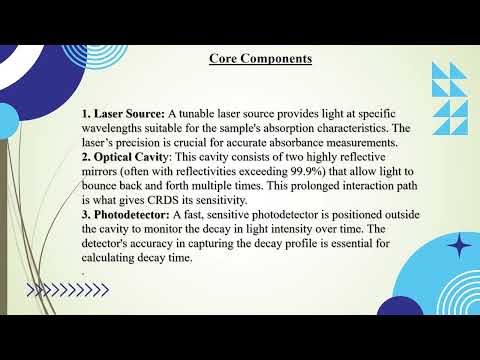
So, how does it work? Well, imagine you have a laser beam bouncing inside a highly reflective cavity. The beam gets absorbed by whatever molecules are floating around in there. Every time the light bounces, it loses some energy based on how many molecules are present. The more molecules you have, the faster the light will lose its energy. This process is called “ringdown,” which sounds cool and mysterious, right?
This technique has become super handy in labs for various reasons. Here are some key takeaways:
- High Sensitivity: CRDS can detect incredibly low concentrations of molecules—think parts per billion or even trillion! This is really useful when you’re studying something that’s only in tiny amounts.
- Fast Measurements: The time it takes to get results is minimal. You can snap up data quickly without waiting around forever.
- No Need for Labels: Unlike some other techniques that require you to tag molecules with dyes or labels, CRDS measures directly how much light gets absorbed.
- Diverse Applications: It’s used in areas ranging from atmospheric science (tracking greenhouse gases) to biomedical fields (analyzing breath samples for health diagnostics).
Think back to when you were a kid playing catch with friends—sometimes you’d toss the ball really high and watch it come down slowly; other times it would scurry back down fast! That interaction mimics what’s happening with light in CRDS.
But like any tech, it’s evolving over time! You’ve got improvements popping up constantly—like enhanced detectors that make measurements even faster and more precise than before. Plus, advancements in software help analyze data better. If you’ve ever struggled with a tough puzzle but then found an easy-to-follow solution online? That’s what this latest software development aims for—a clearer path through complex data.
In short, Cavity Ringdown Spectroscopy keeps pushing boundaries in molecular detection labs worldwide. As technology advances, who knows what else we’ll uncover about the tiny particles all around us? Exciting times ahead!
Cavity Ring-Down Spectroscopy with Picarro: Advancements and Applications in Scientific Research
Cavity Ring-Down Spectroscopy (CRDS) is a really cool technique that scientists use to measure the concentration of gases with great precision. Imagine shining a flashlight in a big empty room. If you turn off the flashlight, the light will bounce around for a while before it fades away. That’s kind of how CRDS works!
In CRDS, light is sent into a cavity made of mirrors. The light bounces back and forth, slowly losing intensity over time due to absorption by molecules in the gas. This loss of intensity—or “ring-down” time—can tell us how many molecules are in there. The Picarro company has made some fascinating strides in this field by creating devices that utilize CRDS for various applications.
One major advancement is the ability to analyze multiple gas species simultaneously. You know how sometimes you want to watch two shows at once? Well, Picarro’s technology can detect different gases like CO2 and CH4 at the same time! This is huge for environmental monitoring because it helps researchers understand greenhouse gas emissions better.
Another neat aspect is its sensitivity. With CRDS, you can detect very low concentrations—think super tiny amounts—of gases! Imagine finding just a pinch of salt in an entire swimming pool; that’s how sensitive CRDS can be. Picarro’s systems can measure parts per billion or even lower, which is super important when studying air quality or tracking pollution sources.
As for applications, they are varied and pretty exciting:
- Agriculture: Scientists use CRDS to monitor soil health by measuring gas emissions from crops.
- Climate Science: It plays a significant role in understanding carbon cycles and global warming.
- Atmospheric Studies: Researchers track pollutants and study their effects on weather patterns.
- Biosciences: In medicine, detecting trace gases can help diagnose diseases.
The story doesn’t stop there! There’s also an emotional angle here. Just think about communities impacted by pollution: they want clean air for their kids to breathe easily while playing outside. Technologies like those developed by Picarro make it possible for scientists to gather data and advocate for cleaner environments.
Overall, Cavity Ring-Down Spectroscopy with Picarro represents an incredible leap forward in how we detect and analyze molecular species in various fields of research. By combining advanced technology with crucial scientific inquiries, we’re inching closer to bettering our understanding of both our environment and ourselves!
Cavity Ring-Down Spectroscopy Manufacturers: Advancements and Innovations in Scientific Instrumentation
Cavity Ring-Down Spectroscopy, or CRDS, is a really cool technique that scientists use to measure very small quantities of molecules. Imagine you’re in a dark room with a flashlight shining on a wall. If you keep turning the flashlight on and off rapidly, you might see the faint light flickering. That’s kinda how CRDS works, but with laser light bouncing around inside a special cavity.
So, how does it work? Well, basically, it involves trapping light in a cavity formed by two highly reflective mirrors. When laser light is injected into this cavity, the photons bounce back and forth between the mirrors for a while before they start to disappear—hence “ring-down.” By measuring how quickly the light fades away, scientists can determine how much of a certain gas or molecule is present. It’s super sensitive!
Now, when it comes to manufacturers of CRDS instruments, there have been some impressive advancements recently. Many companies are putting serious effort into improving accuracy and sensitivity. Let’s look at some key innovations:
- Miniaturization: Companies are developing smaller and more portable CRDS systems. This makes them easier to use in the field rather than just in labs.
- Enhanced Detection Limits: New technologies have improved detection limits even further. Some systems can measure down to parts per trillion! That’s like trying to find one drop of water in an Olympic-sized swimming pool.
- User-Friendly Interfaces: More intuitive software and interfaces mean that even non-experts can operate these devices without feeling overwhelmed. It’s like using your smartphone instead of an old flip phone!
- Real-Time Analysis: Advancements allow for real-time data acquisition which helps researchers get instant results during experiments.
If you’re curious about applications, think about environmental monitoring or detecting pollutants in the air we breathe. I remember my old physics professor sharing stories about how this technology helped track greenhouse gases more accurately than ever before—striking stuff.
Still thinking about where these manufacturers stand? They’re pretty competitive right now! Leading companies are constantly pushing each other to innovate because scientific progress relies so heavily on reliable instrumentation.
In summary, Cavity Ring-Down Spectroscopy is shaping up to be even better with ongoing advancements from manufacturers focused on making it more accessible and efficient for researchers everywhere. Whether you’re an expert or just someone intrigued by science, knowing these innovations adds another layer of appreciation for how we understand our world through molecular detection!
Cavity ringdown spectroscopy, or CRDS for short, is like having a super-sensitive ear that listens to the whispers of molecules. Imagine you’re at a concert, and while everyone around is screaming, you can still hear your friend’s voice as if they were right next to you. That’s kinda what CRDS does with light and molecules.
So here’s the scoop: it works by sending a laser beam into a specially designed cavity. This cavity is like an echo chamber for light. The laser bounces around inside it, and each time it does, some of its energy gets absorbed by whatever molecule is hanging out in there. By measuring how fast the light “dies out” or rings down, scientists can figure out just what kind of molecules are present and how much of them there are.
I remember when I first stumbled across this technique during my studies. I was fascinated by how such an advanced method could help in so many fields—like environmental science, medicine, even astrophysics! One moment really stuck with me: I saw a researcher use CRDS to measure air quality in real-time at a busy intersection. You could practically feel their excitement as they revealed exactly what pollutants were in the air we breathe. It clicked for me then – this isn’t just lab work; it’s about making people’s lives better.
But here’s where it gets really interesting: CRDS is incredibly sensitive, even to parts per trillion! That means it can detect tiny changes that other methods might miss completely. So imagine being able to spot pollutants before they get too harmful or diagnosing diseases at an earlier stage than ever thought possible.
It’s not all sunshine and rainbows though. The setup can be complex and usually requires super precise alignment and control over environmental variables—like temperature fluctuations or vibrations—that could mess with the results. It’s almost poetic in a way; it’s all about finding harmony amidst chaos.
In truth, Cavity Ringdown Spectroscopy represents more than just a scientific technique; it’s like shining a spotlight on molecules that often go unnoticed—making them dance in ways we never thought possible! Pretty cool stuff when you think about it, right?