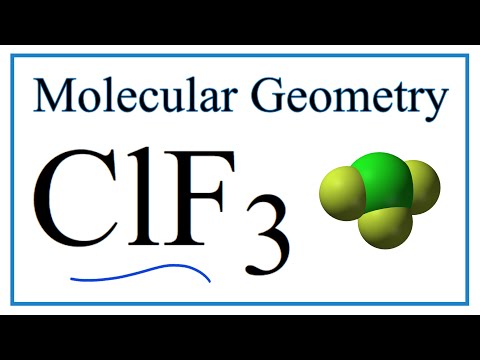
So, picture this: you’re at a party, and someone casually mentions CLF3. You look around, and half the room nods knowingly while you’re just standing there like, “Huh?”
Well, you’re not alone! CLF3 might not be on everyone’s lips, but it’s pretty wild when you break it down. You know how in chemistry class they make it sound all complicated? The truth is, once you get into the Lewis structure of this molecule and its shape, it’s like piecing together a puzzle.
It’s fascinating stuff! In fact, every molecule tells a story. The way atoms bond together can tell us so much about their behavior and properties. So grab your thinking cap because we’re diving into the cool world of CLF3—the chlorine trifluoride that has some serious tricks up its sleeve! Ready? Let’s go!
Understanding the Molecular Geometry of ClF3: Insights from Chemistry
Alright, let’s talk about ClF3, which stands for chlorine trifluoride. It’s one of those molecules that can really blow your mind when you dig into its shape and structure. First, you gotta understand how to draw the Lewis structure.
The Lewis structure is like your map. For ClF3, you start with the chlorine atom in the center because it’s less electronegative than fluorine. You connect it to three fluorine atoms using single bonds. Now, chlorine has seven valence electrons, and each fluorine has seven too. When you form those bonds, chlorine uses three of its electrons—leaving you with four electrons still hanging around.
So here’s where things get interesting! Those remaining four electrons are not just floating around aimlessly; they actually form two lone pairs on the chlorine atom. This is key to figuring out the molecule’s shape.
Now let’s dive into the molecular geometry part! With ClF3, we can use something called VSEPR theory (which stands for Valence Shell Electron Pair Repulsion). Basically, this theory says that electron pairs want to be as far apart from each other as possible. In ClF3, you’ve got three fluorine atoms and two lone pairs of electrons on that central chlorine atom.
The arrangement of these five groups—three bonds and two lone pairs—leads to a T-shaped molecular geometry. Yep, it looks kind of like a capital “T.” The three fluorines are positioned at angles of about 90 degrees from each other in a plane while the lone pairs sit opposite them in space.
- Lone Pairs: Remember how I said there are two? They take up more room than bonding pairs because they’re just chilling there solo!
- Bonds: The angle between the fluorine atoms is roughly 87 degrees due to those pesky lone pairs pushing down a bit on the bond angles.
- Molecular Polarity: Since ClF3 has an asymmetric shape with different atoms around it, it’s polar! This means there’s a difference in charge distribution across the molecule.
If we think back to high school chemistry classes, molecular shapes were often visualized with those funky models made out of balls and sticks. In real life though, there isn’t really any “stick” holding these bonds together—it’s all about electron interactions. Isn’t that wild?
In short, understanding ClF3’s molecular geometry not only gives us insight into how it behaves but helps us grasp fundamental concepts of chemical bonding and electron arrangements. So next time you hear “chlorine trifluoride,” just remember: it’s like a little ‘T’ shaped puzzle made up of chlorine and its fluorine friends hanging out together!
Understanding the Lewis Structure of ClF3: A Comprehensive Guide in Chemistry
The Lewis structure, you know, is a way to represent the bonding between atoms in a molecule. For ClF3, or chlorine trifluoride, things get pretty interesting. So let’s break it down together.
First off, chlorine (Cl) is the central atom in ClF3. It has 7 valence electrons because it’s in group 17 of the periodic table. Each fluorine (F) atom contributes 7 valence electrons too, and since we’ve got three of them, that gives us a total of 21 electrons from fluorine. Altogether, you’re looking at **7 (from Cl) + 21 (from F) = 28 valence electrons** for the whole molecule.
Next up is how those electrons are arranged. You start with chlorine in the middle and surround it with three fluorine atoms. Each F forms a **single bond** with Cl using two of those valence electrons per bond. That uses up **6 electrons**, leaving us with **22 – 6 = 22 remaining electrons**.
Here’s where it gets cool: those leftover electrons go onto the fluorine atoms to satisfy their octet rule since each F needs eight electrons to feel complete and happy. After distributing those extra electrons around the fluorines, each one has three lone pairs left over alongside its bonding pair with chlorine.
So far so good? Now we’ve used up all our valence electrons! But there’s more: when considering the molecular geometry of ClF3, it’s not just about how it looks on paper; we’ve got to consider the angles too.
This molecule adopts a trigonal bipyramidal shape if we look at it from a spatial perspective. However, because two lone pairs sit on opposite sides of the central chlorine atom—think about them repelling each other—they push down on those bonded fluorines. This configuration ends up giving us a T-shaped geometry instead of what you might have initially expected!
In summary:
- Centrally placed Chlorine with one central atom.
- Three Fluorine Atoms surrounding it.
- Total 28 Valence Electrons: 7 from Cl and 21 from F.
- Bonds formed: Three single bonds
- Lone Pairs on Chlorine: No lone pairs, but two lone pairs on Chlorines for structure!
- T-shaped Geometry: due to positioning & repulsion!
And if you ever want to visualize this more clearly? Drawing out that Lewis structure is key—it helps you see how everything fits together nicely!
So why does understanding this matter? Well, knowing how these molecules behave can lead us down some really interesting paths in chemistry—think about reactivity or properties based on shape! If you’d like to explore even further into molecular shapes or reactivity patterns connected to this info? Just shout out!
Understanding Molecular Geometry: A Step-by-Step Guide from Lewis Structures in Chemistry
Alright, let’s chat about molecular geometry, especially focusing on CLF3 and why it matters. This is all about how we can figure out the shape of molecules using Lewis structures. You ready? Let’s get into it!
First off, what’s a **Lewis structure**? It’s a way to represent molecules on paper. Basically, you draw dots for electrons around atoms to show how they bond with each other. Think of it as a blueprint for understanding how atoms hang out together.
Now, with **CLF3**, which stands for chlorine trifluoride, we’ve got one chlorine atom (Cl) and three fluorine atoms (F) connected to it. The first thing you do is count the valence electrons. Chlorine has 7 valence electrons while each fluorine has 7 too. So, you add them up:
1 (Cl) + 3 x 7 (F) = 22 valence electrons.
Next step? You place the chlorine in the center because it can form more bonds than the fluorine atoms. So you’ll bond that Cl to all three Fs first. Each bond uses up two electrons—so that’s six of your total.
At this point, you’ve got:
CL – F
|
F
+
F
After drawing those bonds, you’ll have some leftover electrons—16 to be exact! Now here’s where it gets interesting: put those remaining electrons around the fluorine atoms until they’re happy with 8 around each of them.
So far so good? Now we’re left with just two electrons after filling up the Fs! What do you do with those? You place them on the chlorine atom as lone pairs. Those lone pairs are super important because they affect the overall shape of our molecule.
Once you’ve got your Lewis structure drawn out, it’s time to consider its **molecular geometry** using VSEPR theory (which stands for Valence Shell Electron Pair Repulsion). This theory tells us that electron pairs around a central atom will arrange themselves as far apart as possible to minimize repulsion.
In CLF3, chlorine has three bonded pairs and two lone pairs. Since these lone pairs take up space too, they influence how the entire shape looks. The presence of those lone pairs pushes down on the bonded fluorines below them.
As a result, the shape is described as **T-shaped**! It looks like a T when viewed from certain angles—where the three fluorine atoms are at approximately 90-degree angles from each other.
So here’s a recap:
- Lewis Structure: Draw Cl in center; attach F’s; distribute remaining electrons.
- Molecular Geometry: Use VSEPR to determine that CLF3 is T-shaped due to lone pairs.
- Bond Angles: Expect angles near 90 degrees between F atoms.
And there you have it! Understanding molecular geometry through Lewis structures helps us visualize not just CLF3 but many other compounds too! It’s like cracking a code—once you get how everything fits together, it opens up so many cool insights into chemistry!
Alright, let’s chat about CLF3, or chlorine trifluoride, if you want to get all technical. It’s one of those molecules that seems pretty straightforward at first but has some quirks that make it interesting.
First off, when we’re talking about the Lewis structure of CLF3, you’re looking at chlorine in the center with three fluorine atoms around it. Sounds simple enough, right? But here’s where it gets a bit twisty—chlorine can actually expand its valence shell. So instead of just forming simple two-bond pairs like most atoms, chlorine gets to flex its electron muscles a bit and hold more than eight electrons. You see three single bonds with the fluorine atoms and two lone pairs hanging out on chlorine as well!
Now if you picture this molecule in your mind—or better yet, grab a pen and doodle it out—it starts to resemble a T-shape when you consider its molecular geometry. The lone pairs push down on the bonds because they need their space, which is where things get that T-shaped vibe. Isn’t that cool?
I remember back when I was first learning about molecular geometry. I was sitting at my kitchen table with my mom trying to make sense of these structures—like drawn-out spaghetti noodles! And there we were with our crayons trying to sort out why some things looked more like a star and others like clouds or trees. You don’t forget those moments.
So anyway, what does this all mean for CLF3? Its geometry impacts how it behaves—how it interacts with other molecules or how it reacts chemically. Since it’s less symmetrical compared to others (like say carbon dioxide), it has some unique properties that set it apart from similar compounds.
In essence, it’s fascinating how something so tiny can shape behaviors and reactions on a larger scale. Just goes to show how a little knowledge about Lewis structures can go a long way towards understanding the wonderful world of chemistry!