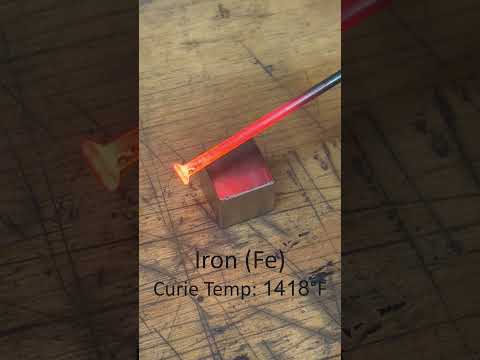
So, picture this: you’re at a party, and someone brings up the wildly exciting world of magnetism. You might be tempted to roll your eyes and wander off to the snack table, right? But hold on! What if I told you that there’s this super cool term called “Curie temperature” that basically determines if iron is magnetic or not?
Yeah, it sounds like something your science teacher would drone on about, but trust me—it’s way more interesting than it sounds! The thing is, when iron heats up past its Curie temperature, it loses its magnetic mojo. Like a superhero hanging up the cape. How wild is that?
So, let’s break down what this whole Curie temperature business means and why it matters for magnetism in iron. You’ll want to stick around because it’s not just for nerds in lab coats—it’s like science meets magic!
Understanding the Relationship Between Curie Temperature and Magnetism in Material Science
Curie Temperature, or just Curie point as some call it, is a pretty cool concept in the world of magnetism. Basically, it’s that temperature at which a material’s intrinsic magnetism gets super excited and changes. It’s like flipping a light switch on and off, but with magnetic properties! Below this temperature, materials like iron can hold their magnetic properties strongly. Above it? Well, they lose that magnetism entirely. Kind of mind-blowing, right?
You might be wondering why iron is such a big deal in this conversation. So, let’s break it down. Iron has a Curie temperature of about 770 degrees Celsius (that’s around 1,418 degrees Fahrenheit). When it crosses that threshold, iron goes from being magnetic to non-magnetic. Imagine heating up a bar of iron; when it gets really hot, it stops being able to stick to your refrigerator anymore!
So what’s happening inside the material? At lower temperatures, the tiny magnets inside the iron—called atomic moments—all align nicely in one direction thanks to their interactions with neighboring atoms. This alignment is what gives iron its **ferromagnetism**, which is just a fancy word for “strongly magnetic.” But as you heat up the iron and get closer to that Curie point, that alignment starts to break down.
You know how when things get hot, they move around more? Well, at higher temperatures, atomic vibrations increase so much that they overcome the forces trying to keep those atomic moments aligned. They start pointing every which way instead of sticking together as a team—and poof! No more magnetism.
And here comes another interesting part: not all materials have the same Curie temperature. Different elements or compounds have different behaviors when heated. Take nickel for instance; its Curie temperature is around 355 degrees Celsius (or 671 degrees Fahrenheit).
Why does this even matter? Understanding how Curie temperature works helps scientists develop new materials for all sorts of applications—from data storage devices to advanced electronics and beyond.
In conclusion or perhaps I should say wrapping this up (because I don’t want you feeling like you’re stuck in school), grasping how Curie temperature relates to magnetism gives us insight into the nature of materials themselves—a real peek behind the curtain on how these everyday bits fit into our larger universe! So next time you see magnets or an old fridge door clinging shut because of them… remember there’s some serious science at play!
The Effects of Curie Temperature on Iron: Understanding Magnetic Behavior in Materials Science
So, let’s get into the nitty-gritty of Curie temperature and how it affects iron. Basically, the Curie temperature is this critical point where a material’s magnetic properties change. For iron, that magic number is around 770 degrees Celsius. Below this temperature, iron acts like a magnet and can stick to your fridge or happily hang out with other magnets. But once it hits that high temp, something interesting happens.
Think about it like this: when you heat up iron, the atoms start moving around more energetically. They shake off their orderly alignment, which is essential for magnetism. It’s like a dance party where everyone suddenly decides to just groove out of sync. So when it’s heated past the Curie temperature, iron loses its magnetic properties and becomes what we call paramagnetic, meaning it won’t stick to a magnet at all!
Now, why does that matter? Well, understanding how Curie temperature works is super important in materials science. For example:
- Electromagnets: When designing machines or devices that rely on electromagnets—like in MRI machines or electric motors—knowing the Curie temperature helps engineers ensure that they operate effectively without overheating.
- Data Storage: In magnetic storage media (think of your hard drive), if you get too hot, the data could be lost because the material can’t hold onto its magnetic state anymore.
- Your Kitchen Appliances: Even your microwave oven has some tech that depends on understanding these principles! If materials were used that didn’t consider Curie temperatures properly? Well, let’s just say your food could end up uncooked or even worse!
Picture a chilly winter evening; you decide to make hot cocoa and sit by a warm fire. The way you feel cozy and relaxed kind of sums up what iron feels below its Curie temperature—it’s stable and comforting in its ferromagnetic state. But once things get too heated? All cozy vibes go out the window.
And here’s something cool! Iron isn’t alone; other materials have their own Curie temperatures too. Take nickel or cobalt; they have different thresholds where they flip from being magnets to not being magnets anymore.
So next time you think about magnets or any technology using them, remember how vital that little number—the Curie temperature—is in keeping everything working smoothly!
Exploring the Magnetic Properties of Iron: Critical Temperatures and Their Scientific Implications
Sure! Let’s take a stroll through the fascinating world of iron and its magnetic properties, specifically focusing on something called the Curie temperature.
So, what’s the deal with iron? Well, iron is not just a metal; it’s like the rock star of magnetism! It has this amazing ability to become magnetized. But here’s where things get interesting—it all hinges on temperature.
In scientific terms, the Curie temperature (often symbolized as Tc) is the point at which iron loses its permanent magnetic properties. For iron, this temperature is around 770°C. Below this temp, you’ve got a ferromagnetic state. This means that iron can keep its magnetism even after you remove an external magnetic field. But when it hits that critical point? Boom! It becomes paramagnetic.
Now, you might be wondering what exactly *paramagnetic* means. It’s pretty straightforward. In the paramagnetic state, iron atoms still have magnetic moments (that’s just their little spinny job). However, they don’t line up neatly like soldiers in formation; they’re more like a chaotic dance party where everyone is doing their own thing. And without an external magnetic field to guide them, they lose their organized magnetism.
Think about it—how does this relate to everyday life? Ever used a fridge magnet? Those magnets stick because they’re made from materials that remain ferromagnetic at room temp. If your fridge somehow heated up above 770°C—yikes! Your magnets would just fall off!
Let’s break down some key points about the Curie temperature and its implications:
- The Curie temperature for pure iron is about 770°C.
- Below Tc: Ferromagnetism reigns! Iron can hold onto magnetism even when not in a magnetic field.
- Above Tc: Iron becomes paramagnetic and loses its ability to be permanently magnetized.
- This temperature is crucial for understanding not only iron but also other materials used in electronics and data storage.
- The behavior of iron near its Curie point helps scientists develop better magnets and technologies.
It’s kind of wild how something as simple as heat can change these properties so dramatically. You know those old-school compasses? They depend on ferromagnetism to work properly. If they experience temperatures close to or above the Curie point, they’re essentially useless!
The implications don’t stop there—they extend into various scientific fields too! Consider materials science or geology; understanding how these magnetic properties change with temperature is essential when studying Earth’s magnetic field or developing new electronic devices.
So next time you admire a shiny piece of iron or feel your fridge magnets clinging on tight, remember this nifty interplay between heat and magnetism. The delicate dance of atoms under varying temperatures isn’t just cool science—it shapes our everyday gadgets too!
You know, when I think about the Curie temperature of iron, it kind of takes me back to my high school physics class. We were working on this project where we had to build a simple electromagnet. I remember being so excited when that little iron piece started picking up paperclips! It felt like magic, right? Little did I know, that whole process was tied to something deeper—like the Curie temperature.
So here’s the scoop: the Curie temperature is this special point, around 770 degrees Celsius for iron, where it goes from being magnetic to non-magnetic. It’s like a switch flipping. Below that temp, the magnetic moments (that’s just a fancy term for tiny magnetic fields) in iron align nicely, and voilà! You have magnetism. But when you heat it up past that point? They start dancing around randomly and lose their organization. Just like when your friends throw their hands in the air at a concert—total chaos!
Now, why does this even matter? Well, if you think about all the gadgets we use every day—computers, phones—they rely heavily on magnetism and materials like iron. The Curie temperature helps scientists figure out how these materials behave under different temperatures. And not just that! This understanding is crucial for things like making stronger magnets or improving data storage technologies.
It’s also pretty cool because it shows how interconnected everything is on a fundamental level. As you go about your day—maybe heating up your lunch or trying to keep warm—you’re bumping elbows with these scientific principles without even realizing it!
Anyway, next time you pick up something metal and stick a magnet to it, maybe take a moment to appreciate all those invisible forces at work. And if you’re ever looking for an icebreaker at a party (seriously!), throw in something about the Curie temperature—it definitely gets people talking!