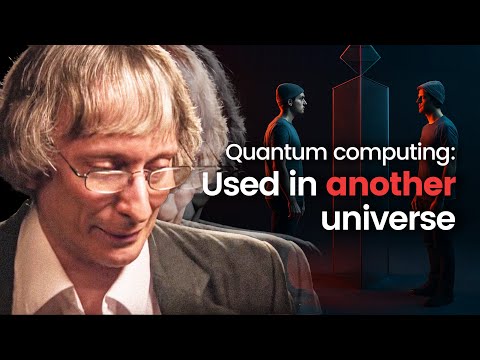
So, picture this: you’re sitting at a coffee shop, and your friend suddenly says, “Did you know David Deutsch nearly revolutionized the way we think about computers?” Like, what? That’s unexpected!
Now, let me tell you about this guy. He’s not just some computer geek. No way! Deutsch is like a wizard of quantum theory. He’s been talking about the potential of quantum computing before it was even cool—like predicting trends in fashion months ahead.
Imagine computers that can solve problems in seconds that’d take our current tech years to figure out. Sounds like sci-fi, right? But seriously, Deutsch is all about making that dream a reality.
I mean, who wouldn’t want to turn their wildest tech fantasies into something tangible? Quantum computing could flip our understanding upside down and lead us to breakthroughs we can’t even imagine yet.
So grab your coffee (or tea!), and let’s chat about why David Deutsch is such a big deal in the quantum computing world. You’re gonna want to keep up with this—trust me!
Exploring David Deutsch’s Role in the Development of Quantum Computing: Myths and Realities in Science
David Deutsch is one of those names that often comes up when you’re talking about quantum computing. And let me tell you, there are a lot of myths floating around about his contributions to the field. So, let’s break things down.
Early Life and Background
Deutsch was born in 1961 in Haifa, Israel. He’s a physicist and a pioneer in quantum computation. His passion for science came early, and it seems like he’s always had this knack for bending the rules—like figuring out how to use quantum mechanics to solve problems that classical computers can’t.
The Concept of Quantum Computation
In 1985, Deutsch proposed a theoretical framework for quantum computing. What he did was pretty groundbreaking; he suggested that a computer could use the principles of quantum mechanics to process information in an entirely new way. Instead of just zeros and ones, you can have qubits which can be both at the same time—talk about mind-bending!
Myths vs Realities
Now, let’s tackle some myths surrounding Deutsch’s work:
- Myth 1: He invented quantum computers.
- Reality: While Deutsch laid much of the theoretical groundwork, he didn’t create hardware or actual machines.
- Myth 2: Quantum computing is just hype.
- Reality: There’s real potential here! Although we’re still in early stages, companies are investing heavily.
- Myth 3: It’s all just about speed.
- Reality: Quantum computers could solve specific types of problems much more efficiently than classical ones—like factoring huge numbers or simulating complex systems.
The Universal Quantum Computer
Deutsch’s concept of a Universal Quantum Computer was revolutionary. It basically means that any problem solvable by one quantum computer can be solved by another. Imagine if all movies could be watched on any device because they’re all compatible! That analogy simplifies what it means for different quantum systems to be interconnected.
The Future of Quantum Computing
So where does this leave us? Well, there’s still tons of work to do before we have fully functional quantum computers in our homes or offices. Pero along with other scientists like Peter Shor and Lov Grover, Deutsch has sparked interest in exploring what these machines can really do.
Remember that feeling when you first learned how to ride a bike? You wobbled at first but eventually got the hang of it! That’s kind of like what is happening with quantum computing right now: we’re learning how to balance all these strange concepts until they start making sense.
In conclusion—and I use that term loosely here—David Deutsch isn’t just another name in science history; he represents a shift towards embracing the weirdness of quantum mechanics for real-world applications. So next time someone throws around his name or talks about these futuristic devices, you’ll know exactly who they’re chatting about and why it’s important!
Unlocking the Future: The Promises and Potential of Quantum Computing in Science
Quantum computing is a super cool topic that’s like stepping into the future of tech and science. You know, it’s based on the weird and wonderful principles of quantum mechanics, which is basically the study of super tiny things, like atoms and particles. So, what’s the deal with quantum computing? Let’s break it down a bit.
First off, quantum computers are different from regular computers in a massive way: they use quantum bits, or qubits, instead of bits. Now, in classic computers, bits can be either 0 or 1. But qubits can be both at the same time! This wacky ability comes from something called superposition. Imagine flipping a coin; while it’s spinning in the air, it’s not just heads or tails—it’s kind of both until you catch it. That opens up a whole world of possibilities for processing information.
And then there’s entanglement. This is another strange aspect where two qubits become linked together no matter how far apart they are. If something happens to one qubit, the other feels it instantly. Basically, it’s like having a secret language between two friends no one else can overhear. This can lead to incredibly fast communication between qubits!
You might be thinking about what this means for science and technology moving forward. Well, get ready because quantum computing could revolutionize so many fields! Here are some key areas where it’s expected to shine:
- Drug Discovery: Quantum computers could simulate molecular interactions in ways classical computers can’t handle well at all. It could lead us to new treatments much faster.
- Climate Modeling: They could help scientists make more accurate models predicting climate change effects by crunching through vast amounts of data quickly.
- A.I. Training: With their processing power, quantum computers could accelerate A.I.’s ability to learn from big datasets.
- Cryptography: On the flip side (and more concerning), they could crack encryption methods that keep our data safe today.
Now here comes David Deutsch into this fascinating mix! He’s like one of the pioneering minds pushing us toward this brave new world. Deutsch argues that quantum computing isn’t just better than classical—it can solve problems we literally can’t even approach with current tech. It’s not just about speed; it opens doors to completely new ways of thinking about computation.
There was this moment when I read about how Deutsch envisioned these possibilities: he painted a picture where we harnessed quantum power not only for practical applications but also for tackling some pretty profound questions about our universe! I mean how wild is that? Using tiny particles to understand gigantic concepts!
Looking ahead, we still have challenges—like perfecting technology and making it practical for everyday use—but you can kind of feel that we’re on the cusp of something huge with quantum computing. So yeah, keep an eye on this space because who knows what amazing things will pop up next? It’s all pretty exciting if you ask me!
Exploring David Deutsch’s Perspective on Quantum Mechanics: Insights from a Pioneer in Scientific Thought
David Deutsch, a well-known figure in the world of physics, has some pretty fascinating ideas about quantum mechanics. He plays a key role in our understanding of how the universe ticks at the tiniest level. So, let’s break down his perspective and see why it’s so intriguing.
First off, Deutsch is really into the idea that quantum mechanics isn’t just some complicated math. To him, it’s a fundamental description of reality. He sees particles as not just little balls bouncing around but more like waves of possibilities. You follow me? The thing is, until we measure or observe them, they exist in multiple states at once—kind of like how your plans for the weekend can change depending on different factors.
He introduces the concept of quantum computing, which is where things get really exciting. You see, traditional computers process information in bits—basically 0s and 1s. But quantum computers use qubits, which can be 0, 1, or both at the same time! Imagine trying to solve a maze; a regular computer would go down one path at a time. A quantum computer? It explores all paths simultaneously. Pretty cool, huh?
Now throw in something called the many-worlds interpretation. This idea suggests that every tiny decision splits the universe into different branches—like if you decided to go left instead of right at a fork in your walk. In one world you chose left; in another, you went right. Deutsch argues that this perspective helps explain why quantum particles can be in multiple states.
But wait—why does this matter? Well, Deutsch believes that embracing these ideas can lead to groundbreaking advances in science and technology. Take quantum teleportation; it sounds like sci-fi but think about it: transferring information instantaneously using quantum states could revolutionize communication as we know it!
And there’s more! Deutsch’s work hints that our understanding of knowledge and reality itself could have profound outcomes for society (yeah!) and how we think about problems—from philosophy to practical tech applications.
In summary:
- Quantum mechanics: A fundamental description of reality.
- Qubits vs Bits: Quantum computing uses qubits for powerful processing.
- The many-worlds interpretation: Each choice creates parallel universes.
- Real-world impact: Advancements could change communication and tech dramatically.
So next time you hear someone talk about David Deutsch or quantum mechanics, remember: there’s a whole world – or many worlds – behind those concepts waiting to be explored!
You know, when I first stumbled upon David Deutsch and his ideas about quantum computing, it totally blew my mind. I mean, the potential of what quantum computers can do is like something out of a sci-fi novel! Deutsch, an advocate for the power of quantum mechanics, sees these computers not just as faster machines but as gateways to new ways of thinking and problem-solving.
I remember sitting with my friends during a neuroscience study group, and one guy started talking about how classical computers basically process information like flipping light switches—on or off. But then he mentioned that with quantum bits, or qubits, it’s all about being in multiple states at once! It was a bit like trying to explain color to someone who’s only ever seen in black and white. Seriously mind-bending stuff!
What Deutsch argues is that quantum computing isn’t just a slight upgrade but rather a transformative leap. He believes that as we harness the quirks of quantum mechanics—like superposition and entanglement—we’re opening up possibilities for complex problem-solving that are currently beyond our reach. Imagine tackling challenges from climate change to drug discovery in ways we can’t even begin to fathom now. That’s like turning on the lights in a huge dark room!
And sure, there are challenges ahead—quantum computers are still pretty much infants in terms of development. But here’s where it gets exciting: Deutsch paints this optimistic picture where these machines could fundamentally change our understanding of reality itself. It feels almost philosophical!
In today’s world filled with seemingly insurmountable problems, the dream of quantum computing gives me hope. It reminds me that human ingenuity seems boundless when we dare to explore beyond conventional limits. You might find yourself daydreaming about what breakthroughs could come next—it’s exhilarating!