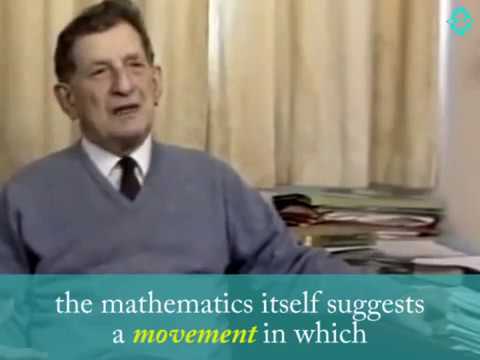
You know that feeling when you try to explain something so mind-boggling that your friends just stare at you blankly? Yeah, I had one of those moments the other day while chatting about David Bohm and his take on quantum theory.
So here’s a wild thing: imagine if everything we thought we knew about reality was just… a smokescreen? Seriously, Bohm’s ideas really shake things up! He had this knack for asking questions that made scientists scratch their heads. It’s like he wanted to pull back the curtain on what’s really going on beneath the surface.
And let’s not even get started on how quantum physics is basically like the universe playing peek-a-boo with us! It sounds nuts, but Bohm’s theories paint a picture that’s not only captivating but incredibly deep. If you’re ready to tumble down this rabbit hole, hold onto your hat — it gets pretty trippy from here!
Exploring Quantum Theory: Insights into the Nature of Reality in Modern Science
So, let’s talk about quantum theory. Honestly, it’s one of those things that can really mess with your head. You know, like when you realize how small the scale we’re dealing with really is. Think atoms, particles, and all that jazz. It’s a world that’s both fascinating and… well, kinda mind-boggling.
Now, when you mention David Bohm, you’re diving into some deep stuff. He wasn’t just any physicist; he had this unique take on quantum physics that challenged the mainstream ideas of his time. Here’s the thing: Bohm believed in an underlying order to reality—something he called the “implicate order.” It’s like suggesting there’s a hidden layer beneath what we can see.
You know how sometimes when you pull at a thread in a sweater, the whole thing might start to unravel? That’s kind of what Bohm was getting at with his theory. He thought that the universe is interconnected in ways we don’t fully understand yet. So, every tiny particle isn’t just bobbing around by itself; it’s part of a grander tapestry of existence.
In Bohm’s world, everything is linked through what he called “holomovement.” Imagine being at a concert where everyone moves in sync—each person is like a particle flowing together in harmony. It’s this idea that everything impacts everything else constantly. This view flips our usual understanding on its head! Instead of seeing things as isolated events or objects, Bohm suggests we’re all part of one big cosmic dance.
You might have heard about those weird experiments with particles behaving differently depending on whether they were being observed. Yeah? That ties back to quantum theory too! It’s like saying reality exists only when we look at it—and that sounds super trippy! Bohm would argue this hints at deeper truths about consciousness and its role in shaping reality.
Quantum entanglement is another wild concept here. Picture two particles having this crazy connection where changing one affects the other instantly—even if they’re far apart! It’s like some sort of cosmic magic trick! According to Bohm’s ideas, this isn’t just science fiction; it’s all part of how interconnected our universe truly is.
The exciting part? This isn’t just academic babble; it pushes us to rethink our place in the universe. If nothing exists independently and everything impacts each other, what does that mean for us humans? It’s almost poetic—this idea that every action sends ripples through reality’s fabric.
The journey into quantum theory can feel overwhelming sometimes—you know? But remember: it’s about asking questions and keeping your mind open to new perspectives. At its core, quantum theory challenges us not only to understand physics but also to wonder about existence itself.
Next time you stare up at the stars or ponder life’s mysteries, think about how interconnected everything might be—just as Bohm suggested!
Understanding David Bohm’s Interpretation of Quantum Mechanics: Insights into Science and Reality
David Bohm was a fascinating figure in the world of quantum mechanics. His interpretation of this mind-boggling field gives us a unique look at reality itself. So, let’s explore his ideas and see what they mean for us!
First off, Bohm’s interpretation challenges the traditional views we have about quantum mechanics. You know how most folks think particles are just little balls zooming around? Well, Bohm suggested that they are more like waves, constantly in motion and interconnected. This idea is called the pilot-wave theory. Instead of seeing particles as isolated entities, he thought of them as part of a broader setup—like a dance where everything is choreographed together.
Then there’s the concept of holism. Bohm believed that everything in the universe is connected, kind of like one big web. When you change one part of it, other parts react too! This is different from our everyday experience where we see things as separate from each other. It’s like when you accidentally hit your toe on the corner of a table; suddenly your whole body feels it! That’s how Bohm saw reality—integrated and interrelated.
Now let’s get into something really cool—non-locality. According to Bohm, particles can influence each other instantaneously, no matter how far apart they are. Imagine two friends who finish each other’s sentences even if they’re standing on opposite sides of a city! This idea flips our usual understanding upside down because it suggests that information doesn’t always travel through space like we think it does.
Bohm also brought up something called implicate order. It’s like saying that everything we see in the universe—the stars, planets, and even us—is just a projection from a deeper reality that we can’t always perceive directly. If you’ve ever watched shadows dancing on a wall while being completely unaware of what’s casting them, you might grasp this notion better.
But here’s where it gets emotional: when Bohm talked about consciousness and its role in understanding reality, he opened up deep philosophical questions. He believed that our mind interacts with this implicate order too! Just think about those moments when you feel an intuition or instinct guiding your decisions—it makes you wonder if there’s more going on beneath the surface.
Now let’s break down some key points about David Bohm’s interpretation:
- Pilot-wave theory: Particles are guided by waves—interconnected rather than isolated.
- Holism: Everything is linked together in one grand tapestry.
- Non-locality: Parts can affect each other instantly over any distance.
- Implicate order: Reality we see is just an unfolding from a deeper level.
- The role of consciousness: Our minds might interact with deeper realities too!
In summary, David Bohm’s take on quantum mechanics shows us that our understanding doesn’t have to be black and white or strictly scientific. Instead, it encourages us to ponder the connections around us and what lies beyond our immediate perceptions. It opens up a whole new way to view ourselves and our place in this vast universe—and honestly? That’s pretty mind-blowing!
Exploring Joe Dispenza’s Insights on Quantum Physics and Its Impact on Science
So, let’s chat about Joe Dispenza and his take on quantum physics. You know? It’s one of those topics that can sound super complicated but is actually pretty fascinating. Dispenza often bridges the gap between science and personal development, tapping into the concepts of quantum physics to explain how our reality is shaped.
To start off, quantum physics is the branch of physics that deals with the tiniest particles in the universe, like atoms and subatomic particles. It’s weird and wonderful because at this scale, things aren’t always what they seem. For instance, particles can exist in multiple states at once until we observe them—like flipping a coin that doesn’t settle until you peek at it. This idea challenges our classic understanding of reality.
Now, where does Joe Dispenza fit into all this? Well, he suggests that our thoughts and feelings can influence this quantum reality. He digs into David Bohm’s quantum theory, which proposes that everything in the universe is interconnected through a “holomovement.” Basically, Bohm believed there’s an underlying order to everything around us, even if we can’t see it directly—kind of like an unbroken web where every thread affects the others.
Here are some interesting takeaways from both Dispenza’s insights and Bohm’s theories:
- Consciousness and Reality: Both thinkers emphasize how our consciousness shapes our experience of reality. According to them, what you focus on influences your life situation.
- The Observer Effect: This principle states that merely observing a phenomenon affects its outcome. It’s like watching someone cook—you might change their technique just by being there!
- Interconnectedness: The idea that everything is connected means your actions or thoughts ripple through the universe. Imagine tossing a pebble in water; it creates ripples far beyond where it lands.
- Potential over Limitations: Dispenza often talks about how close-minded beliefs limit potentials. By changing your thinking (and emotional states), you could reshape your experiences.
Now here’s something kind of personal: I remember feeling stuck in my own life once—a classic case of being trapped in my thoughts! I stumbled onto some concepts around quantum mechanics casually while reading self-help books; it was a real lightbulb moment when I thought maybe my mindset was holding me back.
To wrap up this chat—Dispenza presents an exciting perspective by linking quantum physics to personal growth. He encourages people to harness their minds’ power to change their lives by acknowledging that reality isn’t fixed—it evolves based on how we think and feel.
Even if you don’t buy every bit of what he says, exploring these ideas is worth your time because they push us to think about how we connect with each other and our surroundings! What’s cooler than realizing you might be part of a bigger picture?
David Bohm was a pretty interesting guy, and his quantum theory has always had this way of making people think deeply about reality. You know, he really shook things up with how we understand the world at the quantum level. It’s like he took a giant magnifying glass and held it up to the universe, showing us that things aren’t just as simple as they seem.
So, like, let me tell you a little story. There was this time I was chatting with my buddy under the stars. We were both taking in this beautiful night sky—just endless twinkling lights—and out of nowhere, he asked me how it all works. I mean, if those stars are millions of light-years away, how do we even know they exist? It’s wild! And you can kinda see Bohm’s influence in that moment. What he proposed is that everything is interconnected. In a way, our conversation under those stars felt like we were part of something bigger—a kind of “wholeness,” if you will.
Now, Bohm’s idea about the “implicate order” is also super cool. Instead of seeing the universe as just a collection of separate parts—like planets and atoms—he suggested that everything’s enfolded into each other. Imagine it as an unfolding flower; at first glance, you might only see the petals but digging deeper reveals the whole structure hidden inside them. That’s kind of what he meant! Our everyday experiences are just a dance of this deeper reality.
But here’s where things get really mind-bending: when you start mixing in quantum mechanics with consciousness itself, it opens up even more questions! Like… does our observation actually affect reality? That idea can make your head spin! It raises all sorts of philosophical debates about free will and what it means to exist.
Sometimes, when I try to wrap my head around these concepts—the connection between particles or how observing something changes its behavior—I find myself feeling both overwhelmed and fascinated! It makes me wonder about my place in this grand scheme or whatever you’d call it.
So yeah, Bohm not only pushed the envelope for scientists but also invited us all to ponder life itself. His take on quantum theory invites you to look beyond just physics and dive into some serious existential questions—like how we relate to each other and our reality. I mean, isn’t that something worth chewing on over coffee?