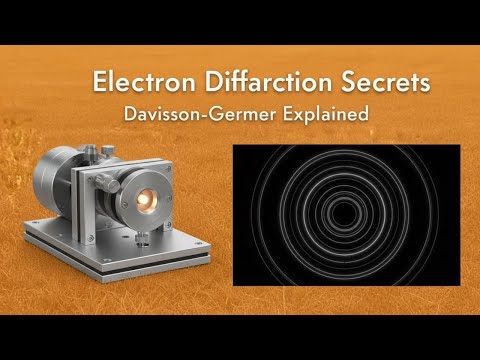
So, picture this: you’re at the beach, right? You toss a rock into the water and watch as those ripples spread out. Pretty neat, huh? Well, there’s something similar happening in the world of tiny particles like electrons.
You might be thinking, “Wait—rocks and electrons? How does that even connect?” Well, grab a snack and settle in because we’re talking about the Davisson-Germer experiment! This experiment is like a light bulb moment that showed us that electrons aren’t just these little hard balls flying around. Nope! They act more like waves.
Seriously, it flipped our understanding of physics upside down. If you’ve ever looked at ocean waves crashing on the shore and thought about how they move together, you’re already halfway to grasping something super cool about electrons. Sounds intriguing, doesn’t it?
Unveiling Wave-Particle Duality: The Davisson-Germer Experiment and Its Impact on Electron Behavior in Quantum Physics
Wave-particle duality is one of those mind-bending concepts in quantum physics that can leave you staring off into space, like, “Wait, what just happened?” It’s the idea that tiny particles, like electrons, can behave both as particles and as waves. I mean, how cool is that? And one of the pivotal moments in unveiling this concept came from the Davisson-Germer experiment.
So here’s the deal. In the early 20th century, two physicists named Clinton Davisson and Lester Germer were messing around with electrons to see what they could learn. They had a beam of electrons and shot it at a nickel crystal. But instead of just bouncing back like little rubber balls, those electrons showed patterns similar to light waves. Seriously! So when they observed these patterns, they realized something super important: electrons can behave like waves.
Now, why does that matter? Well, think about it—if you understand that electrons can act as both particles and waves, it totally flips how we view matter on a tiny scale. They discovered what scientists called diffraction patterns, which are basically interference patterns created by overlapping waves. It’s kind of like when you throw two stones into a pond and watch the ripples interact; sometimes they amplify each other and sometimes they cancel out.
Here are some key takeaways from their experiment:
- Electrons are not just tiny balls. They have wave properties too!
- The diffraction pattern was key. It showed that particles can behave like waves.
- This challenged classical physics. We needed new rules to explain this behavior.
- The results supported quantum theory. It laid groundwork for future advancements in understanding quantum mechanics.
You know what’s wild? This whole thing changed how scientists thought about atoms and molecules! Before Davisson and Germer’s work, everything was mainly described using classical physics—like Newton’s laws of motion. But once this wave behavior was understood, it made room for new theories like wave mechanics.
One emotional anecdote: Imagine sitting in a dimly lit lab filled with glass apparatuses—all those little devices humming with energy—and knowing you might be on the brink of uncovering something monumental for science! That anticipation must have been electrifying *pun intended*. It’s fascinating to think about how pretty much every electron in your body is acting according to these strange rules today!
And this idea didn’t stop there; it led to deeper inquiries into quantum mechanics and paved the way for technologies we rely on now—from semiconductors to lasers. So next time you’re scrolling through social media or using your phone’s camera, remember that some of that tech owes its existence to Davisson and Germer figuring out how weirdly wonderful our universe really is!
In a nutshell? The Davisson-Germer experiment opened up our understanding of electron behavior forever by showing us that at its core—even something as small as an electron—can embody both particle-like qualities *and* wave-like behaviors. That kind of duality is what makes quantum physics so exciting—and honestly, a little mind-boggling too!
Exploring the Electron: The Key Experiment Demonstrating Wave Nature in Quantum Physics
There’s this really cool experiment you might want to know about—the Davisson-Germer experiment. It’s like a classic story in quantum physics, showing us how electrons can behave like waves. Seriously, it’s mind-blowing!
So, back in the 1920s, two physicists named Clinton Davisson and George Germer were trying to figure out some stuff about electrons. They were curious about whether electrons really could show wave-like properties. You see, we usually think of particles as tiny little balls bouncing around. But in the quantum world, things get pretty weird.
Here’s how their experiment went down: they took a beam of electrons and shot it at a nickel crystal. The crystal was super important because its regular structure allows for some interesting things to happen. When the beam hit the crystal, instead of just scattering everywhere like you’d expect with particles, something unusual occurred.
The electrons created what looked like a kind of pattern—a diffraction pattern! This is something you’d normally see when waves, like light waves or water waves, pass through a narrow opening or around an obstacle and scatter off each other. So basically what Davisson and Germer saw was evidence that these electrons were behaving more like waves than solid particles.
But wait! There was more to this story. As they analyzed the results and looked closely at the angles where the electron beams scattered, they realized that these patterns could be explained using wave mechanics. They even used this thing called Bragg’s Law, which deals with how waves reflect off surfaces at specific angles.
What’s amazing is that this experiment didn’t just prove that electrons can act like waves; it also helped confirm Louis de Broglie’s hypothesis. He had suggested earlier that all matter has wave properties—so not just light but also particles! This idea opened up a whole new way of thinking about physics and led to what we now call quantum mechanics.
The results showed that characteristics we usually tie to waves—like interference patterns—also apply to particles under certain conditions. It really flipped our understanding of nature on its head! You could almost say it was like seeing a double rainbow: beautiful and surprising!
To sum it all up:
- The Davisson-Germer experiment demonstrated the wave-like behavior of electrons.
- The process involved shooting an electron beam at a nickel crystal.
- This created diffraction patterns similar to those produced by light waves.
- This work backed up de Broglie’s theory on matter as waves.
This whole adventure into quantum physics reminds us just how weird and wonderful our universe is! Who thought tiny little particles could do such wild things? Just goes to show there’s always more beneath the surface than meets the eye.
Exploring the Wave Nature of Electrons: Key Evidence and Scientific Discoveries
So, let’s talk about something pretty cool: the wave nature of electrons. You’d think electrons are just tiny little particles zipping around, right? But, oh boy, it’s a bit more complicated than that.
The big idea here is that electrons can act like waves. I mean, seriously. Imagine you’re at the beach, and you see those waves rolling in. Electrons can do something similar! This whole wave-particle thing started getting attention back in the early 20th century during some pretty exciting experiments.
One of the major milestones was the Davisson-Germer experiment. Picture this: in 1927, two physicists named Clinton Davisson and Lester Germer were trying to bounce electrons off a nickel crystal. They expected to see particles bouncing straight back like a ping pong ball off a wall. But that’s not what happened!
Instead of typical particle behavior, they noticed something wild: the electrons created a pattern on a detector screen that looked *just like* the interference patterns made by water waves! Like when you throw two stones in water and watch them create overlapping rings. This was huge because it showed that electrons weren’t just little dots; they could behave like waves too.
Here’s where it gets even more interesting. When they analyzed how those electrons were behaving, they found out their wavelength followed this equation derived from Louis de Broglie’s hypothesis:
You’re wondering what that means? Well, λ (lambda) is the wavelength, h is Planck’s constant (a super tiny number), and p is momentum (how fast they’re moving). So the faster an electron goes, the shorter its wavelength becomes!
This wave behavior helps explain why electricity works so well in some materials. Basically, when you hit certain metals with light or other particles, those lovely electron waves can create all sorts of interesting phenomena—like conductivity or even forming new phases of matter.
Now you might be thinking: “What does this mean for me?” Well, consider how we use things like semiconductors and lasers every day! By tapping into this wave nature of electrons, scientists have developed technologies that are part of your phone or computer right now.
But beyond just tech stuff—it really pushes us to rethink our understanding of matter itself. Before these experiments flipped our perspective upside down, people thought there was a clear distinction between particles and waves. Not anymore! Now we know everything from light to tiny atoms like electrons can show both properties depending on how we look at them.
In summary:
So next time someone talks about quantum physics or how bizarre particles can be—just remember those sneaky little electrons dancing through space with their wave-like charm! They’re not only brushing up against some pretty deep questions about reality but also helping power your everyday life!
So, let’s chat about the Davisson-Germer experiment. You know, it’s one of those experiments that just blows your mind a little when you really think about it. It was conducted back in the 1920s by two physicists, Clinton Davisson and Lester Germer, who were trying to dig deeper into the nature of electrons. And what they found was pretty wild!
Imagine this: You’ve got these tiny particles called electrons, and for a long time, scientists were unsure what they were actually like. Were they just little balls zooming around? Or was there something more to them? So Davisson and Germer took some electrons and fired them at a nickel target. What happened next was almost like magic—those electrons bounced off the surface in ways that seemed to suggest they behaved like waves rather than solid little particles.
Now, picture you’re at a beach, throwing pebbles into the water. When you toss them in, they create ripples, right? Well, that’s similar to how electrons behaved in this experiment! They got diffraction patterns—those beautiful patterns of light and dark—as if they were waves crashing against each other. It’s seriously one of those “Aha!” moments where everything starts connecting.
But what really gets me is thinking about how people reacted to this finding. Like, can you imagine being back then? Suddenly realizing that matter behaves in such complex ways makes you question everything we thought we knew about the physical world! It feels kinda poetic when you think about it; we’re made up of particles that aren’t as straightforward as we’d like them to be—like life itself!
This whole wave-particle duality thing—not an easy concept to wrap your head around! Electrons can act like both waves and particles depending on how you’re looking at them. Sometimes I wonder if this idea isn’t just a reflection of our own lives; maybe we all have various sides depending on the situation we’re in.
And despite many decades since that initial experiment, its implications still ripple through physics today! Quantum mechanics is built on these ideas—they changed everything from technology to how we perceive reality itself. Seriously mind-boggling stuff when you stop and think about it.
In a nutshell? The Davisson-Germer experiment opened doors; it challenged us to look at the universe with fresh eyes—and isn’t that what science is all about?