You know that feeling when you’re trying to figure out why your soda bubbles like crazy when you open it? It’s all about the electrolytes! Well, sort of.
So, picture this: you’re at a party, and a friend keeps handing you drinks, totally hyped up about those fizzy delights. You love ’em, but have you ever thought about what’s really happening in that can?
Enter Debye and Huckel. These two scientists came along and figured out what was going on with electrolytes in solutions. It’s kind of neat how their work explains why things fizz, dissolve, and conduct electricity. Yeah, all that cool stuff boils down to some pretty interesting chemistry!
Stick around as we unravel the Debye-Huckel theory together! I promise it’ll be more fun than reading the back of a cereal box!
Comprehensive Guide to Debye-Hückel Theory: Downloadable PDF Resource for Students and Researchers in Physical Chemistry
The Debye-Hückel theory is all about understanding how ions interact in electrolyte solutions. It’s pretty essential in physical chemistry, especially when we deal with solutions like saltwater or even our bodily fluids. You probably know that when you dissolve salt in water, it breaks down into sodium and chloride ions, right? Well, those ions don’t just float around aimlessly. Their behavior gets influenced by their surroundings, and that’s where Debye-Hückel comes into play.
What’s the big deal about Debye-Hückel? Basically, this theory helps us explain how the presence of other ions affects the activity (or effective concentration) of ions in solution. Think of it like a crowded party. If you’re trying to move through a room packed with people, it’s harder than if the room is empty. Similarly, ions “feel” each other through electrostatic forces that change their behavior depending on how many there are around.
Key Principles of Debye-Hückel Theory:
- Activity Coefficient: This coefficient (let’s call it γ) takes into account how ion interactions alter their effective concentrations.
- Interaction between Ions: The theory states that as the concentration of ions increases, their interactions grow stronger.
- Dilute Solutions: The original formulation works best for dilute solutions where ion interactions aren’t too congested.
You might be wondering about the math behind this. The main equation looks like this:
log(γ) = -A * z^2 * sqrt(I)
Here:
– **A** is a constant depending on temperature and the solvent.
– **z** is the charge of the ion.
– **I** stands for ionic strength which tells us how many ions are present overall.
If you remember your chemistry classes, ionic strength combines both charge and concentration of all species in solution—kind of like adding up all your friends’ weight to see who can fit in one car.
Now let’s put this into perspective with an example: if you’ve got a solution with a high ionic strength from lots of dissolved salts, say magnesium sulfate (MgSO4), the activity coefficients for magnesium and sulfate will drop more than they would in pure water. This means they’re less “active” than you’d expect based solely on their concentrations!
However, Debye-Hückel does have its limits. It mainly applies to diluted solutions because at higher concentrations, things start getting messy—ions pack together so closely that we can’t ignore all those interactions anymore.
So when researchers or students delve into this area of study using resources like downloadable PDFs or textbooks focused on physical chemistry concepts such as this one, they’ll find tons of information about calculations, real-world applications (like how batteries work!), and insights on further developments from other theories related to ionic solutions.
If you’re diving deeper into physical chemistry or working on electrolyte-related projects—understanding Debye-Hückel can give you some cool tools to predict behaviors you’d otherwise overlook! And who knows? You might just find yourself at that crowded party again figuring out how to dance among all those people—you get me?
Understanding the Debye-Hückel Theory: Insights into Strong Electrolyte Behavior in Physical Chemistry
So, the Debye-Hückel Theory is one of those concepts in physical chemistry that helps explain how electrolytes behave in solutions. Seriously, it’s a game changer when you’re trying to understand why some salts dissolve in water and others don’t.
To break it down simply, electrolytes are substances that split into ions when dissolved in water. This process allows them to conduct electricity, which is why we use them in batteries and even in our bodies. The exciting part? The Debye-Hückel Theory digs into why these ions interact the way they do.
Here’s the thing: when you dissolve an electrolyte like sodium chloride (that’s just table salt), the positive sodium ions (Na+) and negative chloride ions (Cl-) separate and float around in the water. It sounds straightforward, right? Not so fast! These charged particles create an electric field that influences each other. That’s where Debye-Hückel comes in.
The key insight from this theory is about **ionic strength**—a fancy term for how many charged particles are floating around in your solution at any given moment. More ions mean more interactions.
Here’s what you need to know:
- Ionic interaction: The presence of one ion affects others nearby through electrostatic forces.
- Debye length: This is a measure of how far these ionic interactions extend; think of it as a sort of “influence zone” for each ion.
- Activity coefficients: These help us understand how “effective” an ion is at participating in reactions compared to what you’d expect from its concentration.
Okay, let’s talk about that last point a bit more because it’s super important! When ions are close together, they act differently than if they were alone at low concentrations. For instance, when Na+ and Cl- are both present at high concentrations, they might not behave exactly as you would expect just based on their amounts. They kinda influence each other—more interaction means less predictable behavior.
Now imagine you’re at a party where everyone knows everyone else (high concentration). If someone new shows up (dilute), they might feel awkward because they don’t know anybody yet! But if the whole room was filled with familiar faces (high ionic strength), all those connections change how everyone behaves together.
Why does this matter? Well, understanding these dynamics helps scientists predict things like solubility and reactivity of different substances under various conditions. You can see its applications everywhere—like developing better fertilizers or optimizing chemical reactions in industry!
In summary, the Debye-Hückel Theory gives us vital tools to explore electrolyte solutions beyond just looking at simple concentration numbers. It teaches us that there’s so much going on behind the scenes with those little charged particles! So next time you sprinkle salt on your food or mix chemicals for a cool project, you’ll appreciate all this energy happening at such tiny scales!
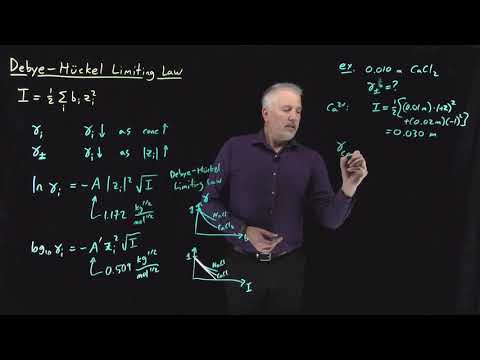
Understanding the Debye-Hückel Limiting Law: Its Implications and Applications in Physical Chemistry
The Debye-Hückel Limiting Law is one of those concepts in physical chemistry that sounds super complex at first, but it actually helps us understand a lot about how particles behave in solutions. So, what’s the deal with it? Well, let’s break it down together.
First off, the law deals with **electrolytes**, which are substances that dissolve in water and break down into ions. Think of salt when it dissolves — it splits into sodium and chloride ions. These ions are charged, which makes them interact with each other in interesting ways.
The **Debye-Hückel theory** was developed by two smart cookies, Peter Debye and Erich Hückel, back in the early 20th century. Their big idea was to look at how these interactions impact things like activity coefficients. Activity coefficients tell us how much an ion behaves like we’d expect based on its concentration.
Now here’s where the limiting law comes into play. It basically tells us that at low concentrations of electrolytes — you know, when they’re really diluted — there’s a specific relationship between ion concentration and these activity coefficients. The formula they came up with looks kinda intimidating:
log(γ) = -A * z² * √I
And if you’re scratching your head at that, let me simplify! Here’s what all those letters mean:
So basically, as ionic strength increases (or you add more salts), the interactions between those ions start messing with their behavior.
One emotional anecdote? You know that feeling when you add too much salt to your food? You think it’s going to taste great but end up ruining it? That’s kinda what happens in solutions too. When there are too many ions bouncing around close together, they start influencing each other in ways we can’t predict just by looking at concentration alone.
This law is important for various applications. For instance:
So yeah, having a grip on this limiting law not only helps scientists make sense of chemistry but also plays a vital role across different fields.
If you ever find yourself working with solutions or just having a curious chat about why certain drinks taste better than others when diluted—now you’ve got some serious grounding to back it up!
Alright, let’s chat about something a bit nerdy but super interesting—the Debye-Hückel theory. This theory isn’t just some dry stuff from textbooks; it actually helps explain how electrolytes behave in solutions. So, you know when you’re sipping on a fizzy drink and wonder why it has that zing? Well, that zing is partly thanks to electrolytes!
So, picture this: you’re baking cookies with a bunch of friends. You’ve got sugar, chocolate chips, flour—like all the good stuff mixed together. Now imagine those ingredients are ions in a solution. The Debye-Hückel theory helps us understand how these ‘ingredients’ interact with each other in a solution based on their charges and concentrations.
I remember this one time in college when I had to conduct an experiment involving saltwater solutions. It wasn’t just adding salt and stirring; I had to consider how the ions were interacting with each other. That’s where the Debye-Hückel theory swooped in like a superhero! What it basically says is that ions create electric fields around themselves—it’s like they have little invisible bubbles around them. When these bubbles overlap because there are lots of ions packed closely together, they start affecting each other’s behavior.
This interaction leads to something called “activity.” So instead of focusing merely on concentration—how much salt there is—activity tells you how effective those ions are at doing their thing, which is super important for reactions happening in solutions.
And here’s where it gets even cooler: this isn’t just textbook science. It has real-life implications! Think about biological systems—they rely on electrolytes for pretty much everything from nerve impulses to muscle contractions. So if you take the Debye-Hückel theory into account, you can make sense of how our bodies maintain balance and function properly.
You see? The science behind this theory wraps around so many aspects of life and nature! Learning about it helped me appreciate not just electrochemistry but also the connections between chemistry and biology. Kind of mind-blowing when you think about it!
Anyway, every time I grab that fizzy drink or even cook with salt now, I can’t help but think about all those little interactions happening under the surface—and yeah, that makes me smile just a bit more while enjoying what I have in front of me!