So, picture this. You’re at a party, and someone starts chatting about math. Everyone’s eyes glaze over, right? But then someone drops “Extended Euclidean Algorithm,” and suddenly, the party is buzzing. Yeah, that’s a thing!
This algorithm might sound like something out of a textbook, but it’s got some seriously cool applications in real life. Like, did you know it helps in everything from cryptography to computer graphics? It’s not just numbers for the sake of numbers; there’s some serious science behind it.
You might be thinking, “Why do I care about this?” Well, let me tell you—it connects to so many aspects of tech and even our day-to-day lives! Who knew math could be such a party trick? So let’s break down how this funky algorithm fits into the scientific world.
Exploring the Applications of the Extended Euclidean Algorithm in Scientific Research and Problem Solving
The Extended Euclidean Algorithm (EEA) might sound super technical, but it’s really just a clever method to find the greatest common divisor (GCD) of two numbers. The amazing part? It goes beyond just solving math problems; it has real applications in science and engineering. Let’s break it down, shall we?
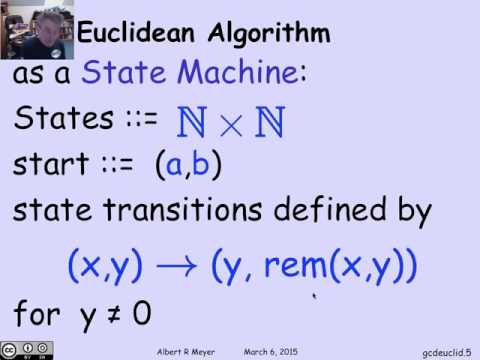
First off, what does the Extended Euclidean Algorithm do? Well, it finds the GCD of two integers and also gives you coefficients that express this GCD as a linear combination of those integers. In simpler terms, if you have two numbers, say 56 and 15, the EEA helps figure out how they relate to each other in terms of divisibility. This is like finding the common ground between them.
Now, let’s see where this nifty algorithm pops up in scientific research:
- Coding Theory: In computer science, encoding and decoding information is crucial. Many error-correcting codes use the EEA to generate keys for secure communication. Imagine sending a secret message where only your friend can decode it—that’s thanks to algorithms like this one.
- Cryptography: This is another area where EEA shines! In public key cryptography systems like RSA, finding large prime numbers is essential for security. The Extended Euclidean Algorithm helps compute multiplicative inverses which are key in creating those secure keys.
- Signal Processing: Sometimes signals get a bit mixed up due to noise or other factors. The EEA can help design filters that keep valuable parts of a signal while tossing out the junk. You want clear audio or video? This algorithm plays a role there!
- Control Systems: Think about all those fancy robots or automated machines. They need to be controlled precisely! The EEA helps optimize control parameters by ensuring that systems behave stably under various conditions.
Beyond techy stuff, here’s a fun little story: A friend of mine who loves music once told me about how he used math to tune his guitar strings perfectly. He didn’t realize he was applying something akin to the EEA when he was figuring out how different notes related to each other—finding which strings could be adjusted together for harmony!
So you see? The Extended Euclidean Algorithm isn’t just dry math—it’s interwoven into so many parts of our lives! Whether it’s ensuring your online shopping experience is safe or helping your favorite songs sound great without hiccups, it’s there behind the scenes making everything smoother.
In short, while it may seem like just numbers on paper, this algorithm has some seriously cool applications in science and beyond—helping you decode messages and even enhancing your daily tech experiences without you even knowing it!
Exploring the Real-Life Applications of the Euclidean Algorithm in Science and Technology
Alright, let’s chat about the Euclidean Algorithm and its real-life applications. You might be thinking, what’s that even about? Well, the Euclidean Algorithm is a way to find the greatest common divisor (GCD) of two numbers. In simpler terms, it helps us figure out the biggest number that can evenly divide both numbers without leaving a remainder. So, why should we care about this ancient math trick? Because it has some cool applications in modern science and technology!
1. Cryptography
Okay, here’s where things get interesting! The Extended Euclidean Algorithm plays a key role in cryptography—the art of keeping information safe. Think about online banking or sending secret messages; you want to know they’re secure, right? This algorithm helps generate keys for encrypting and decrypting data. It ensures that only the intended recipient can read your message. Without it, online privacy would be a total mess!
2. Computer Science
In computer science, efficiency is everything. The Euclidean Algorithm is used in algorithms responsible for various tasks like optimizing routes and managing resources in networks. For example, when you’re routing data packets across the internet or reducing file sizes, this algorithm helps make those processes smoother and quicker.
3. Signal Processing
Now let’s talk about signal processing—think of all those tunes you stream on your devices! Here’s where the algorithm pops up again: it helps in designing filters for audio signals. By finding common frequencies among signals using the GCD method, engineers can create clearer sound quality for music or phone calls.
4. Computer Graphics
Ever wondered how video games render beautiful images so quickly? Well, in computer graphics, calculations involving triangles are pivotal for designing scenes or models. The Euclidean Algorithm assists in calculating pixel values based on their coordinates smoothly—making gaming visuals pop without lagging.
5. Robotics
And then there’s robotics! Robots often have to move along paths calculated with precision—like navigating through complex environments without bumping into stuff! The GCD helps optimize these paths by simplifying calculations related to movement patterns and turns.
So there you have it! The Extended Euclidean Algorithm isn’t just some old-school math trick lost in textbooks; it’s got real-world applications that keep our digital life secure and efficient! It’s amazing how something so simple can have such a big impact on various fields—including ones we may not even think about everyday!
Exploring Real-World Applications of Euclidean Geometry in Scientific Fields
Exploring the applications of Euclidean geometry in real-world scenarios is pretty cool. You might think of it as just a bunch of lines, angles, and shapes, but the truth is, these concepts pop up everywhere—in science and engineering. Let’s break it down.
First off, what’s Euclidean geometry? It’s the study of flat spaces. Think about a classic two-dimensional plane—like your school notebook—where you can draw shapes like triangles and circles. But what you might not know is how this kind of geometry plays a massive role in various scientific fields.
One major player here is computer science. When you’re coding for video games or simulations, you need to understand how objects relate to each other in space. For instance:
- The algorithms used for rendering 3D environments depend heavily on principles from Euclidean geometry.
- Collision detection in games ensures that characters don’t just walk through walls or each other—that’s some real-time application of geometric calculations!
Now let’s shift gears to robotics. Robots have to navigate their surroundings effectively, right? They do this using parameters based on Euclidean geometry! Here’s how:
- Robots utilize triangulation methods to determine their position relative to fixed points.
- This involves calculating distances and angles with the help of geometric formulas.
And talking about distance and angles brings us to another field: astronomy. Imagine trying to measure distances between planets or stars. The ancient Greeks, through simple geometric principles, laid the groundwork for modern astronomy.
In practical terms, astronomers often use techniques derived from Euclidean geometry when measuring vast distances across space. For instance:
- Using parallax—the apparent shift in position of an object viewed from different angles—astronomers can calculate the distance of nearby stars.
Another interesting example is how scientists apply the extended Euclidean algorithm specifically in areas like cryptography:
- This mathematical tool helps in finding the greatest common divisor (GCD) and plays a crucial role in asymmetric encryption methods.
- Making sense? It means your personal data stays secure online—thanks to those ancient geometric concepts reimagined for modern tech!
Now let’s not forget about architecture! Builders use these basic geometric principles every day when designing structures.
For instance:
- The stability of bridges relies on understanding shapes and angles derived from Euclidean methods.
- A building’s design must account for load distribution—which depends on solid geometric foundations!
Remember that time you tried assembling furniture without instructions? Well, imagine engineers tackling complex scientific problems without an understanding of geometry! That would be a total mess.
So yeah, from gaming to star-gazing and everything in between, Euclidean geometry isn’t just some dusty old math thing—it breathes life into so many crucial aspects of our world. That connection between ancient principles and today’s cutting-edge technology really shows us just how timeless these ideas are. It’s fascinating stuff when you think about it!
You know, when we think about math, it often feels like a bunch of numbers just sitting there on a page. But seriously, some of this stuff has real-life applications that are super cool and important, especially when you look at something like the Extended Euclidean Algorithm. Yeah, it sounds fancy and all, but it’s really just a clever way to find solutions to equations that involve integers.
So, here’s the deal: the Extended Euclidean Algorithm helps us find not just the greatest common divisor (GCD) of two numbers but also how to express that GCD as a combination of those numbers. Sounds tricky? Well, think about it like this: imagine you and your buddy are trying to split a pizza into equal slices using different sizes of pizza cutters. This algorithm can help you figure out how many times you use each cutter to get the best slice size possible without wasting any pizza!
Now, what’s fascinating is how this math trick jumps right out of the classroom and into fields like computer science. For instance, in cryptography—where we keep things super secure online—the Extended Euclidean Algorithm helps generate keys for encrypting messages. Pretty wild when you consider that every time you shop online or send a private message, some serious number crunching is happening behind the scenes to keep your info safe.
I remember one time when I was trying to understand how encryption worked for my first computer science class. The teacher explained this algorithm using an example with gold coins—what kid wouldn’t want to visualize treasure? The idea that math could help protect treasures from prying eyes made me see numbers in a whole new light!
And it’s not just computers! In engineering or even economics, people use this algorithm for problem-solving where ratios and divisibility come into play—you can optimize resources or design systems more effectively by knowing these relationships.
So yeah, from slicing pizzas to securing online transactions and optimizing resources in engineering or economics—this seemingly simple mathematical tool plays a key role in everyday life without most of us even realizing it! It’s one of those moments where you think about math beyond classrooms and exams; it’s like magic hiding right under our noses.