You know, I once thought math was just a bunch of numbers dancing around on paper. But then I stumbled upon the GCD algorithm, and everything changed. Seriously, it’s like the backstage pass to understanding numbers better.
Picture this: You’re at a party with a huge crowd, and you want to find your best friend who’s wearing a bright red hat. The GCD is kinda like that—it helps you find common ground among numbers! It’s all about figuring out what they share, like a secret handshake.
So, let’s unravel this together! The GCD isn’t just some geeky math term; it’s got real power in the world of mathematics. Stick with me as we dive into its role and why it matters more than you might think.
The Crucial Role of the Greatest Common Divisor (GCD) in Scientific Problem Solving and Mathematical Applications
Alright, let’s chat about the **Greatest Common Divisor**, or GCD for short. It may sound fancy, but this little gem is super important in both math and science! So what exactly is the GCD? Well, it’s just the biggest number that can evenly divide two or more numbers. For example, if you look at 8 and 12, the GCD is 4 because it’s the largest number that can fit neatly into both.
Now you might wonder why we even care about this? Here comes the fun part! The GCD isn’t just some math homework problem; it plays a crucial role in various scientific problem-solving.
1. Simplifying Fractions
Reducing fractions is where the GCD shines. You know how when you’re cooking, sometimes you need to halve a recipe? Imagine you’re making pasta for two people using 8 cups of water and 12 grams of salt. To simplify your measurements, finding the GCD helps: divide both by 4! Now you’re left with 2 cups of water and 3 grams of salt. Much easier, right?
2. Computer Algorithms
GCD also shows up in computer algorithms like Euclid’s algorithm. This method uses division to find the greatest common divisor efficiently—like having a calculator that makes things simpler without breaking a sweat! And trust me, computers love simplicity; it’s all about efficiency.
3. Cryptography
In science and technology fields like cryptography (you know, how we keep online information secure), GCD plays a role too! Algorithms based on prime numbers use GCD to create secure keys for encryption. If you like puzzles or codes, think of it as making sure only certain people can read your secret messages.
4. Number Theory
If you’re into number theory (which is just a fancy way of saying “the study of numbers”), understanding GCD helps unlock deeper concepts such as coprime numbers—those pairs that share no divisors other than one. It opens doors to explore patterns and properties that seem abstract but are super useful in various applications!
So yeah, even though we might not always notice it in our daily lives, the **GCD** is quietly helping us out behind the scenes—from cooking to coding! Next time you’re simplifying a fraction or working on something techy, remember that little mighty divisor; it’s got your back in more ways than one!
Understanding the Termination of the Euclidean Algorithm: Insights from Mathematical Science
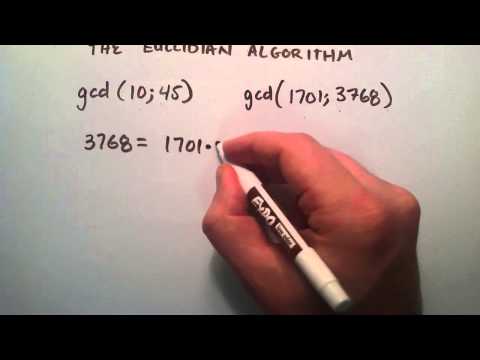
So, let’s talk about the Euclidean Algorithm. Sounds fancy, huh? But don’t worry—it’s actually pretty straightforward! This algorithm is a way to find the greatest common divisor (GCD) of two numbers, which is the largest number that can divide both without leaving a remainder. You know, like finding out what’s the biggest shared slice of pizza you can get when friends bring different sizes.
The fun part comes with how this all ends—the termination of the Euclidean algorithm. It’s like finishing up a puzzle: you keep putting pieces together until there’s only one left—no more pieces to fit. The algorithm works by repeatedly applying a simple step involving division and remainders. Here’s how it flows:
- You start with two numbers, let’s say A and B.
- If A is smaller than B, switch them around.
- Divide A by B and look at the remainder.
- Replace A with B and B with that remainder.
- You repeat these steps until B becomes zero.
- The last non-zero remainder is your GCD!
Now, here comes the cool part about termination. The process stops when we reach a point where one of our numbers—let’s call it B—becomes zero. When that happens, A holds the GCD. So why does this work?
The reason it always ends has to do with how division works and that numbers get smaller every time you replace A and B. Imagine running down a hill—you just keep going down until you hit flat ground! Each time you calculate a new remainder, you’re essentially making sure things don’t get stuck in an endless loop.
This method shows just how efficient math can be! Every division brings us closer to our answer. Besides, it beautifully illustrates some important concepts in number theory—a branch of math that feels almost magical at times.
So next time you tackle some math problems involving GCDs or need to simplify fractions, remember that neat little trick called the Euclidean Algorithm. It wraps everything up nicely by finding those shared parts without fussing over all the other factors! And when it reaches its endpoint? That’s just mathematics saying The end!
Understanding the Algorithm for Greatest Common Divisor (GCD) in Mathematical Science
So, the greatest common divisor, or GCD for short, is one of those neat little tricks in math that can help us simplify things. It’s essentially the largest number that can divide two or more numbers without leaving a remainder. Makes sense, right? This concept plays a solid role in number theory and helps with stuff like fractions and ratios.
Now, when we talk about finding the GCD, there are a couple of methods you can use. The most popular one has got to be **Euclid’s Algorithm**. It sounds fancy, but it’s really straightforward. Here’s how it works:
Euclid’s Algorithm is based on the idea that the GCD of two numbers also divides their difference. So if you have two numbers—let’s say 48 and 18—you’ll take the larger number and keep subtracting the smaller one until you get down to zero or reach a smaller number that can’t be further reduced.
Here’s a simple step-by-step using our numbers:
1. Start with 48 and 18.
2. Subtract 18 from 48:
You get 30 (so now you’re looking at 30 and 18).
3. Now subtract again:
Take 30 minus 18 and you get 12 (so now you’re down to checking between 18 and 12).
4. Keep going:
From here, subtract again—18 minus 12 gives you 6.
5. Subtract once more:
Now you’re at 12 minus 6 equals 6.
6. Finally:
When you do that last subtraction (6 minus itself), you reach zero.
When your smaller number reaches zero like this, your last non-zero remainder is your GCD! In this case, it’s **6**.
But hey, there’s another cool way to find GCDs called the prime factorization method. This involves breaking down each number into its prime factors—the building blocks of all numbers—and then taking those common factors to find the GCD.
For example, if you were looking at 48 and gave it some prime love:
– The prime factors of **48** are (2 times 2 times 2 times3) or (2^4 times3^1).
– The prime factors of **18** are (2 times3times3) or (2^1 times3^2).
The next step is to find all common primes; here we have (2) and (3). You take the smallest exponent from each pair:
– For **2**, it’s (min(4,1)=1)
– For **3**, it’s (min(1,2)=1)
So multiply those together: **GCD = (2^1 times3^1 =6)**!
Some key points about GCD might include:
- Relationship with Fractions: It’s super helpful in simplifying fractions.
- Number Theory: A foundational concept for more advanced mathematics.
- Computational Relevance: Used in algorithms for cryptography.
In a nutshell, understanding how to find the GCD lets us work smarter with numbers—whether we’re simplifying fractions or diving deeper into mathematical theories. Plus, it just feels good to harness such an elegant solution from the realm of math!
You know, when you first hear about the Greatest Common Divisor (GCD), it might not sound all that thrilling. I mean, seriously, it’s just a fancy term for the largest number that divides two numbers without leaving a remainder, right? But hang on—there’s more to it!
Let me take you back to my school days. I remember sitting in math class trying to figure out why we even cared about this stuff. My teacher would go on and on about how finding the GCD could help us simplify fractions. At the time, I thought it was just busywork. But looking back now, it’s like realizing those boring exercises were actually building blocks for understanding math at a deeper level.
So here’s the scoop: the GCD isn’t just a random concept stuck in our textbooks. It’s kind of like that friend who always knows how to get you out of tricky spots. For example, when you want to simplify a fraction like 8/12, knowing that the GCD is 4 can help you reduce it smoothly to 2/3. It feels almost magical when everything clicks.
And here’s where it gets even cooler! The Euclidean algorithm—sounds fancy, huh?—is this neat little method we use to find the GCD efficiently. Basically, instead of trying all possible divisors (which can take ages), you keep subtracting or dividing until you reach zero. It’s like having a shortcut through the woods instead of winding around forever.
But it doesn’t stop there! The GCD has found its way into other areas too—like cryptography and computer science. Imagine sending secret messages or securing your data; yeah, GCD plays a part in keeping things safe and sound.
So next time someone says “GCD,” don’t roll your eyes just yet! This little gem is woven into the fabric of math and has some serious implications beyond what meets the eye. Who knew that something so seemingly simple could have such a rich tapestry behind it? Pretty wild if you ask me!